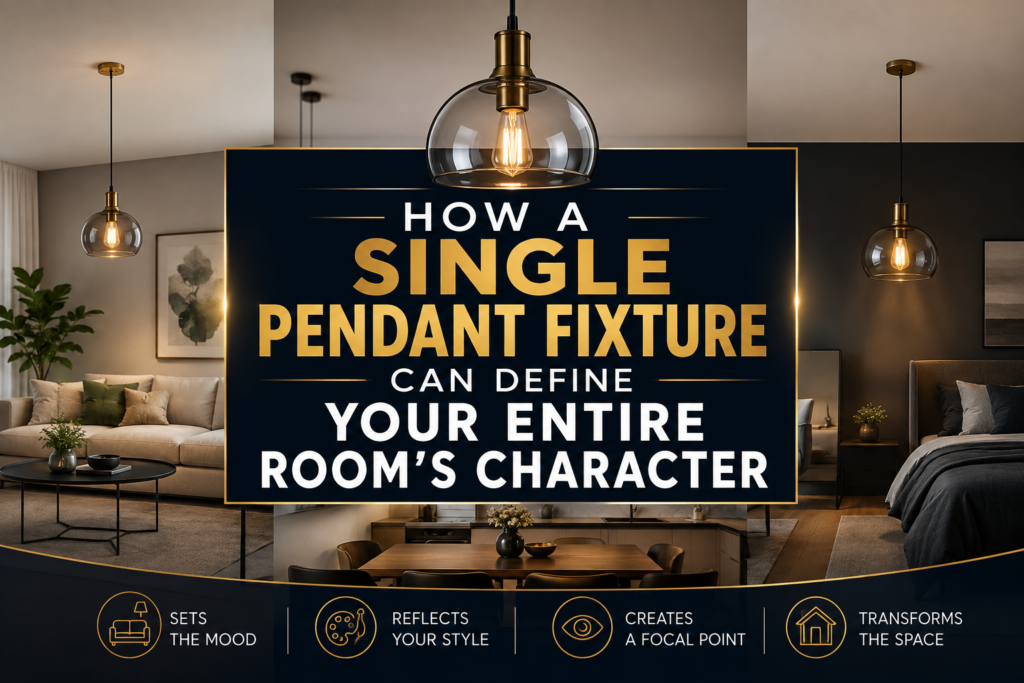
Interior designers know something that most homeowners haven’t figured out yet: a single lighting fixture can do more to transform a room than any other single element. More than paint color. More than furniture choice. More than architectural details. A statement pendant light is the closest thing to interior design shorthand; it tells visitors everything they need to know about the space’s aesthetic intention in a glance.
But getting that fixture right is surprisingly tricky. Most people choose pendants for how they look in product photos, then get disappointed when they’re installed in their actual space.
Why Size and Scale Matter More Than Aesthetics
This is the biggest mistake homeowners make when selecting a pendant light: choosing a size based on how the fixture looks in isolation, not considering how it will read in the actual room.
A pendant that looks elegant and delicate in a 6-foot by 8-foot product photo becomes invisible and fussy when hung in a 20-foot dining room. The eye just slides past it. Guests don’t notice it. The fixture disappears into the architecture instead of anchoring the space.
Conversely, a fixture that seems bold and oversized in a product photo becomes exactly right when it’s suspended in a room with generous proportions and high ceilings. Suddenly it’s not too big, it’s perfectly scaled to the space it occupies.
The rule most designers follow is counterintuitive to people shopping for their first statement pendant: go bigger than feels comfortable. Not excessively so, but consistently larger than your first instinct suggests.
There’s a reason luxury hotels and high-end restaurants often have absolutely massive pendant lights. It’s not because the designers are trying to be showy. It’s because scale is how you make a fixture actually register as a design element instead of just something hanging from the ceiling.
Perforated Materials Create Visual Interest That Solid Fixtures Can’t Match
Once you’ve gotten size right, material becomes the next critical decision. Most pendants are either glass, fabric, or solid metal. These are fine. They’re neutral. They do their job.
But there’s an entire category of visual possibility that opens up when you use perforated or patterned materials. Instead of light passing through a fixture or bouncing off it, perforated metal creates a completely different effect: light filters through the perforations, casting a pattern of light and shadow that dances across nearby surfaces.
This does something emotional that solid fixtures can’t replicate. It adds visual texture and depth to a room. It gives the fixture a sculptural quality it becomes something people actually want to look at, not just something that produces light.
Walk into a dining room lit by a perforated metal pendant and your eye is naturally drawn upward. The fixture becomes the focal point. It controls the visual hierarchy of the entire room. This is design leverage that solid fixtures don’t provide.
The Challenge of Making Scale and Material Work Together
The problem is that truly statement-sized perforated fixtures are surprisingly rare. Most contemporary lighting manufacturers play it safe with either modest sizes or simple materials.
Finding a fixture that combines both dramatic scale that actually works in a residential space AND thoughtfully designed perforated construction that creates interesting light patterns narrows the options significantly.
This is why designers sometimes end up spending so much on lighting. A fixture that’s actually bold enough to anchor a room, actually scaled correctly to residential ceiling heights, AND actually designed with material consideration that justifies looking at it… that’s not a commodity product. That’s a designed object.
How Fixture Finish Changes Everything
Most people don’t think about metal finish when choosing a pendant, but finish is actually one of the most consequential decisions.
Polished nickel reads as contemporary and clean. It feels modern and refined. It works in minimalist spaces and in rooms with lots of glass and steel.
Bronze and brass finish the same fixture in warm tones that anchor a space differently. They add richness. They work in transitional rooms, in spaces with wood and natural materials, in traditional settings that want a contemporary update.
Antique or burnished finishes add even more depth. The patina suggests age and thoughtfulness. The same geometric fixture in antique brass reads as artisanal and carefully chosen, while polished nickel reads as clinical precision.
The optical effect is profound. You’re not just choosing a finish. You’re choosing the emotional temperature of the entire room.
The Installation Consideration Nobody Plans For
Here’s something that catches people off guard: the way a pendant hangs can matter as much as the pendant itself.
Ceiling height is one part of this. A fixture that hangs too high feels disconnected from the space. Hang too low and it becomes a head-bumping hazard or visually crowded. There’s a Goldilocks zone for pendant height depending on ceiling height and room scale, and most people get it wrong.
Customizable hanging height becomes more valuable than most people realize. A fixture that can be adjusted from 27 inches to whatever is required gives you flexibility that fixed-height pendants don’t allow.
Room layout matters too. A pendant that’s absolutely perfect for an island that’s well clear of traffic paths becomes a problem if the island is positioned where the fixture dangles between the seating area and the kitchen. Suddenly it’s visually intrusive and physically awkward.
Choosing a Fixture That Actually Works
The best approach to selecting a statement pendant is to think about it in the context of the actual space, not just the image in your mind.
How large is the room? Bigger than you think, probably. If you’re hesitant about size, go larger.
What’s the dominant material palette? Is the space warm with wood and brass, or cool with glass and steel? The pendant finish should reinforce that, not contradict it.
How will the light interact with surfaces? A perforated metal fixture casts interesting shadows and light patterns. A solid fixture is just an object. Which creates the mood you want?
What’s the actual ceiling height and can you adjust hanging height to get the proportions right? This is where the freedom to customize becomes valuable. Not every room has 10-foot ceilings, and pendants designed for one height rarely work perfectly in another.
One fixture that addresses most of these considerations is a large perforated metal pendant with customizable hanging height and multiple finish options something that’s actually scaled to make a visual impact, designed with material consideration that gives the room dynamic light and shadow, and flexible enough to work across different ceiling heights and aesthetic contexts.
A large perforated metal pendant with customizable hanging height, available in finishes like antique-burnished brass, bronze, and polished nickel, creates architectural interest through precision perforations while anchoring spaces with confident scale</a> is exactly this kind of fixture thoughtfully designed, properly scaled, materially interesting, and flexible enough to actually work in the room you’re designing.
Why This Matters Beyond Aesthetics
Getting a statement pendant right feels like a pure aesthetic choice, but it has practical consequences.
A fixture that’s properly scaled and correctly positioned actually lights better. Light distributes more evenly across the space. Shadows fall in places that flatter the room rather than creating harsh contrasts.
A fixture made from quality materials outlasts cheap alternatives by years. It doesn’t fade, discolor, or deteriorate. A fixture that costs more upfront but is still in beautiful condition 15 years later is cheaper per year than a fixture that’s replaced three times.
A fixture that people actually want to look at becomes a focal point for the whole room. Guests notice it. It shapes how people perceive the quality and intentionality of the entire space.
The Bottom Line
Choosing a statement pendant is one of the highest-leverage design decisions a homeowner can make. One fixture, properly selected and properly installed, can elevate an entire room’s visual impact and actually change how it feels to be in that space.
The temptation is to choose based on what’s available or what looks good in photos. Better to think through the space, consider scale and material, and choose something that’s actually designed to anchor a room rather than just hang from a ceiling.
That extra consideration pays off every single day you live with the fixture. And it pays off in how others perceive the space. A thoughtfully chosen statement pendant doesn’t just light a room. It defines it.