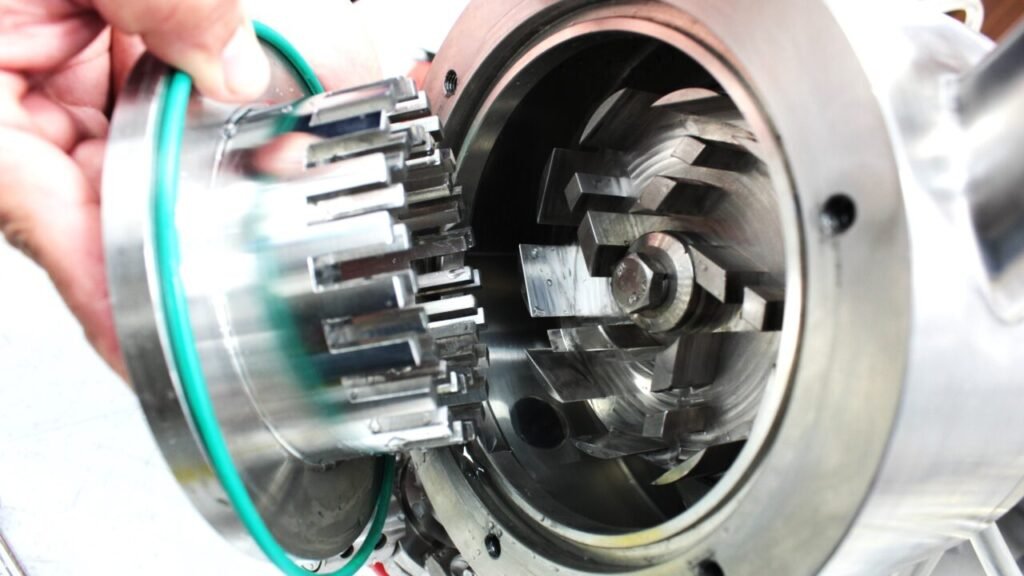
Turbulence is one of the key mechanisms behind effective dispersion and homogenization. It creates rapid fluid movement, breaks up concentration gradients, and helps distribute particles or droplets throughout a mixture. In a high shear mixer, turbulence works alongside intense localized shear to produce the energy needed for demanding mixing applications.
However, more turbulence is not automatically better. The useful level depends on viscosity, particle size, formulation, impeller geometry, and the desired final product.
What Is Turbulence in Mixing?
Turbulence describes irregular fluid motion containing constantly changing velocity and direction.
In a mixing vessel, an impeller transfers mechanical energy into the liquid. That energy creates circulation and smaller-scale eddies. These movements repeatedly transport material from one region to another.
This matters because a poorly mixed product can contain concentration differences from one location to another. Turbulent flow helps reduce those differences by continuously moving material through the vessel.
In simple terms, it keeps the product from sitting still.
How Turbulence Supports Dispersion
Dispersion involves distributing one material throughout another phase.
Examples include:
- Dispersing powders into liquids
- Distributing pigments
- Suspending solid particles
- Breaking up agglomerates
- Incorporating additives into a liquid
Turbulence helps transport particles away from their original location. At the same time, local shear forces act on particle clusters and agglomerates.
This combination is important.
Bulk turbulence handles large-scale circulation, while smaller turbulent structures and shear forces work on localized regions. Together, they improve particle distribution and reduce concentration differences.
Turbulence vs. Shear
These two concepts are closely related, but they are not identical.
Shear occurs when adjacent layers of fluid move at different velocities. The resulting velocity gradient can deform droplets, break apart agglomerates, and improve dispersion.
Turbulence involves irregular fluctuations and eddies across different length scales.
A shear mixer is designed to generate significant velocity gradients and localized energy input. Its performance depends heavily on rotor-stator geometry, rotor speed, clearance, and product properties.
So, turbulence provides broader fluid movement, while shear can deliver more concentrated mechanical action.
Why Rotor-Stator Systems Generate Strong Mixing
Rotor-stator equipment is particularly effective when a process requires intense dispersion or homogenization.
The rotor spins at high speed inside or near a stationary stator. Fluid is pulled into the rotor region, accelerated, and forced through narrow openings in the stator.
This creates:
- High velocity gradients
- Localized turbulence
- Strong shear forces
- Rapid circulation through the mixing zone
The result is a highly energetic mixing environment.
However, the goal is not simply to generate maximum mechanical force. Engineers must balance energy input with the sensitivity of the product.
Turbulence and Homogenization
Homogenization aims to create a more uniform mixture, often by reducing differences in droplet or particle size.
Consider an oil-in-water emulsion. Large oil droplets can separate or rise over time. Strong localized mixing can break these droplets into smaller ones.
Turbulent eddies then help distribute the smaller droplets throughout the continuous phase.
The final result depends on several variables, including:
- Rotor speed
- Rotor-stator gap
- Product viscosity
- Droplet size
- Interfacial properties
- Processing time
This is why simply increasing RPM does not always produce the desired result.
The Importance of Energy Dissipation
Not all mechanical energy contributes equally to the process.
Some energy creates bulk circulation. Some is dissipated through turbulence and shear. The location of that energy dissipation matters.
In high-shear equipment, a large portion of the energy can be concentrated around the rotor-stator region.
That makes the mixing zone extremely effective for particle breakup and droplet reduction. However, it also means that the product may experience localized heating.
For temperature-sensitive materials, engineers may need to consider cooling capacity, residence time, and operating speed.
Viscosity Changes the Mixing Picture
Viscosity has a major influence on turbulence. Low-viscosity fluids generally develop turbulent flow more readily. As viscosity increases, more energy is required to create comparable fluid movement.
This is where equipment selection becomes important. A formulation that mixes easily at low viscosity may require substantially more torque after thickening. Simply running the mixer faster may not solve the problem.
Engineers need to consider the product’s rheology when determining impeller geometry, speed, power input, and processing time.
Reynolds Number and Flow Regime
Reynolds number is a useful engineering parameter for understanding whether flow is more likely to be laminar, transitional, or turbulent.
It considers factors such as:
- Fluid density
- Characteristic velocity
- Equipment dimensions
- Fluid viscosity
Higher Reynolds numbers generally indicate stronger inertial effects relative to viscous forces.
However, mixing systems are more complicated than a simple pipe-flow calculation. Impeller geometry, vessel dimensions, rotating flow, and local shear zones all influence actual behavior.
Still, Reynolds number provides a useful starting point when evaluating mixing conditions.
Why Excessive Turbulence Can Be a Problem
More energy is not always better. Excessive turbulence can create unwanted effects such as:
- Air entrainment
- Foaming
- Product heating
- Ingredient degradation
- Unnecessary energy consumption
For delicate formulations, aggressive mixing may actually reduce product quality.
For that reason, the process should be designed around the required dispersion or homogenization target rather than the highest possible mixer speed.
It is about finding the sweet spot.
Matching Turbulence to the Application
Different applications require different levels of mixing intensity. A powder dispersion may require strong local shear to break up agglomerates. A simple liquid blend may need primarily bulk circulation.
Likewise, an emulsion may require high localized energy to reduce droplet size, while a suspension may depend more heavily on maintaining adequate velocity near the vessel bottom.
The equipment should therefore be selected based on the process objective.
A high shear mixer can provide intense localized energy, but the surrounding vessel geometry and operating conditions still determine how effectively that energy reaches the entire batch.
How Engineers Optimize Turbulence
Effective mixing starts with measurable process requirements.
Engineers typically evaluate:
- Product viscosity and density
- Required batch volume
- Desired particle or droplet size
- Mixing time
- Required power input
- Rotor-stator configuration
- Operating speed
- Heat generation
Pilot testing can then help determine whether the selected configuration delivers the required result.
This approach is much more reliable than choosing equipment based solely on motor horsepower.
Closing Insights
Turbulence plays a central role in dispersion and homogenization because it improves fluid transport and helps distribute energy throughout the mixing system. When combined with localized shear, it can break up agglomerates, reduce droplet size, and improve product uniformity.
The key is balance. A well-designed shear mixer should generate enough energy to achieve the required process result without creating excessive heat, foaming, or unnecessary energy consumption.
Ultimately, effective high-shear mixing is not about making the fluid move as violently as possible. It is about delivering the right energy, in the right place, at the right intensity.