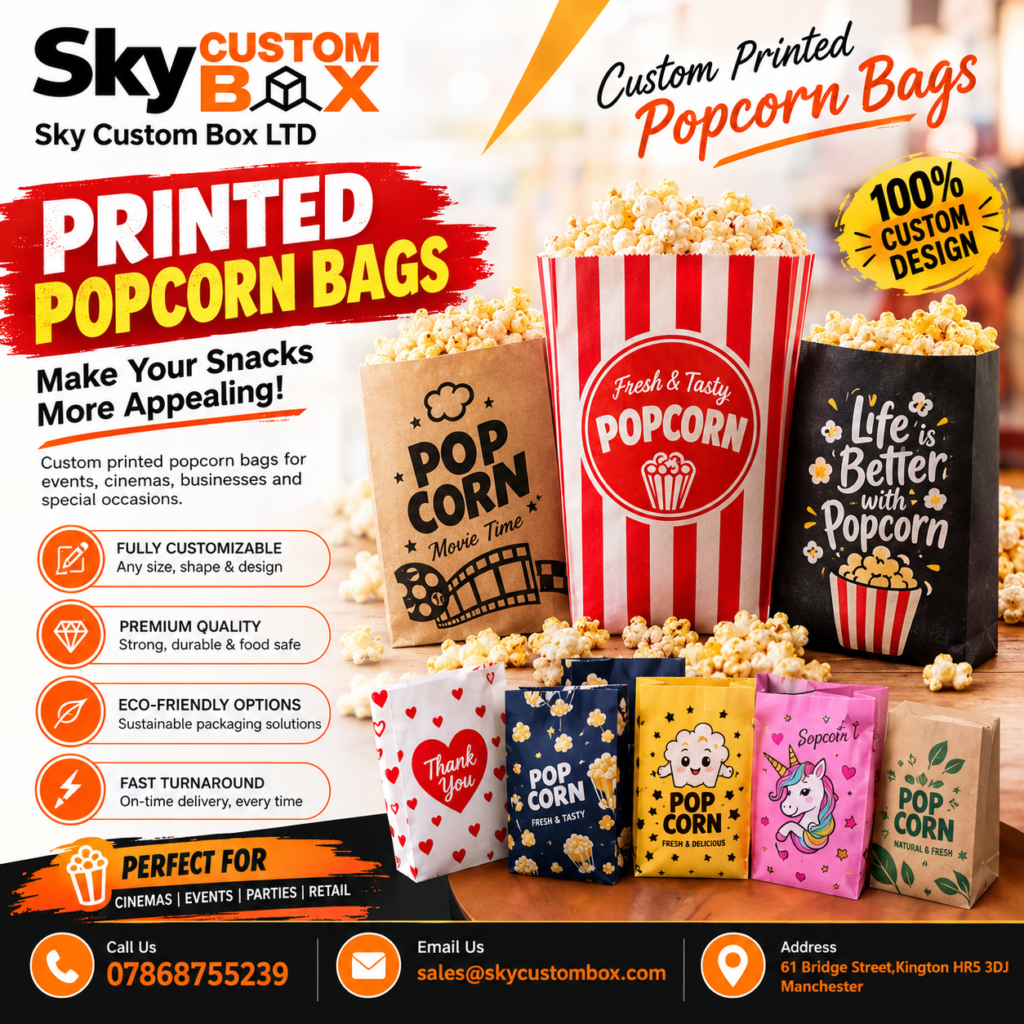
Popcorn is a simple snack, but the packaging used to serve it can have a noticeable impact on presentation, convenience, and the overall event experience. Whether the occasion is a cinema night, wedding reception, school fundraiser, birthday party, corporate gathering, or community event, choosing the right popcorn container requires more consideration than simply selecting the cheapest option.
A well-designed blank popcorn box can provide a practical serving solution while also leaving room for stickers, stamps, handwritten messages, printed labels, or other decorative details. The right choice depends on factors such as box size, material, strength, food suitability, quantity requirements, and how the packaging will be used.
Consider the Size and Serving Requirements
The first consideration should be how much popcorn each guest is expected to receive. Popcorn expands considerably during preparation, so the apparent size of a container does not always correspond directly to its usable serving capacity.
Small popcorn boxes can work well for children’s parties, tasting events, dessert tables, and portion-controlled servings. Medium containers are commonly suited to movie nights, school events, and casual gatherings, while larger popcorn boxes may be appropriate for festivals, cinemas, promotional events, and situations where generous portions are expected.
Before ordering packaging, consider:
- The average serving size per guest
- Whether the popcorn will be served as a snack or main refreshment
- Available table or counter space
- Whether guests will carry the boxes around
- How much storage space is available before the event
Ordering samples before committing to a large quantity can also help organisers assess the practical capacity of the container.
Choose a Material Suitable for Food Service
Material selection affects both appearance and performance. Popcorn boxes are commonly manufactured from paperboard or other food-suitable paper-based materials. The material should be sufficiently rigid to remain upright while being handled and filled.
Food-contact suitability is particularly important. Packaging intended to hold popcorn should come from a supplier that can provide appropriate information about the material’s intended use.
A suitable container should ideally:
- Hold its shape when filled
- Have clean, secure folds
- Be comfortable to hold
- Resist minor handling pressure
- Be appropriate for the intended food application
- Store efficiently before assembly
Paperboard packaging is also popular because it can be relatively lightweight and easy to transport. For events where sustainability is an important consideration, organisers may also investigate recyclable or responsibly sourced paper options.
However, environmental claims should be checked carefully. Terms such as “eco-friendly,” “green,” or “sustainable” can mean different things depending on the material and disposal infrastructure available in a particular area.
Think About Branding and Decoration
One of the biggest advantages of plain packaging is flexibility. A blank popcorn box can serve as a neutral foundation for event-specific decoration without requiring a completely custom-printed package.
This makes blank containers useful for organisations that want to add their own visual identity. For example, a business could apply branded stickers, while a wedding organiser might use a custom stamp containing the couple’s names and event date.
Other decoration options include:
- Logo stickers
- Custom labels
- Rubber stamps
- Printed paper bands
- Handwritten messages
- Event-themed stickers
- Seasonal decorations
- Colour-coordinated ribbons or tags
This approach can be particularly useful for smaller events because the same plain packaging style can potentially be adapted for different occasions.
Packaging providers such as Sky Custom Box can be considered when researching paper-based packaging formats and customisation possibilities, although the exact suitability of a product should always be checked against the event’s food-service requirements.
Match the Packaging to the Event
Different events have different practical needs. A packaging format that works for a children’s birthday party may not be ideal for a formal corporate event.
For a movie night, classic popcorn packaging can reinforce the cinema theme and make individual servings easy to distribute.
For weddings and private celebrations, plain boxes can be decorated to match invitations, table settings, or the overall colour palette.
For school and community fundraisers, simple packaging can keep preparation straightforward while leaving enough space for event names, sponsor information, or decorative labels.
For corporate events, a clean presentation may be more appropriate. A neutral box combined with a professionally printed logo or small branded label can provide a subtle connection to the organisation.
For retail and promotional activities, packaging can become part of the customer experience. Consistent sizing, neat presentation, and clear branding can make the serving area appear more organised.
Check Assembly, Storage, and Handling
A frequently overlooked consideration is what happens before the popcorn is actually served. Flat-packed or foldable paper packaging can reduce storage requirements, but organisers need to understand how much assembly is involved.
For larger events, hundreds of boxes may need to be prepared. Even a simple folding process can become time-consuming when repeated at scale.
Ask these questions before selecting packaging:
- Does the box arrive flat or assembled?
- How quickly can it be folded?
- Does it require adhesive?
- Will the base remain secure when filled?
- Can empty boxes be stacked efficiently?
- Is the packaging easy for staff or volunteers to handle?
- Can it be stored safely in a clean, dry environment?
Conducting a small trial run is a practical way to identify problems before event day.
It is also worth considering how the filled containers will be transported. If popcorn is being prepared in advance, the packaging should allow staff to fill and distribute servings without excessive handling.
Avoid Common Popcorn Packaging Mistakes
Many packaging problems can be prevented through basic planning. One common mistake is selecting a container based only on appearance. A visually attractive box may not have the capacity or structural strength required for the intended serving.
Another issue is ordering the exact number of boxes needed. Events can involve unexpected guests, damaged packaging, or last-minute changes, so a modest contingency quantity can be useful.
Other mistakes include:
- Ignoring actual serving sizes
- Failing to test the box before ordering in bulk
- Choosing unsuitable food-contact materials
- Underestimating assembly time
- Storing paper packaging in damp conditions
- Applying decorations that interfere with handling
- Selecting packaging that is too large for the planned portion
Testing the complete process—from assembly to filling and serving—provides a much clearer picture of whether the packaging will work in practice.
Consider Quantity and Overall Value
Price per individual box is only one part of the overall cost. Event organisers should also consider shipping, storage, assembly time, decoration materials, and potential waste.
Buying in larger quantities may reduce the unit cost, but only when the packaging can realistically be used or stored for future events. Excess packaging can become inconvenient if it takes up valuable storage space or has a design that is specific to a single occasion.
For recurring events, standardising a packaging size can make procurement easier. The same box style could potentially be used across movie screenings, promotional campaigns, community events, and seasonal activities, with the visual identity changed through labels or decorations.
A Practical Checklist Before Choosing
Before selecting popcorn packaging, review the following checklist:
- Capacity: Is the size appropriate for the intended serving?
- Material: Is it suitable for the food application?
- Strength: Can it hold the expected quantity without collapsing?
- Design: Does the shape suit the event?
- Customisation: Can labels, stickers, or decorations be added?
- Storage: Can unused boxes be stored efficiently?
- Assembly: How much preparation is required?
- Quantity: Is there enough packaging, including a reasonable contingency?
- Sustainability: Are the material and disposal options appropriate?
- Testing: Has the packaging been trialled before the event?
This simple evaluation can prevent many of the common issues associated with event packaging.
Conclusion
Choosing popcorn packaging is ultimately about balancing presentation, functionality, food suitability, cost, and event requirements. A plain container can offer considerable flexibility because it can be decorated or branded according to the occasion without committing to a single permanent design.
The most suitable blank popcorn box is therefore not necessarily the largest or least expensive option. It is the one that matches the required serving size, performs reliably during handling, fits the event’s visual style, and can be stored and prepared efficiently.