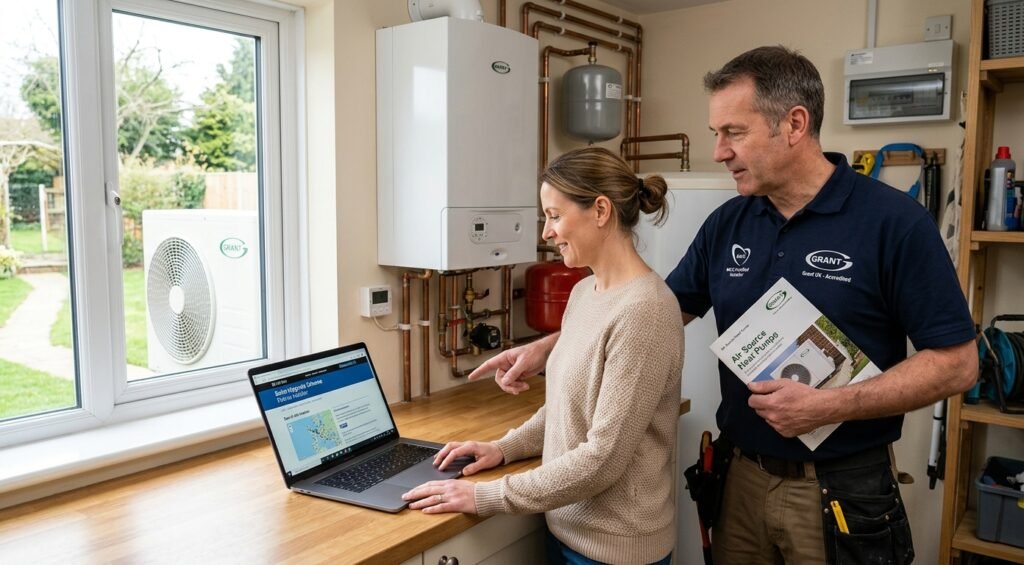
Homeowners can’t send in a Boiler Upgrade Scheme form themselves. The installer makes the claim to Ofgem for you, so picking that firm is, in practice, your application.
A good choice means a well-sized heat pump, a smooth grant, and lower bills. A poor one can leave you with a cold house and a voucher that runs out. Here’s how to find the right team.
Where Should You Start Looking?
Begin with the MCS “Find an installer” directory. Type in your postcode and pick the technology you want, such as an air source or ground source heat pump. The results only show firms certified for that exact system.
Two other routes can widen your shortlist:
- Manufacturer networks. Brands like Vaillant, Kensa and others keep lists of local partners trained on their kit.
- Umbrella schemes. Some smaller firms work under a larger company’s certification, which then handles the grant claim.
Whichever route you take, cross-check every name against the MCS directory. A brand badge on a van doesn’t prove a firm can claim the grant.
Online reviews help too, but read them closely. Look for comments about heat pumps rather than boiler servicing. Pay attention to how the firm dealt with problems after the job was finished.
How Many Quotes Do You Need?
Three is a sensible number. Fewer gives you nothing to compare, while more eats weeks of home visits.
Price alone won’t tell you much. Heat pump quotes often differ by thousands because each firm plans a different job. Lay them side by side and check:
| What to compare | Why it matters |
|---|---|
| Room-by-room heat loss figures | Shows the pump was sized from real measurements, not a guess |
| Heat pump output (kW) | Too small leaves rooms cold; too big wastes money |
| Radiator changes | Bigger radiators often cut running costs |
| Hot water cylinder | Most combi homes need one added |
| Expected running costs | Lets you compare against your current bills |
If one quote skips the heat loss figures, ask for them. A firm that can’t supply them hasn’t done the homework.
Does a Local Installer Make a Difference?
Often, yes. A heat pump needs a yearly service, and faults get fixed faster when the engineer lives 20 minutes away rather than three hours.
Large national companies bring strengths of their own. They may hold more stock and book installs sooner. Some, however, hand the actual fitting to subcontractors you never meet. Ask who will turn up on the day, and who you call if the system stops working in January.
For most homes, a firm based within an hour’s drive strikes the best balance between experience and aftercare.
What Should You Ask Each Firm?
A ten-minute chat reveals a lot. Keep these questions handy during each survey:
- How many heat pumps have you fitted in the past year?
- Will you apply for boiler upgrade scheme funding for me, and how soon?
- Which consumer code do you belong to: RECC or HIES?
- What warranty covers the heat pump, and what covers your workmanship?
- Who services the system each year, and what does it cost?
- Can I speak to a past customer with a home like mine?
Confident installers answer quickly and plainly. Vague replies on questions 1 and 6 usually mean limited experience.
[Add: one question your own customers find most useful, and why.]
What Happens Once You Pick an Installer?
An email from Ofgem lands in your inbox soon after the firm submits the claim. It asks you to confirm that the installer may apply for you. Reply promptly, because nothing moves until you do. Check your spam folder too.
Once approved, the grant arrives as a voucher with a time limit:
- 3 months for an air source heat pump or biomass boiler
- 6 months for a ground source heat pump
The system must be fitted and signed off within that window. Changing your mind about the firm later is possible, but the first voucher has to be cancelled before a new one can be issued. So settle on your choice before the claim goes in.
Which Red Flags Mean You Should Walk Away?
Most firms are honest. A few patterns, though, should end the conversation fast:
- A price given over the phone with no home visit
- Pressure to sign on the day of the survey
- No written heat loss report
- Cold calls or doorstep visits pushing air source heat pump government grants as a “free” upgrade
- Refusal to share their MCS certificate number
Trust the slower firm that measures every room over the quick one with a slick pitch. Your heat pump should run for 15 years or more, so a careful start pays back for a long time.