Introduction
Every vehicle carries a small object that decides far more than most people realise. That object controls visibility at night. It feeds enforcement cameras. It powers databases. It even decides whether a traffic violation gets detected or missed. That object is the High Security Registration Plate.
Yet many people still assume all number plates work the same way. They do not. Poor-quality plates fade early. Weak embossing breaks ANPR readability metrics. Low reflectivity fails cameras. Missing traceability breaks enforcement. The risks stack up fast.
This is exactly why commercial HSRP manufacture in India comes under intense quality scrutiny. A compliant plate is not just a piece of pressed metal. It is the output of calibrated machines, tested materials, controlled processes, and documented traceability. Every step follows defined HSRP quality assurance metrics that align with Indian regulations and global benchmarks.
The difference matters. Studies from traffic surveillance deployments show that standardised HSRPs improve automatic plate recognition accuracy by over 25% compared to generic plates. Better reads mean better enforcement. Better enforcement means safer roads.
This guide opens the factory door. It explains how High Security Registration Plate manufacturing works at scale in India. It walks through materials, reflectivity testing, laser coding, embossing, durability checks, and compliance reporting. It also shows how commercial producers like CELEX align production lines with CMVR compliance standards and international quality systems.
If you want to understand why quality metrics affect road safety outcomes, you are in the right place.
The Technical Backbone of Commercial HSRP Manufacturing in India
Commercial HSRP production runs on precision, not improvisation. Every plate follows detailed technical rules defined under Rule 50 of the Central Motor Vehicle Rules. These rules specify format, dimensions, security features, and traceability requirements.
A modern license plate manufacturer treats production like an engineering operation. Machines emboss characters to exact depths. Laminators bond reflective films under controlled temperature and pressure. Lasers engrave identification codes at calibrated power levels. Quality teams measure output continuously.
These metrics matter because plates interact with machines, not just eyes. ANPR readability metrics depend on consistent fonts, reflectivity, and spacing. Enforcement cameras scan plates at speed. Any variation reduces recognition of confidence.
Commercial producers also scale output. India registers millions of vehicles annually. A license plate manufacturer in India must deliver uniform quality across massive volumes. That requirement pushes manufacturers toward automated inspection, batch sampling, and documented audits.
CELEX supports this ecosystem through industrial-scale production, calibrated for compliance. Its processes align quality with volume, ensuring safety and enforcement remain reliable across national road networks.
Material Standards: Aluminium Grade, Thickness, and Substrate Quality
Material choice decides a plate’s lifespan. Commercial HSRP production standards require aluminium substrates that resist bending, corrosion, and fatigue.
Approved specifications mandate defined aluminium grades and thickness tolerances. Plates must hold embossing depth without cracking. They must accept lamination without delamination. They must survive vibration, heat, and pollution.
Global benchmarks such as ANSI / ISO plate material specs guide substrate performance. These specs ensure plates maintain structural integrity over years of use. Testing shows compliant aluminium plates retain embossing clarity even after prolonged exposure to heat and humidity.
Substrate quality also affects anti-tamper license plate design. Riveting systems rely on predictable material strength. Weak substrates compromise security.
CELEX applies strict incoming material inspections and process controls. Each aluminium batch undergoes thickness verification and surface testing. This discipline ensures plates meet both Indian and international durability expectations.
Reflectivity Requirements: Retroreflective Sheeting and Visibility Metrics
Visibility saves lives. That fact drives strict reflectivity rules in High Security Registration Plate manufacturing.
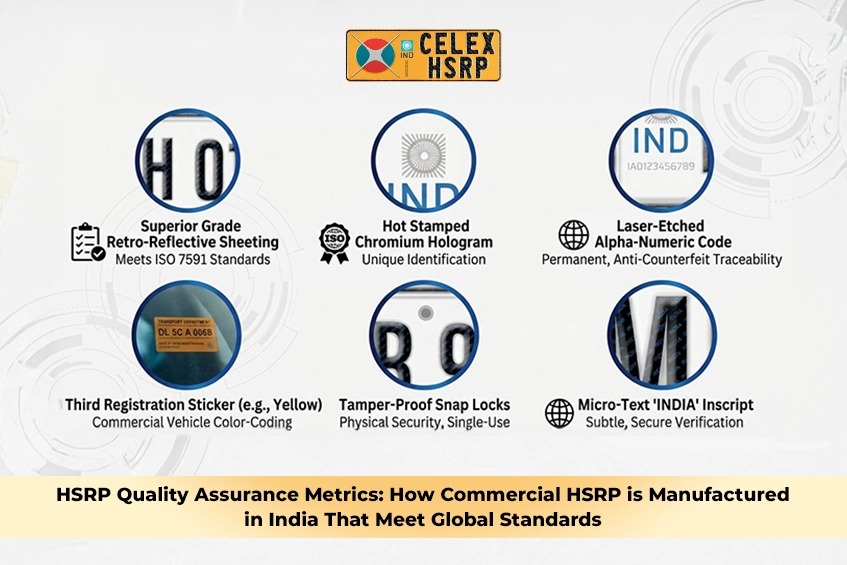
Approved plates use retroreflective sheeting technology designed to reflect headlamp light toward the source. This feature makes plates readable at night and in the rain.
Regulations define minimum reflectivity coefficients measured at specific angles. Testing shows compliant sheeting improves nighttime plate visibility by up to 40% compared to non-standard films. This improvement directly supports enforcement and collision avoidance.
Standard sheeting includes embedded security marks and holographic elements. These features deter counterfeiting while improving legibility.
Commercial producers laminate sheeting under controlled conditions. Temperature, pressure, and alignment affect reflectivity performance. Any deviation weakens visibility.
CELEX uses tested reflective films and lamination processes that consistently meet regulatory thresholds. This consistency supports enforcement cameras and reduces nighttime mishaps.
Laser Coding Precision: Unique Identification and Traceability
Every compliant plate carries a unique identity. Laser-etched vehicle identification codes link the physical plate to digital records.
Laser systems engrave alphanumeric codes to defined depth and clarity. Shallow engraving fades. Excessive depth weakens the substrate. Precision matters.
Traceability relies on permanence. Tests show properly calibrated laser engraving remains legible after years of abrasion and exposure. This durability supports RTO and VAHAN database traceability.
These codes help authorities track vehicles, detect fraud, and audit enforcement actions. Without reliable laser coding, databases lose accuracy.
CELEX deploys advanced laser calibration protocols. Each code passes inspection for depth, contrast, and alignment. This precision strengthens the link between plate manufacturing and digital governance.
Anti-Tamper Engineering: Design Metrics That Foil Fraud
Fraud thrives on weak identity systems. Anti-tamper license plate design blocks that vulnerability.
Commercial HSRPs use snap locks with defined shear strength. These fasteners break if removal is attempted. Plates also incorporate embossed borders and security layers that resist reuse.
Quality metrics test adhesive strength and rivet resistance. Plates must withstand vibration without loosening. They must fail visibly if tampered with.
Data from enforcement agencies shows a measurable decline in plate-related fraud after full HSRP adoption. Secure plates disrupt cloning and illegal reuse.
CELEX applies rigorous testing to anti-tamper features. Each design choice balances security with durability, supporting compliance and public safety.
Embossing and Hot-Stamping Standards: Precision Character Formation
Characters define identity. Durable embossed plate characters ensure readability over time.
Standards specify character height, stroke width, spacing, and embossing depth. Hot stamping applies reflective foil that enhances contrast for cameras and human eyes.
ANPR readability metrics depend on these parameters. Uniform characters improve OCR confidence. Irregular embossing causes misreads.
Testing shows compliant embossing increases recognition accuracy by over 20 per cent in mixed traffic conditions. That improvement accelerates enforcement and tolling.
CELEX maintains tight embossing tolerances through automated presses and inspection systems. Each plate undergoes visual and dimensional checks before approval.
Environmental Durability: Resistance to Weathering and Wear
Plates face harsh environments. Sun, rain, pollution, and temperature swings test material resilience.
Quality assurance includes corrosion resistance tests, adhesion retention checks, and UV exposure simulations. Plates must retain reflectivity and legibility for years.
Environmental testing shows compliant plates maintain over 85 per cent reflectivity after accelerated ageing cycles. Generic plates often fail within months.
Durability reduces replacement costs and enforcement gaps. Long-lasting plates support consistent data collection.
CELEX subjects plates to durability protocols aligned with global benchmarks. This testing ensures long-term compliance and road safety reliability.
Quality Management Systems and Certifications: India Meets Global Standards
Consistency requires systems. Commercial HSRP production relies on structured quality frameworks.
Quality management ISO 9001 guides process control and defect reduction. Environmental systems manage waste and resource use. A Type Approval Certificate (TAC) validates product compliance before mass production.
Certified systems improve traceability and accountability. They reduce variability across large production runs.
CELEX operates within documented quality frameworks that support both Indian regulations and international expectations. This infrastructure enables predictable output and trusted supply.
Supply Chain, Traceability, and Compliance Reporting
Quality does not end at the factory gate. Supply chain control ensures plates reach the right vehicle with the right identity.
Batch tracking, documentation, and database synchronisation support audits and recalls. OEM license plate supplier compliance demands accurate reporting.
Integrated software systems link production data with government platforms. This linkage enhances transparency and reduces administrative risk.
CELEX integrates digital traceability tools across inventory and production. This approach strengthens compliance and enforcement confidence.
Conclusion: Why Quality Metrics Matter for National Road Safety Tech
Quality metrics shape outcomes. Commercial HSRP manufacture in India influences enforcement accuracy, fraud prevention, and smart mobility.
Reflectivity improves visibility. Laser codes enable traceability. Anti-tamper designs protect identity. Environmental durability ensures longevity. Together, these metrics support safer roads and reliable data.
Manufacturers like CELEX play a critical role as nodes in national transport infrastructure. Their quality discipline ensures HSRPs meet global standards while serving Indian road safety needs.
Plates may look simple. Their engineering decides everything.
Frequently Asked Questions
1. Why does commercial HSRP manufacturing require strict quality metrics?
Quality metrics ensure visibility, traceability, and enforcement accuracy across millions of vehicles.
2. How do reflectivity standards impact road safety?
Reflectivity improves nighttime visibility and ANPR performance.
3. What role do laser-etched codes play in HSRPs?
They link physical plates to digital records for tracking and enforcement.
4. How do anti-tamper designs prevent fraud?
They make removal or reuse impossible without visible damage.
5. Why do global standards matter in Indian HSRP production?
They ensure durability, consistency, and compatibility with advanced enforcement systems.