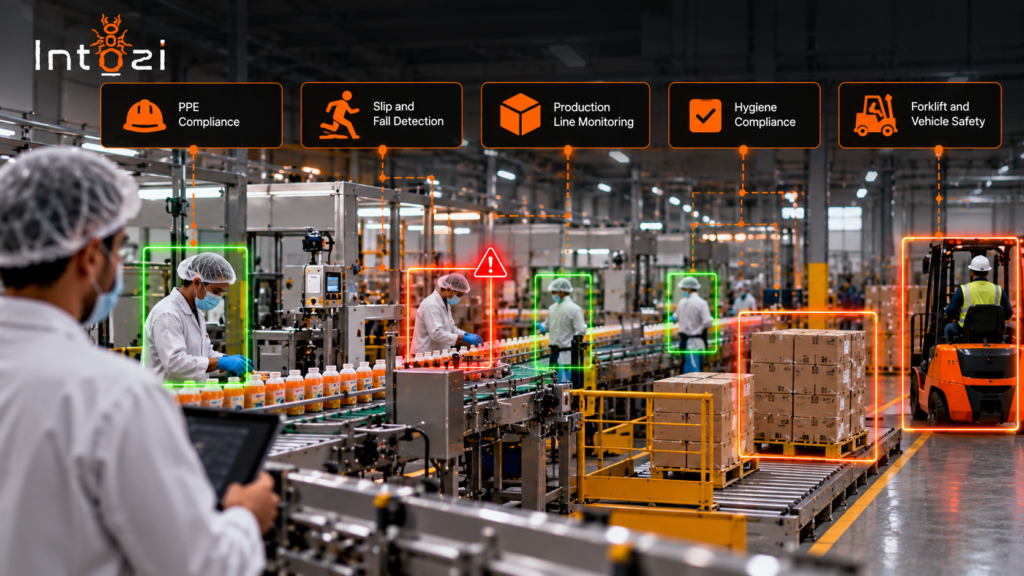
Fast-moving consumer goods (FMCG) manufacturers manage high-volume production, packaging, storage, and dispatch operations where even small monitoring gaps can affect safety, compliance, and productivity. An AI in FMCG manufacturing approach can help organisations move beyond simply recording factory activities towards identifying specific events that require attention. While traditional CCTV provides footage for observation and investigation, intelligent monitoring uses AI to analyse video streams and flag predefined activities for review.
This shift is encouraging manufacturers to evaluate video analytics as part of their broader digital transformation efforts. Rather than relying entirely on manual observation, they can use video-based insights to improve visibility across production areas, worker movement, restricted zones, and material-handling operations.
Why Are FMCG Manufacturers Moving Beyond Traditional CCTV Monitoring?
Traditional CCTV remains valuable for recording activities and investigating incidents. However, monitoring dozens of camera feeds manually can be difficult in facilities operating multiple production lines and shifts.
Manufacturers may face challenges such as:
- Identifying unauthorised entry into restricted production areas.
- Checking compliance with specified personal protective equipment (PPE) requirements.
- Reviewing activities around machinery, loading bays, and storage areas.
- Finding relevant footage after an incident has occurred.
- Maintaining consistent monitoring across large manufacturing facilities.
These limitations have increased interest in AI solutions for FMCG manufacturing that can identify defined events and help responsible teams prioritise their attention.
How Can AI Video Analytics Improve Visibility Across FMCG Factories?
Unlike passive recording, AI video analytics for FMCG manufacturing can analyse compatible video streams against configured rules and detection models. When a supported event is identified, the system can generate an alert for further review.
Examples include detecting people entering restricted areas, identifying selected PPE violations, and monitoring movement around designated operational zones.
With FMCG manufacturing video analytics, manufacturers can potentially:
- Monitor multiple production and packaging areas.
- Identify visible safety violations more consistently.
- Flag unusual movement in restricted zones.
- Review incidents using event-related footage.
- Identify recurring patterns that may indicate a need for better procedures or camera coverage.
These applications depend on camera positioning, video quality, lighting, and the capabilities of the selected AI models. Human review remains important when an alert requires operational judgement.
Can AI Help FMCG Manufacturers Improve Hygiene and Safety Compliance?
Hygiene and safety requirements are particularly important in food, beverage, personal care, and other consumer goods production environments. Manual inspections remain essential, but continuous observation of every workstation and entry point may be difficult.
An AI hygiene compliance system for FMCG can support the monitoring of visible behaviours, such as whether workers entering designated controlled areas appear to be wearing required protective clothing. Depending on the deployed models, video analytics may also identify selected procedural violations in monitored zones.
Similarly, AI safety monitoring for FMCG manufacturing can support the identification of:
- Missing PPE in areas where specific equipment is required.
- Entry into restricted production or machinery zones.
- Unsafe proximity between workers and moving vehicles.
- People falling or remaining on the ground, where supported by the model.
- Unusual activity around designated work areas.
These capabilities can help supervisors decide where further inspection is needed. However, video analytics cannot independently verify microbiological cleanliness or replace sanitation checks, laboratory testing, and established safety procedures.
What Role Does AI Play in FMCG Quality Inspection?
Product quality is another major concern in high-volume manufacturing. Packaging defects, incorrect labels, damaged containers, and sealing issues can affect product consistency and lead to waste.
AI quality inspection for FMCG manufacturing typically involves specialised computer vision models that examine products or packaging under suitable imaging conditions. Depending on the application, these systems can inspect visible characteristics such as label placement, package shape, print quality, or seal appearance.
It is important to distinguish product inspection from general CCTV analytics. A factory surveillance camera may provide useful operational context, but it is not automatically suitable for identifying small product defects. Dedicated inspection cameras, controlled lighting, and task-specific models may be necessary.
Combining product inspection with broader operational monitoring can help manufacturers understand both visible quality issues and the conditions surrounding production activities.
How Can FMCG Plants Connect Monitoring Across Production and Logistics?
Factory operations extend beyond production lines. Raw materials, packaging supplies, finished goods, loading docks, and dispatch routes all contribute to the movement of products through a facility.
FMCG plant monitoring software can help coordinate operational information when it integrates with suitable video systems and other plant applications. Depending on the deployment, teams may review video alerts alongside incident records, operational reports, or notifications from other systems.
Potential applications include:
- Monitoring activity around finished-goods storage.
- Reviewing movement near loading and unloading areas.
- Identifying recurring access or safety issues across shifts.
- Investigating activity around designated equipment zones.
- Recognising gaps in camera coverage or monitoring procedures.
These applications can provide useful context for operational reviews, although video analytics alone does not replace production planning systems, inventory management software, or machine sensors.
What Should Manufacturers Consider Before Adopting AI Monitoring?
Selecting a suitable solution starts with defining the actual problem. A manufacturer seeking to monitor PPE compliance may need a different model and camera configuration from one inspecting packaging defects.
Before implementing AI-powered FMCG manufacturing solutions, organisations should evaluate:
- Business requirements: Define the specific safety, security, hygiene, or inspection challenge.
- Camera suitability: Check whether existing cameras provide sufficient image quality and coverage.
- Detection performance: Test the system under real factory conditions and assess false alerts and missed events.
- Workflow integration: Determine who receives alerts and how incidents are reviewed or escalated.
- Data governance: Establish appropriate access controls, video retention policies, and privacy safeguards.
- Operational value: Measure whether the deployment improves visibility, response times, or compliance review processes.
Starting with a clearly defined use case can help manufacturers assess performance before extending the technology across additional areas.
How Can Intozi and Ikshana Support Intelligent FMCG Monitoring?
Intozi develops AI video analytics software for organisations seeking actionable insights from video infrastructure. Its Ikshana platform supports real-time video analytics applications across industrial environments, including use cases related to security, safety, and operational visibility.
For FMCG facilities, AI video analytics solutions for FMCG manufacturing can be evaluated according to the plant’s monitoring priorities, existing camera infrastructure, and required alert workflows. The appropriate combination of video analytics, specialised inspection technology, and established operational procedures can help manufacturers make better use of visual information while keeping human oversight in the decision-making process.
Frequently Asked Questions (FAQs)
What is intelligent monitoring in FMCG manufacturing?
Intelligent monitoring uses AI and suitable digital systems to analyse operational information, including video, and flag defined events for review. It can help teams identify selected safety, security, or process-related issues more efficiently.
How is AI video analytics different from traditional CCTV?
Traditional CCTV primarily records video for live viewing or later investigation. AI video analytics processes compatible video streams to identify configured events and generate alerts when supported conditions are detected.
Can AI video analytics work with existing CCTV cameras in FMCG factories?
Yes, some platforms can use compatible existing cameras. Feasibility depends on camera specifications, image quality, positioning, network connectivity, and the intended analytics application.
Can AI detect hygiene violations in FMCG manufacturing plants?
AI may identify selected visible behaviours, such as missing protective clothing or entry into controlled areas without following specified procedures. It cannot independently confirm microbiological cleanliness or replace formal hygiene verification.
Can AI video analytics inspect FMCG product quality?
General-purpose video analytics is not automatically suitable for detailed product inspection. Dedicated computer vision systems with appropriate cameras, lighting, and inspection models may be needed to detect packaging defects or other visible quality issues.
What are the main benefits of intelligent monitoring for FMCG manufacturers?
Potential benefits include improved visibility across monitored areas, faster identification of selected events, more focused incident review, and better insight into recurring safety or security issues. Results depend on the suitability and performance of the deployed system.