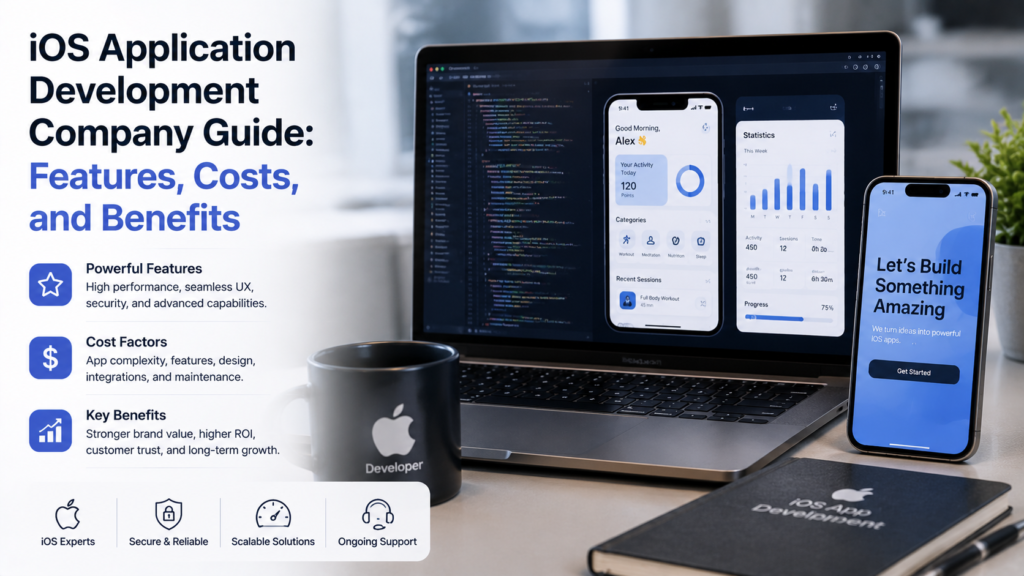
iOS Application Development Company Guide: Features, Costs, and Benefits
iOS Application Development Company
Tariq spent two months interviewing development agencies before he signed anything. He runs a property management business in London, around forty residential units spread across three boroughs, and the problem he was trying to solve was straightforward: his tenants had no reliable way to submit maintenance requests, track their status, or pay rent without calling his office or sending a WhatsApp message that might get buried. He wanted an app. He’d decided on iOS first because his tenant demographic, young professionals in their late twenties and thirties, skewed heavily iPhone. What he hadn’t decided was which kind of agency to work with, and the more he talked to teams, the less clear the distinction between them became. One call with a good iOS application development company finally gave him a framework that made sense. This guide covers what that framework looks like, applied to the real decisions someone like Tariq actually faces.
What an iOS-Focused Agency Does Differently
A generalist mobile agency builds apps. An iOS-focused agency builds apps and has gone unusually deep in the specific ecosystem Apple has built around its devices and developer tools. That depth shows up in a few specific ways.
SwiftUI and UIKit fluency at a level beyond the basics matters more than it sounds. SwiftUI is Apple’s modern declarative UI framework, and the difference between a team that knows the official documentation and a team that has shipped complex SwiftUI-based interfaces in production, including understanding where SwiftUI’s current limitations require UIKit fallbacks, affects both build quality and timeline accuracy in meaningful ways. A team that quotes a SwiftUI-based project confidently without having actually shipped one at meaningful complexity will find out why that matters during the build, not in the pitch meeting.
Xcode toolchain depth, including Instruments for profiling, TestFlight for beta distribution, and the App Store Connect API for submission automation, is another area where genuine iOS experience shows versus general mobile experience. Agencies that primarily build cross-platform apps using Flutter or React Native and occasionally do native iOS work often have thinner toolchain knowledge than agencies where native Swift development is the core of what they do.
Apple’s ecosystem of frameworks, HealthKit for health data, Core Location for GPS, ARKit for augmented reality, Core ML for on-device machine learning, PassKit for Apple Wallet integration, WatchKit for Apple Watch, and StoreKit for in-app purchases, each have their own depth. An agency that has genuinely shipped apps using several of these frameworks has navigated the real-world implementation challenges that documentation alone doesn’t prepare you for.
The Features Worth Discussing Early
For any iOS app project, certain feature categories warrant early, specific conversation because their implementation complexity isn’t obvious from the outside and their scope affects both timeline and cost significantly.
Push notifications sound simple and aren’t. Apple Push Notification Service has its own infrastructure, and implementing rich notifications with actions, notification grouping, time-sensitive alerts, and proper handling of notification permissions under iOS’s increasingly restrictive permission model takes considerably more work than “add push notifications” in a spec document suggests.
In-app purchases and subscriptions are governed by StoreKit 2, Apple’s current purchase framework, and App Store review guidelines around purchase implementation are strict and occasionally surprising. An agency with real StoreKit implementation experience knows where the review guidelines create friction and how to avoid the rejection reasons that commonly affect apps with subscription models.
Offline functionality using Core Data or SwiftData, Apple’s local persistence frameworks, requires architectural decisions made early in the build that are expensive to change later. An app that needs to work without connectivity, something Tariq needed for his property managers who sometimes work in buildings with poor signal, needs its data synchronization architecture designed properly from the start.
Accessibility compliance under Apple’s accessibility frameworks matters both ethically and because App Store review increasingly flags accessibility gaps. VoiceOver support, Dynamic Type compliance, and proper semantic labeling aren’t features to add at the end of a build.
How to Evaluate a Prospective iOS Agency
The most useful signal is usually the specificity of their questions during early conversations, not the quality of their presentation. An agency that asks about your minimum iOS version requirement before quoting is demonstrating awareness that iOS version targeting affects which SwiftUI features are available and which require UIKit fallbacks. An agency that asks what Apple frameworks the project will need to integrate demonstrates familiarity with how differently various Apple APIs behave in practice. An agency that asks about your App Store review timeline relative to launch demonstrates experience with review process realities.
Portfolio review should include actually downloading and using the apps if they’re live in the App Store, not just looking at screenshots. The feel of an iOS app, how it responds to gestures, how transitions animate, how it handles state restoration when backgrounded, tells you things about build quality that a portfolio screenshot doesn’t.
References from clients in a similar industry or with similar technical requirements are worth following up on specifically, asking about post-launch support, the accuracy of the initial estimate, and how the team handled problems that came up during the build.
What Development Actually Costs
To put a real number on it upfront: iOS Application Development Cost in 2026 varies significantly based on scope, team location, and project complexity, and any figure given without a scope conversation attached to it isn’t worth much.
That said, realistic ranges: a simple utility app with a few screens, basic local functionality, and no complex backend runs $15,000 to $40,000 with a Western agency, less with Eastern European or South Asian teams. A standard business app with user authentication, a backend, push notifications, and a moderate number of screens runs $50,000 to $150,000. A complex app integrating multiple Apple frameworks, HealthKit, ARKit, WatchKit, or with significant custom functionality runs $150,000 and up, with the ceiling determined by scope rather than any fixed market rate.
Native iOS development typically costs more than cross-platform development using Flutter or React Native for comparable functionality, because the skillset is more specialized and the development environment is more constrained. Whether native iOS is worth the premium depends on how much the project relies on deep Apple ecosystem integration, where native consistently outperforms cross-platform in both capability and feel.
Annual Apple Developer Program membership adds $99 per year. Ongoing maintenance for a live iOS app runs approximately 15 to 20 percent of the original build cost annually, covering OS update compatibility, bug fixes, and security patches.
What Tariq’s Project Actually Looked Like
He went with a mid-size iOS-focused agency in Eastern Europe, a team of five with a track record in property and facilities management apps specifically. The build took fourteen weeks. The app covered maintenance request submission with photo upload, status tracking with push notifications, and rent payment via Apple Pay. His tenants’ adoption rate in the first month was higher than he’d expected, partly because the Apple Pay integration removed the friction that had made digital payment feel like more effort than a bank transfer.
The thing he said was most useful in the evaluation process: the agency he chose spent the first meeting asking him about his tenants, his property managers, and his maintenance workflow in detail before discussing technology at all. The agencies he didn’t hire spent the first meeting talking about their process. The difference in those two types of conversations ended up being a reliable predictor of which team would build something his tenants would actually use.