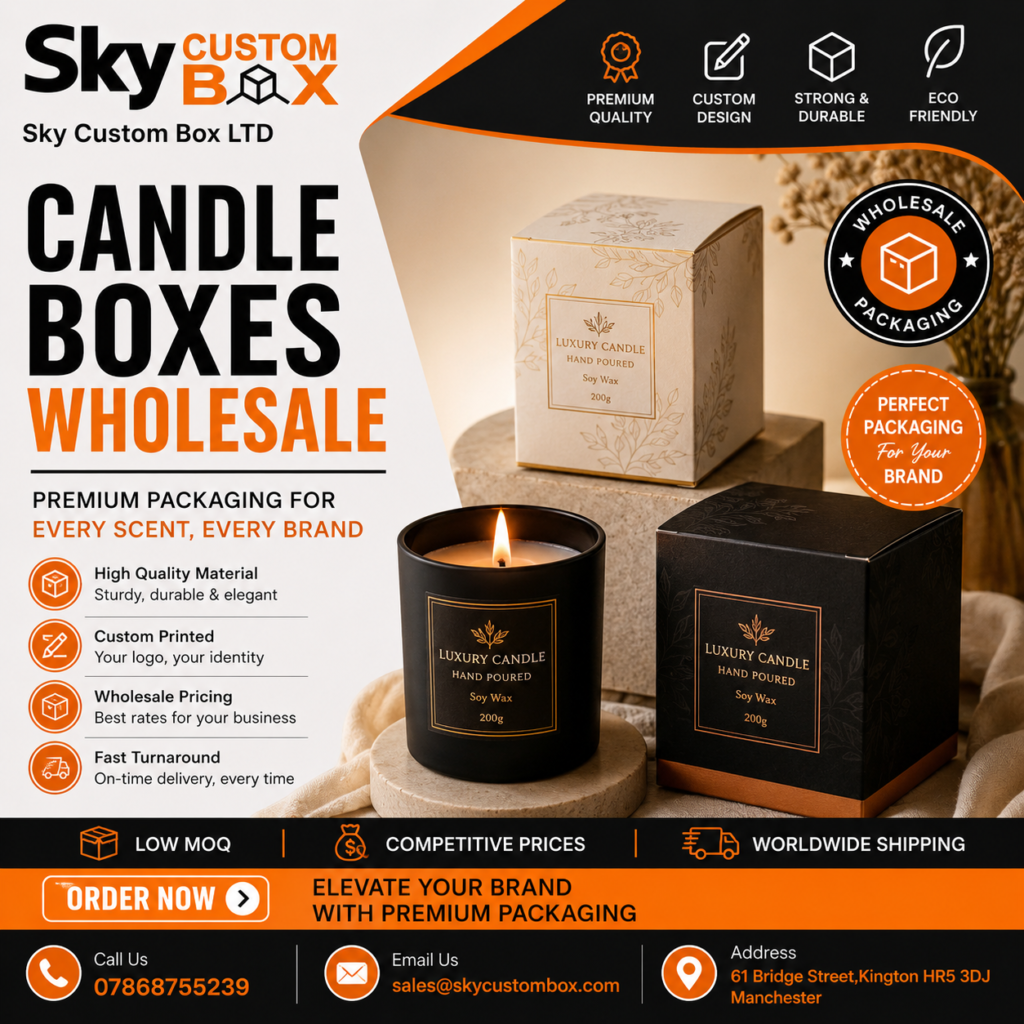
Candles have become popular products for home décor, relaxation, gifting, and personal wellness. As the market grows, packaging plays an increasingly important role in protecting candle jars, communicating product quality, and creating a memorable customer experience. For independent candle makers, established retailers, and e-commerce businesses, choosing the right Luxury Candle Jar Boxes Packaging can help balance product protection, visual appeal, and operational costs.
A well-designed candle box does more than hold a product. It protects glass containers during storage and transportation, supports brand recognition, and provides customers with useful product information. Whether a business produces scented soy candles, decorative jar candles, or premium gift collections, packaging should reflect the product’s positioning while meeting practical shipping requirements.
Understanding materials, structural design, printing techniques, and sustainability considerations can help candle businesses make informed packaging decisions.
1. Why Candle Box Packaging Matters for Premium Brands
Candle packaging serves several purposes, from protecting fragile glass jars to influencing how customers perceive a product. Since candles are frequently purchased as gifts, packaging can be an important part of the overall buying experience.
Protecting Glass Candle Jars
Glass jars can crack or break when exposed to impact, vibration, or excessive movement. Appropriate packaging helps reduce these risks during handling and delivery.
Effective protective packaging may include:
- Corrugated cardboard outer boxes for shipping.
- Paperboard cartons for retail presentation.
- Custom inserts that keep candle jars centred.
- Dividers for gift sets containing multiple candles.
- Protective cushioning for particularly fragile products.
The appropriate construction depends on the jar’s weight, dimensions, shape, and intended distribution method. A lightweight carton suitable for a candle sold in a physical shop may not provide sufficient protection for a glass jar shipped through a courier network.
Businesses should test packaging with the actual candle, including its lid and any additional components, rather than relying exclusively on the box’s external dimensions.
Creating a Recognisable Brand Identity
Packaging is also an opportunity to communicate a candle brand’s personality. Minimalist typography, elegant colour combinations, subtle textures, and carefully positioned logos can help establish a premium appearance.
For example, a botanical candle collection might use muted greens, natural paper textures, and understated illustrations. A luxury fragrance collection could use deep colours, metallic accents, and refined typography.
Consistency is particularly important when a business sells multiple fragrances or seasonal collections. A recognisable packaging system allows customers to identify the brand while still distinguishing individual products.
2. Choosing the Right Materials for Luxury Candle Boxes
Material selection affects durability, appearance, print quality, storage, and overall packaging costs. The best option depends on the candle’s price point and the conditions it will encounter before reaching the customer.
Rigid Boxes for Premium Candle Collections
Rigid boxes are constructed from thick, sturdy board and are often associated with luxury retail packaging. Their solid structure and refined appearance make them suitable for premium candles, limited-edition fragrances, corporate gifts, and special-occasion collections.
They can incorporate magnetic closures, fitted inserts, decorative paper, and premium finishes. However, rigid boxes generally cost more than standard folding cartons and may require more storage space.
Folding Cartons for Everyday Retail
Folding cartons are made from paperboard and are supplied in flat form before assembly. They offer flexibility in shape, printing, and design while helping businesses manage storage requirements.
They can be appropriate for scented candles, smaller jar candles, retail shelves, and products that do not require the same presentation as high-end gift collections.
Corrugated Packaging for Shipping
Corrugated cardboard contains a fluted layer between paper liners, providing additional strength and cushioning. It is commonly used for shipping individual candles and multi-product orders.
For fragile glass jars, a corrugated outer box combined with a properly fitted internal insert can offer a practical balance between protection and material efficiency.
When selecting materials, candle makers should consider the entire packaging system rather than evaluating the decorative box alone. A premium retail carton may still need a separate shipping box to withstand courier handling.
3. Custom Luxury Candle Boxes: Design, Printing and Finishing
Custom luxury candle boxes allow businesses to tailor packaging to their products, customers, and visual identity. The most effective designs combine attractive presentation with straightforward functionality.
Structural Design and Accurate Sizing
A box should fit the candle jar securely without applying excessive pressure to the glass. Measurements should account for the jar body, widest point, lid, base, and any protective insert.
Important design considerations include:
- Internal length, width, and height.
- Jar weight and glass thickness.
- Space required for inserts or cushioning.
- Ease of opening and closing.
- Storage and transportation requirements.
- Whether the box will be displayed vertically or horizontally.
For a collection containing different jar sizes, a business may need several box dimensions or a flexible insert system. Standardising packaging where possible can simplify stock management without compromising product protection.
Printing and Decorative Finishes
Printing can transform a simple carton into a recognisable retail package. Common techniques include digital printing for shorter runs and offset printing for larger production quantities.
Finishing options may include:
- Foil stamping: Adds metallic details to logos or selected text.
- Embossing and debossing: Creates raised or recessed design elements.
- Matte or gloss coatings: Changes the surface appearance.
- Spot UV: Highlights selected parts of a printed design.
- Textured paper: Adds tactile interest to the packaging.
Not every candle brand needs multiple decorative finishes. A restrained design with clear typography, suitable colours, and quality materials can look sophisticated while keeping production complexity manageable.
Businesses should request a physical sample when possible, particularly if colour matching, insert fit, or premium finishing is important.
4. Sustainability, Costs and Common Packaging Challenges
Sustainability and cost control are increasingly relevant to packaging decisions. However, businesses need to evaluate practical performance alongside environmental claims.
Reducing Packaging Waste
Paper-based packaging can often be recycled where local collection systems accept the material and it is not contaminated by incompatible components. Recyclability may be affected by plastic laminations, certain coatings, adhesives, and mixed-material inserts.
Practical improvements include:
- Choosing appropriately sized boxes to reduce unused space.
- Using paper-based inserts when they provide sufficient protection.
- Avoiding unnecessary layers and decorative components.
- Reviewing whether finishes affect recyclability.
- Providing clear disposal guidance when appropriate.
Claims such as “eco-friendly” or “fully recyclable” should be supported by the actual materials and relevant disposal conditions. Businesses should verify supplier specifications rather than assuming every cardboard-based package can be recycled in the same way.
Understanding the Cost of Candle Box Packaging
The cost of candle packaging depends on several factors, including material choice, box dimensions, order quantity, printing method, finishing options, inserts, and delivery charges.
Rigid boxes with elaborate finishes usually require a greater investment than standard folding cartons. Custom structural designs may also involve setup or tooling costs.
To control expenditure, candle businesses can:
- Start with a small range of standardised box sizes.
- Compare plain and custom-printed options.
- Request quotations at different order quantities.
- Evaluate packaging costs per finished order.
- Account for storage and assembly time.
- Test samples before approving a large production run.
The cheapest box is not always the most economical option. Packaging that fails to protect a glass jar can lead to breakages, replacement shipments, customer complaints, and wasted stock.
A more useful comparison considers the total cost of packaging, fulfilment, and potential product damage.
5. Where Luxury Candle Packaging Is Used
Different candle businesses require different packaging approaches. Matching the design to the sales channel helps avoid unnecessary expenditure and performance problems.
E-commerce candle brands: These businesses should prioritise secure inserts, suitable outer shipping cartons, and resistance to normal handling during delivery.
Gift shops and boutiques: Attractive printed cartons, coordinated colours, and clear product information can improve shelf presentation and make candles easier to merchandise.
Corporate gifting companies: Rigid gift boxes, coordinated product sets, and personalised branding can support seasonal campaigns and business gifts.
Artisan candle makers: Smaller production runs, simple printed cartons, and standardised packaging can help independent makers manage inventory while maintaining a consistent appearance.
Premium fragrance brands: High-quality materials, refined typography, and carefully selected finishes can reinforce a luxury positioning, provided the packaging remains functional.
Businesses exploring suppliers can consider providers such as Sky Custom Box when researching customised packaging formats. The important step is to compare material specifications, minimum order quantities, sample quality, production timelines, and suitability for the intended candle jars.
Conclusion
Choosing the right Luxury Candle Jar Boxes Packaging requires more than selecting an attractive design. Packaging must protect fragile glass containers, communicate brand identity, support the sales channel, and remain practical to produce and store.
Rigid boxes can suit premium gifts, folding cartons offer flexibility for retail products, and corrugated boxes provide additional protection for shipping. Meanwhile, thoughtful sizing, appropriate inserts, and carefully selected printing finishes can improve the customer experience without adding unnecessary complexity.
CONTACT US:
ABOUT US:
Social Media:

