Mortgage Note Investing in 2026: How Investors Can Improve Due Diligence
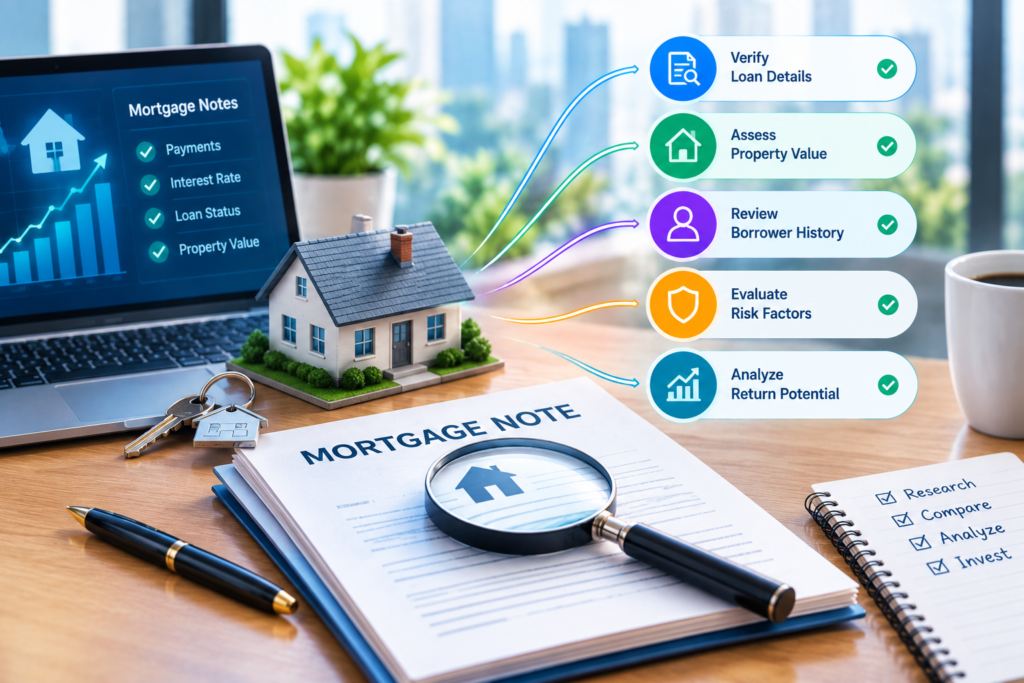
Mortgage Note Investing in 2026 How Investors Can Improve Due Diligence
Mortgage note investing continues to attract investors who are interested in real-estate-backed cash flow without necessarily purchasing and managing physical property directly. However, evaluating a mortgage note requires more than reviewing the outstanding balance and expected payments. Investors need to understand the loan documents, property securing the debt, payment history, lien position, ownership records, and potential exceptions before committing capital.
This makes Mortgage Note Buyers an important part of the investment process. A note can appear attractive on a spreadsheet while public records or loan documentation reveal issues that could affect its value, enforceability, servicing, or potential recovery.
For investors evaluating individual notes or larger portfolios, a structured research process can provide a clearer picture of what is actually being purchased.
Understanding Mortgage Note Investing
Mortgage note investing involves purchasing the right to receive payments associated with a real estate-backed loan. Depending on the transaction, the investor may acquire a performing note with regular payments or a non-performing note where the borrower has fallen behind.
These two categories require different types of analysis.
Performing notes generally require careful review of payment history, loan terms, collateral documentation, lien position, taxes, insurance, and ownership records. Non-performing notes can require additional research involving foreclosure status, bankruptcy, judgments, statute-of-limitations exposure, and potential curative issues.
Scalance Global’s Notes Investor service specifically separates performing and non-performing note diligence and provides research covering these different requirements.
Why Mortgage Note Due Diligence Matters
The information provided in a loan tape or seller package may not tell the entire story. Investors need to verify important information against the underlying records.
For example, a seller may identify a loan as a first-lien asset, but the public record could contain an intervening lien, re-recorded document, or other issue affecting the recorded position. Scalance Global notes that lien position should be verified against the record rather than accepted solely from the seller’s description.
This is particularly important when investors are purchasing multiple notes at once. A single exception may not be significant across a large portfolio, but a pattern of exceptions can change the way an investor evaluates the entire acquisition.
Verify Lien Position
Lien position is one of the most important elements of mortgage note research. Investors need to know where their mortgage sits relative to other recorded interests.
A first-lien position and a junior-lien position can have very different risk characteristics. Investors should therefore verify the recorded mortgage and investigate other liens, judgments, tax-related interests, and relevant instruments.
The purpose is not simply to collect documents. The goal is to establish the actual recorded position of the investment.
This research becomes especially important when a note is distressed and the investor may eventually need to pursue foreclosure or another recovery strategy.
Review the Chain of Title
Ownership history is another critical part of mortgage note investing. Investors should understand how the note moved from the original lender to the current holder.
An assignment chain may contain gaps, missing assignments, recording issues, or transfers involving entities whose authority needs additional documentation. These issues may become more important when a borrower defaults.
Finding a documentation problem before purchasing a note gives an investor an opportunity to investigate it during due diligence. Discovering the same problem later during a foreclosure or enforcement process can create additional complications.
Scalance Global’s note diligence services include chain-of-title and assignment verification as well as assignment recording tracking.
Reconcile Loan Data With Documents
Loan tapes and spreadsheets are useful for reviewing large portfolios, but investors should not rely on tape information alone.
Important data points such as unpaid principal balance, interest rate, payment amount, maturity date, delinquency status, and borrower information should be reconciled against the underlying documentation.
Differences between the tape and the documents can create questions about the actual economics of a note.
A systematic reconciliation process can help identify these discrepancies before an investment is finalized. For larger portfolios, this type of review can also help investors classify exceptions and determine which assets require deeper investigation.
Review the Original Note and Allonges
The promissory note and related endorsement documents can be central to understanding the debt. Investors may need to determine whether the available documentation supports the ownership and transfer history represented by the transaction.
Allonges, endorsements, assignments, and custody information can therefore become important components of due diligence.
Scalance Global’s performing-note diligence includes note endorsement and allonge review, original document and custody status verification, and collateral file completeness review.
The exact legal significance of a document depends on the circumstances and applicable law, so investors should consult qualified legal professionals when legal conclusions are required.
Check Property Taxes and Insurance
A mortgage note is supported by real estate collateral, so investors should understand the current status of the property.
Property taxes and insurance can affect the underlying collateral and the economics of the investment. Unpaid taxes, insurance problems, or gaps in coverage may require additional attention.
Reviewing these items as part of the diligence process can help investors identify potential issues before closing.
This is particularly relevant for distressed notes, where a property may have experienced changes in occupancy, maintenance, taxes, or insurance status.
Performing Note Due Diligence
Performing notes can offer investors a different research profile because the borrower is generally making payments according to the loan terms.
However, regular payments do not eliminate the need for due diligence.
Investors can still benefit from verifying lien position, chain of title, assignments, collateral documentation, payment history, tax status, and insurance information.
A performing note can become distressed in the future, so understanding the documentation and collateral position before purchase can remain important.
The objective is to establish a reliable baseline for the investment rather than assuming that current performance will continue indefinitely.
Non-Performing Note Due Diligence
Non-performing notes require additional attention because payment problems can create a range of legal, financial, and operational questions.
Investors may need to research foreclosure status, bankruptcy filings, judgments, other liens, borrower information, and the history of the default.
Statute-of-limitations exposure can also be relevant. Scalance Global identifies statute-of-limitations exposure checks as part of its non-performing note diligence process.
Understanding these issues before acquiring a distressed note can help investors assess the asset more comprehensively and determine what additional professional review may be required.
Portfolio-Level Mortgage Note Due Diligence
Individual note research can become difficult when an investor is purchasing hundreds or thousands of assets. Reviewing every file manually using the same level of effort may not be the most efficient approach.
Portfolio-level screening can help identify exceptions before deeper asset-by-asset research begins.
For example, investors can classify notes according to missing documents, lien issues, assignment gaps, delinquency status, bankruptcy indicators, or other research findings.
Scalance Global describes a portfolio approach in which exceptions are classified so investment teams can make pricing or exclusion decisions before commissioning deeper diligence on the remaining assets.
This can help investors focus resources on assets that require additional attention.
How Technology Can Improve Note Investing
Technology can make mortgage note research more organized, particularly when investors are handling large portfolios.
Automated workflows can help collect information, reconcile datasets, route files, track exceptions, and maintain status updates. However, automation should not be viewed as a replacement for professional review when records are complicated or jurisdiction-specific.
The most useful approach may be a combination of technology and experienced research teams. Repetitive tasks can be organized through workflows while exceptions can be directed toward deeper human review.
This approach can help investment teams spend less time searching for basic information and more time evaluating the issues that actually affect an asset.
How scalanceglobal Supports Mortgage Note Investors
scalanceglobal provides investor-focused title, lien, collateral, and public-record research for mortgage note transactions. Its Notes Investor service covers both performing and non-performing notes.
For performing notes, the service includes lien position verification, chain-of-title and assignment verification, note endorsement and allonge review, original document and custody verification, loan-data reconciliation, tax and insurance checks, collateral file review, payment-history reconciliation, and assignment recording tracking.
For non-performing notes, the research can extend to bankruptcy searches, foreclosure status, judgment and lien research, statute-of-limitations exposure checks, and curative scoping.
This type of support can help investors organize information before purchasing individual notes or larger portfolios.
Preparing for a Mortgage Note Acquisition
Investors can improve their acquisition workflow by establishing clear diligence requirements before reviewing a potential transaction.
The process can begin with the loan tape and seller-provided documents, followed by verification against title and public records. Exceptions can then be classified according to their potential relevance to pricing, ownership, enforceability, collateral, or servicing.
A consistent process can also make it easier to compare different portfolios.
Instead of looking only at the projected return, investors can evaluate the complete information profile of the asset. This creates a more comprehensive framework for understanding what is being purchased.
Final Thoughts
Mortgage Note Investing requires careful analysis of both financial information and underlying records. Payment history and projected cash flow are important, but investors should also understand lien position, ownership history, assignments, collateral documentation, taxes, insurance, and potential legal or servicing issues.
Performing and non-performing notes require different diligence approaches, while large portfolios may benefit from exception-based screening before deeper asset-level research.
For investors purchasing mortgage notes, the objective is to understand the asset before capital is committed. scalanceglobal supports this process through title, lien, collateral, document, and public-record research designed for investor due diligence.
A strong mortgage note investment workflow is not simply about finding attractive numbers. It is about verifying the information behind those numbers and identifying the issues that could change the economics of the investment.