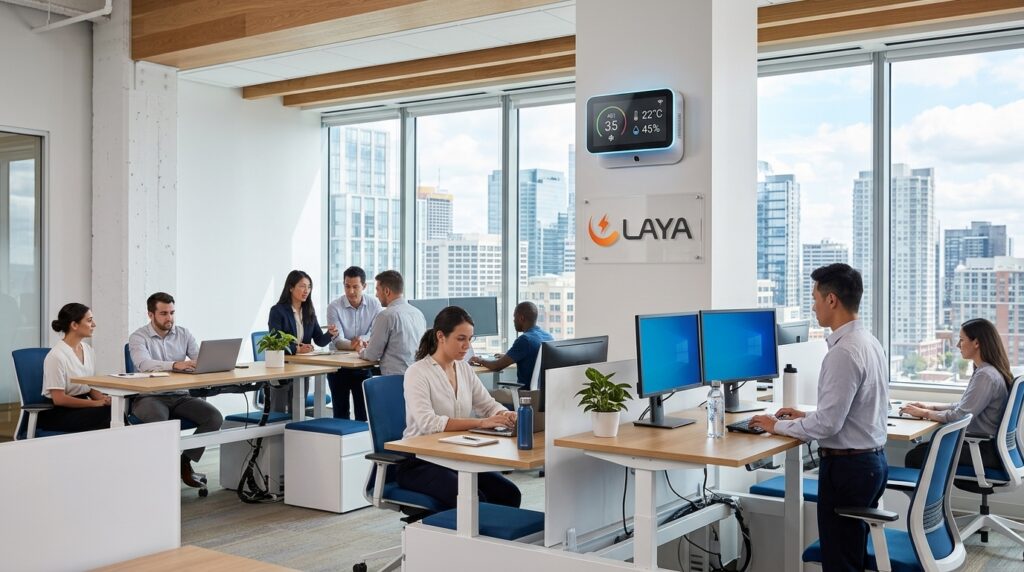
Why Modern Offices Need More Than Climate Control
Modern office environments have become significantly more complex than the simple work-and-meeting spaces of earlier generations. Hybrid work patterns have created highly variable occupancy that makes traditional fixed-schedule HVAC operation inefficient. Health awareness has elevated indoor air quality from a background concern to a critical workplace amenity. Sustainability commitments require detailed energy monitoring rather than just monthly utility bill review. Employee experience expectations now include comfort, productivity-supporting conditions, and demonstrated environmental responsibility.
Traditional office building management systems address some of these needs but typically through fragmented systems that require specialized expertise to operate effectively. The result is many offices operating with significant inefficiencies and environmental issues that go undetected until they generate complaints or contribute to underlying productivity problems. Smart sensor deployment provides accessible, integrated monitoring that addresses the full range of modern workplace concerns through a unified system that any facilities manager can deploy and operate.
Air Quality and Productivity in the Workplace
Indoor air quality has emerged as a measurable factor in workplace productivity through extensive research published over the past decade. Carbon dioxide concentrations correlate clearly with cognitive performance, with elevated levels measurably affecting decision-making, complex task completion, and meeting effectiveness. Particulate matter, volatile organic compounds, and humidity all contribute to broader comfort and health metrics that affect employee experience and absenteeism.
Continuous monitoring of these factors transforms workplace management from reactive complaint response to systematic environmental optimization. Conference rooms with high meeting density often show elevated CO2 levels that warrant ventilation upgrades or scheduling adjustments. Open-plan areas may show humidity patterns that contribute to seasonal illness transmission. Specific zones may show air quality issues from new furniture, recent renovations, or operational practices that warrant targeted attention. The accumulated data supports systematic improvement initiatives that no anecdotal management approach could match. Layla’s office monitoring solution provides this comprehensive workplace environmental intelligence in a system designed for modern office deployment.
Occupancy Sensing for Hybrid Work Environments
Hybrid work patterns create office occupancy variability that fundamentally challenges traditional space management approaches. Some days the office is full, others nearly empty. Some areas remain consistently active while others sit unused. Specific conference rooms get heavily booked while others remain available. Without continuous occupancy data, facilities managers operate largely in the dark about how their space is actually used, leading to suboptimal allocation, energy waste, and missed optimization opportunities.
Smart occupancy sensing transforms this picture by providing continuous, accurate data about how every monitored space is actually used. The data reveals patterns that inform space planning decisions like whether to expand or consolidate, which conference rooms warrant additional resources or different layouts, and how HVAC schedules can be optimized for actual rather than theoretical occupancy. The accumulated intelligence enables data-driven decisions about expensive real estate that historically have relied on impression and guesswork. The financial leverage from improved space utilization typically exceeds the monitoring deployment cost many times over for any organization with meaningful office space.
Energy Optimization for Sustainable Operations
Energy optimization in modern offices increasingly serves both financial and sustainability objectives. Companies with public sustainability commitments need detailed energy data to support reporting, target-setting, and progress demonstration. Companies focused primarily on cost reduction need the same data to identify and pursue savings opportunities. Smart sensor deployment provides the granular, real-time energy intelligence that supports both purposes.
Specific optimization opportunities surface clearly through accumulated monitoring data. HVAC systems running during low-occupancy hours waste energy that occupancy-driven scheduling would eliminate. Conference rooms with always-on equipment consume meaningful baseline energy that smart shutoffs could reduce. Lighting systems in low-traffic zones may operate continuously despite minimal actual use. Each of these patterns becomes addressable once visible, and the cumulative savings from systematic optimization across an office portfolio often reach 25 to 35 percent of total energy costs. The financial impact across larger office portfolios can be substantial, easily justifying significant monitoring investment from cost considerations alone.
Compliance and Health Reporting for Modern Workplaces
Workplace health and safety compliance has expanded significantly over recent years, with new requirements around indoor air quality, occupancy density, and ventilation increasingly common across jurisdictions. Some industries face additional sector-specific requirements around specific airborne contaminants, humidity for product preservation, or temperature for comfort and safety. Documentation of compliance with these requirements often requires continuous monitoring data that periodic spot checks cannot provide.
Smart sensor deployment generates the documentation automatically as a side effect of routine operation. The accumulated data supports compliance reporting, audit preparation, and any disputes that arise about workplace conditions during specific periods. Some companies share environmental monitoring data with employees as part of transparency initiatives, building trust through demonstrated commitment to workplace quality. Others use the data internally for management decisions while making summary information available to employees on request. The compliance benefits combined with the operational improvements often produce documented returns that significantly exceed the investment in monitoring infrastructure.
Privacy-Respecting Monitoring in Employee Spaces
Workplace monitoring raises important privacy considerations that affect both employee trust and legal compliance. Camera-based monitoring in work areas generates significant employee resistance and raises legal complications in many jurisdictions. Audio monitoring is even more problematic. Smart environmental sensors avoid these issues entirely by measuring conditions rather than recording behavior, providing useful workplace intelligence without the surveillance concerns that compromise employee experience.
Transparent communication with employees about the monitoring approach further strengthens trust. Explaining that the sensors measure environmental conditions like air quality, occupancy patterns, and energy usage without capturing any personally identifiable data typically generates positive employee response. The framing of the monitoring as working in employees’ interest through better workplace conditions also helps. Some companies even make summary monitoring data available to employees through dashboards or regular communications, demonstrating commitment to workplace transparency. Layla’s smart workplace sensors provide this privacy-respecting workplace intelligence in a system designed for the employee experience considerations that modern workplaces require.
Deploying Workplace Monitoring at Scale
Deploying smart sensor monitoring across larger office spaces requires planning that accounts for the variety of zone types and use patterns. A single sensor may suffice for small offices, while larger spaces benefit from multiple sensors distributed across distinct zones like open-plan areas, conference rooms, executive offices, break rooms, and reception areas. Each zone often has different characteristic conditions and warrants potentially different threshold configurations.
Centralized dashboards integrate the multi-sensor data into unified views that facilities managers can monitor efficiently. Alerts route to appropriate personnel based on issue type and zone. Historical analysis surfaces patterns that inform space planning, HVAC optimization, and operational improvements. The combined deployment cost typically scales reasonably with office size while delivering proportional benefits, making the economics work across organizations from small companies through enterprise scale. Track office environment with Layla across your workspace portfolio with deployment that scales gracefully from single offices through enterprise multi-location operations.
Frequently Asked Questions
Q1: How does air quality really affect employee productivity?
A: Research consistently shows measurable impacts on cognitive performance from elevated CO2, with smaller but real effects from particulate matter and humidity outside comfort ranges.
Q2: Can sensors help us right-size our office space?
A: Yes. Continuous occupancy data reveals actual usage patterns that inform decisions about expansion, consolidation, and zone reallocation far better than impression-based planning.
Q3: Will employees object to environmental monitoring?
A: Generally not when the monitoring is clearly explained as environmental rather than personal. Camera-free, audio-recording-free sensors typically generate positive employee response.
Q4: How much can offices save on energy with smart monitoring?
A: Systematic optimization across HVAC, lighting, and equipment based on occupancy data typically delivers 25 to 35 percent energy cost reductions over fixed-schedule operations.
Q5: Do smart sensors work in larger office buildings?
A: Yes. Modern platforms support deployments from small offices through enterprise multi-location operations with appropriate scaling and management features.