Pharmaceutical facilities need three connected water systems working together — specialized pharma wastewater treatment to neutralize API residues and antibiotic contamination, an industrial effluent treatment plant (ETP) to carry general process effluent to dischargeable standards, and a wastewater recycling program to reuse treated water for cooling, utility, and non-critical applications. Planning all three as one system, rather than as separate projects, typically cuts both compliance risk and long-term treatment costs.
Why Pharma Wastewater Needs Specialized Treatment
Pharmaceutical wastewater differs from general industrial effluent in one critical way: it can contain trace active pharmaceutical ingredients (APIs), antibiotic residues, and solvents that resist standard biological treatment — and in some cases actively inhibit it. A conventional activated sludge process, designed for typical industrial effluent, can fail outright if antibiotic residues kill the microorganisms doing the treatment work.
What makes pharma effluent harder to treat:
- High and variable chemical oxygen demand (COD), often shifting batch to batch
- Antibiotic and antimicrobial residues that inhibit biological treatment
- Solvent residues from synthesis and purification
- pH swings from cleaning-in-place cycles and mixed production runs
Because of this, pharma wastewater treatment systems are purpose-built rather than adapted from generic effluent plants — typically combining advanced oxidation (ozone or UV/peroxide), acclimated or membrane bioreactor (MBR) biological treatment, and close monitoring for batch-to-batch variability.
How Does an Industrial ETP Fit Into Pharma Water Management?
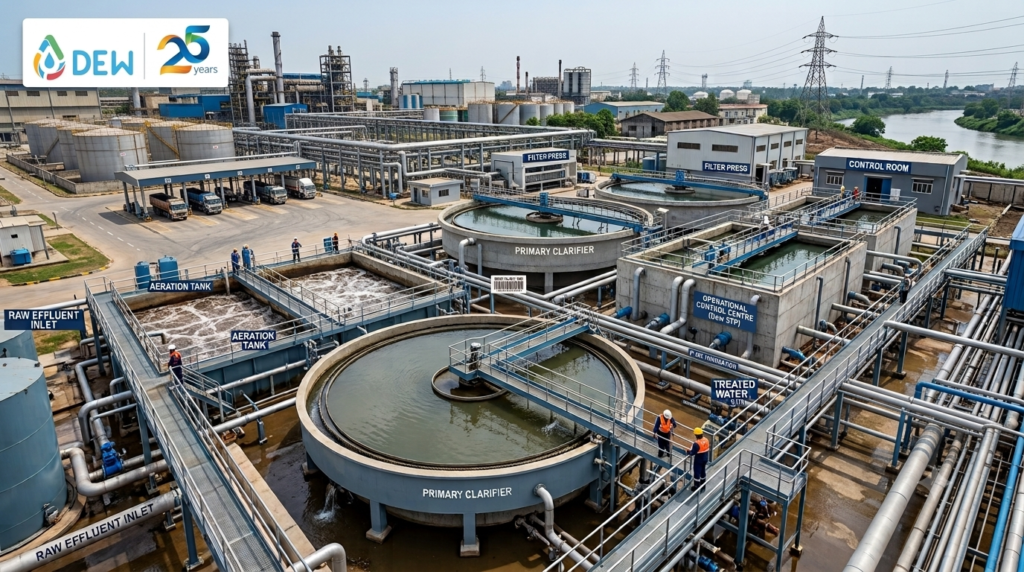
An Industrial Effluent Treatment Plant is the system that takes wastewater the rest of the way to a dischargeable or reusable standard — handling general process effluent, cleaning water, and utility discharge across the facility, not just the specialized pharma streams.
A typical pharma-facility ETP runs in four stages:
- Primary treatment — screening, equalization, and neutralization to absorb flow and pH swings
- Secondary (biological) treatment — organic load reduction, often using cultures suited to pharma-adjacent contaminants
- Tertiary treatment — filtration and membrane polishing to remove remaining solids and dissolved contaminants
- Sludge management — dewatering and disposal under hazardous waste rules, since pharma sludge often needs specialized handling
The design detail that matters most: decisions made upstream (like segregating high-strength solvent streams from general effluent) directly determine how much load the ETP has to absorb. Poor segregation is one of the most common reasons pharma ETPs underperform.
Does Wastewater Recycling Make Financial Sense for Pharma Plants?
Yes — for most pharma facilities, recycling treated water is now a cost-saving decision, not just a compliance or sustainability one. Three factors drive this:
- Water scarcity and cost. Many pharma manufacturing clusters sit in regions with inconsistent municipal supply, making on-site water security an operational necessity.
- Tightening discharge norms. Pollution control boards in several industrial clusters are moving toward stricter limits, and some pharma zones are approaching zero liquid discharge requirements.
- Treatment costs scale with volume. Every liter recycled is a liter that skips the full downstream treatment chain — a direct cost saving, not just an environmental one.
Wastewater recycling programs typically route treated water (often polished via reverse osmosis) to cooling tower makeup, utility water, washdown applications, and landscaping — matching treatment quality to end use rather than over-treating everything to the highest standard.
Why Plan Pharma Treatment, ETP, and Recycling Together?
Most facilities approach these as sequential projects: fix the ETP first, add pharma-specific treatment later, consider recycling as a later-stage sustainability initiative. In practice, this sequencing usually costs more over time than integrated planning from the start, for three reasons:
- Segregation decisions made early reduce load on every downstream stage — cutting chemical and energy costs across the specialized treatment, ETP, and recycling systems simultaneously.
- Recycling targets should shape treatment design, not be retrofitted afterward. If a facility knows recycled water needs to hit cooling-tower or boiler-feed quality, polishing systems can be sized correctly from day one.
- Regulatory direction is consistent: many jurisdictions are moving pharma clusters toward zero or near-zero liquid discharge, so recycling capacity built now avoids a costly retrofit later.
Frequently Asked Questions
What’s the difference between pharma wastewater treatment and a standard industrial ETP? Pharma wastewater treatment targets specific contaminants — API residues, antibiotics, solvents — that standard ETPs aren’t designed to handle. In practice, pharma facilities need both: specialized front-end treatment for high-strength streams, feeding into a broader ETP for general effluent.
Can recycled pharma wastewater be reused for sensitive applications like boiler feed? Yes, but it requires adequate polishing — typically reverse osmosis — to remove dissolved solids and residual trace compounds to the quality boiler feed water demands. Lower-grade applications like landscaping or washdown need less treatment.
How do zero liquid discharge requirements affect pharma facilities? Facilities in regions moving toward ZLD mandates benefit from building recycling and advanced treatment capacity proactively. Retrofitting an existing ETP to meet ZLD standards is typically far more expensive than designing for it upfront.
What’s the first step in upgrading pharma wastewater treatment? A thorough wastewater characterization study — covering standard parameters like COD and BOD as well as specific API and solvent residues — should precede any system design or upgrade decision.
Final Thoughts
For pharmaceutical manufacturers, water management is a direct reflection of how well a facility is engineered to handle regulatory complexity and variability. Treating pharma wastewater treatment, wastewater recycling, and the industrial effluent treatment plant as one integrated system — rather than three separate initiatives — consistently produces better compliance outcomes and lower long-term costs.
If your facility is evaluating pharma wastewater treatment upgrades, a recycling program, or ETP expansion, working with an experienced water treatment partner ensures the system is engineered around your actual process chemistry, not a generic template.