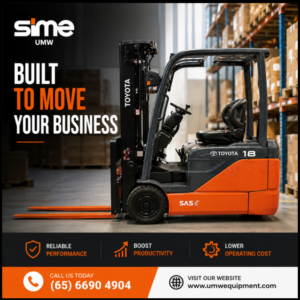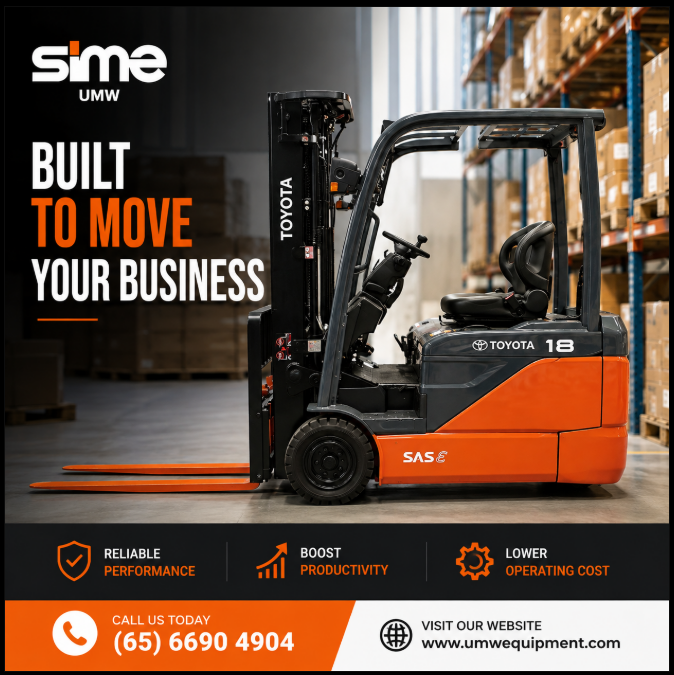
Toyota forkliff Singapore – Not every pallet movement requires a full-sized forklift. In many warehouses, retail backrooms, loading areas and distribution operations, the challenge is moving goods horizontally between locations without adding unnecessary complexity to the task. Choosing between a powered pallet truck, stacker and forklift begins with understanding whether the work involves transport at floor level, lifting into storage or handling loads at greater heights.
Understand the Main Difference
A powered pallet truck is primarily designed to move palletised loads horizontally. A stacker can transport and raise suitable loads to a stacking height, while a counterbalance forklift is designed for a broader range of lifting and loading applications within its rated capacity and operating conditions. The categories overlap in some workflows, but they are not interchangeable for every job.
Match the Equipment to the Movement
Frequent Short-Distance Transfers
A powered pallet truck may suit repeated pallet transfers over relatively short distances, such as moving goods from receiving to staging or replenishment areas. Consider travel distance, load weight, floor quality, pedestrian activity and how often the operator must stop and start. A compact unit may be useful in confined spaces, but dimensions and manoeuvring clearance still need to be checked.
Light Stacking and Raised Storage
A powered stacker may be appropriate when the task includes lifting pallets to selected rack or shelf levels. Buyers should verify lift height, rated capacity, pallet type, leg configuration and aisle clearance. The actual load and storage arrangement determine whether a particular stacker can perform the task safely.
Loading, Unloading and General Lifting
A counterbalance forklift may be more appropriate when loads must be lifted from the floor, moved around a yard or handled at loading bays. The selection depends on the working environment, surface conditions, load characteristics and the model’s specifications. Do not choose a larger truck automatically if a smaller handling tool can complete the task more efficiently.
Look at the Whole Workflow
Map where pallets enter the facility, where they are checked, where they are stored and how they reach dispatch. If a forklift spends much of its time moving light loads over short distances, the operation may benefit from assigning those tasks to equipment designed for horizontal transport. This can free larger trucks for lifting tasks that genuinely require them.
The objective is not to add more equipment without a plan. Too many truck types can increase training, charging, servicing and fleet-management complexity. Compare the productivity benefit with the cost of maintaining another unit, and make sure operators understand which equipment is approved for each task.
Safety and Operator Familiarisation Still Matter
Smaller equipment does not mean risk-free equipment. Loads can obstruct visibility, pedestrians can enter travel paths and uneven floors can affect stability. Establish clear routes, inspect equipment before use and train employees on the specific controls and limitations of the machine they operate.
For equipment that raises loads, confirm the rated capacity and operating instructions, and never use a pallet truck or stacker outside its intended purpose. Defective equipment should be reported and removed from service when required by workplace procedures.
Explore Available Material Handling Options
UMW Equipment & Engineering lists Toyota and BT powered pallet trucks and stackers for different material handling needs at https://toyota-mhe.simeumw.com/powered-pallet-stackers/. The available models vary in dimensions, capacity and intended application, so confirm specifications rather than assuming one model suits every facility.
Frequently Asked Questions
Can a powered pallet truck lift pallets onto high racks?
A standard powered pallet truck is generally intended for horizontal transport, not high-level stacking. If the task involves raising pallets into storage, assess a suitable stacker, reach truck or forklift instead.
Should every warehouse have both pallet trucks and forklifts?
Not necessarily. The ideal fleet depends on the tasks, movement volume, layout and budget. Analyse the workflow before deciding whether multiple equipment types add value.
Choose Equipment That Makes Every Movement Count
The right material handling equipment can help teams move goods with less unnecessary travel and a clearer division of tasks. If your business is comparing Toyota forklift Singapore options with powered pallet trucks or stackers, visit https://toyota-mhe.simeumw.com/home and explain the loads, distances, lifting heights and site constraints to the Sime UMW team. Make your next equipment decision around the task—not simply the size of the machine.