Psychiatry Conference 2026 Shortage Data and Best Events
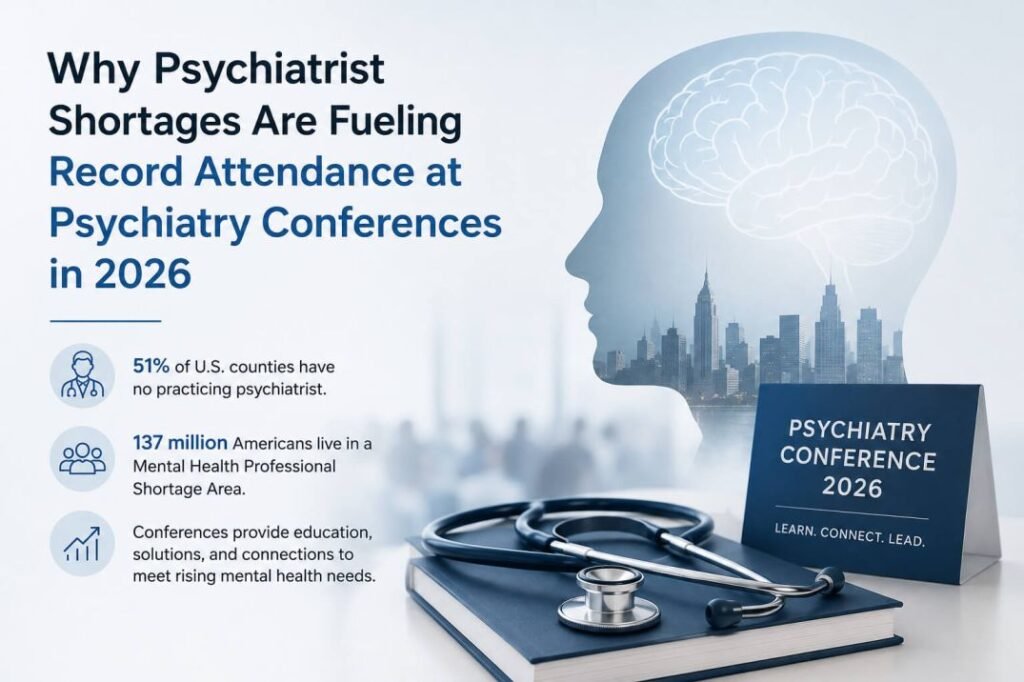
More than half of all U.S. counties — 51% — have no practicing psychiatrist at all, and roughly 137 million Americans now live in a federally designated Mental Health Professional Shortage Area. These are not projections or estimates from an advocacy group; they are verified figures from the Association of American Medical Colleges (AAMC) and the Health Resources and Services Administration (HRSA), and they explain a trend that is reshaping the psychiatric profession in real time: record numbers of clinicians are turning to a psychiatry conference 2026 to stay current, build referral networks, and find practical solutions to a workforce crisis that shows no sign of slowing down.
For decades, continuing medical education (CME) events were treated as a professional formality — a box to check for licensure renewal. That has changed. As the gap between psychiatric need and psychiatric supply widens year after year, conferences have become one of the few places where overstretched clinicians can access new treatment protocols, telepsychiatry frameworks, and collaborative-care models fast enough to keep pace with demand. This article breaks down the verified data behind the shortage, explains why it is driving record conference attendance in 2026, and shows where U.S.-based psychiatrists and mental health professionals can find the events worth prioritizing this year.
The Scale of the Psychiatrist Shortage in 2026
The numbers behind this crisis are stark and well documented. According to AAMC research on barriers to mental health care, more than half (51%) of counties in the United States have no practicing psychiatrists, and the gap is far worse outside major cities: 65% of nonmetropolitan counties had no practicing psychiatrist, compared with 27% of metropolitan counties. In some states, the picture is even more extreme — in Texas, for example, nearly three out of four counties (185 of 254) have no psychiatrist at all, according to reporting by NPR based on state workforce data.
HRSA’s most recent workforce modeling, published in its State of the Behavioral Health Workforce report, confirms the scale of the problem at a national level. As of December 2025, approximately 137 million Americans — about 40% of the U.S. population — lived in a designated Mental Health Professional Shortage Area (HPSA). Within those shortage areas, only about 27% of the actual need for care is being met. Looking ahead, HRSA’s baseline projections estimate the country will be short roughly 36,780 adult psychiatrists by 2038, a number that could climb as high as 86,430 under elevated-need scenarios that account for improving access to care rather than assuming today’s under-treatment rates continue.
To put that in perspective: the current psychiatrist-to-population ratio in the U.S. sits at roughly one provider for every 5,000 to 8,300 residents, depending on the methodology used, and demand for behavioral health services is projected to grow by 49% by 2033, while the supply of providers is expected to grow by only about 11% over the same period. That is not a shortage that stabilizes on its own — it is a gap that widens every year unless something changes in how psychiatrists are trained, distributed, and supported.
Where the Shortage Hits Hardest
State-level data makes clear that this crisis is not evenly distributed. Based on HRSA’s Designated HPSA Quarterly Summary, the states meeting the smallest share of their mental health workforce need include West Virginia (5.7%), Delaware (7.0%), Arizona (10.1%), Alaska (12.2%), North Carolina (12.5%), and Tennessee (13.3%). Rural counties bear a disproportionate share of the burden nationwide: roughly 60% of all Mental Health HPSA designations are in rural areas, and among the smallest rural counties (populations of roughly 2,500 to 20,000), close to three-fourths have no psychiatrist and 95% have no child psychiatrist, according to research from the WWAMI Rural Health Research Center.
This maldistribution matters for how the profession responds. A shortage concentrated in a handful of well-resourced urban centers would be a very different problem than a shortage that spans nearly every rural county in the country. Solving it requires psychiatrists in shortage areas to have access to the same level of ongoing education, peer consultation, and clinical innovation as their counterparts in well-served cities — which is precisely the gap that a well-run psychiatry conference is designed to close.
Why the Gap Keeps Widening
Several forces are compounding the shortage simultaneously, and understanding them helps explain why conferences have become more than a networking exercise — they’ve become a working solution.
Demand is rising faster than supply. Reported cases of anxiety and depression rose 9.3% and 10.6% respectively between 2025 and 2026, while stress and burnout-related visits rose 3.8% and trauma-related visits rose 7.1%, according to data reported by mental health platform Rula. At the same time, access to care has moved in the wrong direction: the share of U.S. adults who have accessed mental health services like talk therapy or psychiatry actually fell from 50% in 2025 to 47.4% in 2026, meaning that more than half of American adults have never accessed psychiatric or therapeutic care at all.
Training takes over a decade. Unlike psychologists, social workers, and licensed counselors, who can be trained and licensed in a matter of years, psychiatrists require a medical degree followed by a multi-year residency. Even with the number of psychiatry residency matches growing over the past five years, according to AAMC data, the pipeline cannot close a gap of this size quickly. That lag is a major reason clinicians are looking for faster ways to expand their own capacity and effectiveness — through better tools, sharper diagnostic frameworks, and collaborative-care models that extend a single psychiatrist’s reach across more patients.
Treatment complexity is increasing. An estimated 35% of people with depression do not respond adequately to two antidepressant trials, a condition known as treatment-resistant depression (TRD) that affects an estimated 2.8 million or more Americans in any given year, according to data compiled by Innerwell. Patients with TRD face a roughly seven-fold higher risk of a suicide attempt compared with those who respond to treatment. On a global scale, the World Health Organization estimates that depression and anxiety alone cause $1 trillion in lost productivity and 12 billion lost working days every year. These are not conditions a clinician can manage effectively with static, years-old training — they require ongoing exposure to the latest research on ketamine-assisted therapy, TMS, novel pharmacology, and psychedelic-assisted protocols, much of which is presented first at clinical conferences before it filters into standard practice guidelines.
New tools are entering the clinic faster than training programs can absorb them. Capital in 2026 has flowed heavily toward clinical infrastructure tools — AI scribes, documentation assistants, and psychiatry copilots — rather than consumer wellness apps, according to industry trend analysis from Nortex Psychiatry. Therapy adoption has also reached record highs, with 62% of Americans having consulted a mental health professional at some point in their lives, up from 48% just a year earlier. That combination — more patients seeking care, and more AI-assisted tools entering clinical workflows — means psychiatrists need a reliable, recurring venue to evaluate what’s genuinely useful versus what’s simply new.
How the Shortage Is Reshaping Professional Development
Put these pressures together and a clear pattern emerges: individual psychiatrists, especially those practicing in shortage areas or rural regions, are carrying more patients, more complexity, and more administrative burden than ever before, often without a nearby peer network to consult. A National Council for Mental Wellbeing survey found that 93% of behavioral health workers report burnout, with 62% describing it as severe, and nearly half saying current conditions are pushing them to consider leaving the field entirely.
This is exactly the environment in which conference attendance stops being optional. A well-designed psychiatry conference offers something a shortage-area clinician often cannot get locally: peer consultation on difficult cases, structured exposure to new treatment protocols, and direct access to researchers and specialists who are working on the exact problems — treatment-resistant depression, child and adolescent psychiatry gaps, telepsychiatry scaling — that are hitting shortage regions hardest. For psychiatrists managing caseloads that would have been split across three or four providers a decade ago, that kind of concentrated, verified clinical update is not a luxury; it’s a way to keep pace safely.
Virtual and hybrid CME formats have made this more accessible than ever. A psychiatrist in a rural West Virginia county meeting just 5.7% of local need doesn’t have to travel to a major metro area to access the same clinical updates as a colleague in Boston or San Francisco — they can join sessions remotely, which is part of why conference attendance figures have climbed even as in-person travel budgets at many practices have tightened.
Where to Find the Best Psychiatry Conferences 2026 USA
With demand for high-quality CME rising alongside the shortage itself, choosing the right event matters more than ever. Not every conference offers the same depth of clinical content, and in a year when treatment-resistant depression research, AI-assisted diagnostics, and workforce-expansion strategies are all moving quickly, psychiatrists need events that reflect the most current, evidence-based thinking — not recycled material from prior years.
For clinicians and researchers looking to stay ahead of these shifts, psychiatry conferences 2026 usa listings bring together upcoming events across the country covering exactly the topics driving this surge in attendance: workforce and access solutions, treatment-resistant depression and novel therapeutics, AI-assisted clinical tools, telepsychiatry scaling for shortage areas, and child and adolescent psychiatry — the specialty with one of the most severe projected gaps, given that 95% of the smallest rural counties have no child psychiatrist at all.
When evaluating which event to attend, U.S.-based psychiatrists should look for a few specific signals of quality:
- Verified CME accreditation that satisfies state licensing board requirements, since renewal deadlines vary and shortage-area clinicians often have less administrative support to track compliance.
- Sessions built around current clinical data, not general awareness content — treatment-resistant depression protocols, updated prescribing guidelines, and psychopharmacology updates carry more practical value than broad “state of mental health” overviews.
- Rural and telepsychiatry-focused tracks, given that the shortage is concentrated in nonmetropolitan counties where 65% have no local psychiatrist at all.
- Hybrid or virtual attendance options, which matter disproportionately to solo practitioners and clinicians in shortage regions who cannot easily leave their caseload for multi-day travel.
- Networking structured around collaborative care, since expanding a single psychiatrist’s effective reach through supervision of nurse practitioners, physician assistants, and licensed counselors is one of the more realistic near-term responses to a shortage that cannot be solved through residency pipelines alone.
What a Psychiatry Conference in 2026 Actually Covers
Agendas at this year’s leading events reflect the pressures outlined above rather than generic professional development themes. Expect heavy representation of the following:
Workforce and access strategy. With HRSA projecting a psychiatrist shortfall of nearly 37,000 by 2038 under baseline assumptions — and potentially more than double that under elevated-need scenarios — sessions on collaborative care models, psychiatric nurse practitioner supervision, and integrated primary-care partnerships are drawing significant attendance. These models let a single psychiatrist safely extend oversight across a larger patient population, which is one of the few scalable near-term responses to a shortage that residency pipelines alone cannot fix within a decade.
Treatment-resistant depression and novel therapeutics. Given that TRD affects an estimated 2.8 million or more Americans annually and carries a roughly seven-fold higher suicide-attempt risk, updates on ketamine-assisted therapy, TMS protocol refinements, and emerging pharmacological options remain among the most heavily attended session tracks.
AI-assisted clinical tools. As investment shifts toward AI scribes and clinical documentation copilots rather than consumer-facing wellness apps, psychiatrists are using conferences to separate genuinely useful tools from unproven ones — evaluating accuracy, liability considerations, and integration into existing electronic health record systems before adopting anything into daily practice.
Rural and telepsychiatry scaling. With 65% of nonmetropolitan counties still lacking a practicing psychiatrist, sessions focused on telepsychiatry licensure across state lines, asynchronous consultation models, and hub-and-spoke staffing structures for shortage regions have become a permanent fixture rather than a niche addition.
The Ripple Effect: Why This Shortage Affects More Than Psychiatrists
It’s worth stepping back to note that the psychiatrist shortage doesn’t just strain the clinicians directly affected by it — it reshapes the entire behavioral health ecosystem around them. HRSA’s workforce modeling projects shortfalls that extend well beyond psychiatry: roughly 99,840 psychologists, 99,780 mental health counselors, and 77,050 addiction counselors are projected to be needed by 2038 alongside the psychiatrist gap. A 2024 survey by the National Conference of State Legislatures (NCSL) found that 43 out of 44 responding states reported a behavioral health workforce shortage of some kind, confirming that this is a near-universal problem rather than an issue confined to a handful of underserved regions.
The financial dimension compounds the clinical one. The American Psychological Association’s 2024 Practitioner Pulse Survey found that 82% of psychologists who left or avoided insurance panels cited insufficient reimbursement as the reason, while 62% cited administrative burden and 52% cited payment delays and clawbacks. When providers across the entire behavioral health spectrum are leaving insurance networks for financial reasons, psychiatrists — who are already the scarcest resource in the system — end up absorbing a disproportionate share of the patients left without care. That dynamic is a major reason psychiatric conferences increasingly feature practice-management and reimbursement-strategy sessions alongside purely clinical content; understanding how to sustain a practice financially has become inseparable from the ability to keep treating patients at all.
Wait times reflect this strain directly. The national average wait for behavioral health services sits at roughly 48 days, according to National Council for Mental Wellbeing data cited by HRSA, with rural areas and specialties like child and adolescent psychiatry typically waiting even longer. For families in the smallest rural counties, where roughly three-fourths have no psychiatrist and 95% have no child psychiatrist, a 48-day average likely understates the real wait, since it may reflect a drive of an hour or more just to reach the nearest available provider.
Practical Takeaways for Psychiatrists Navigating the Shortage
Given the scale of these numbers, individual clinicians understandably ask what they can realistically do about a systemic gap this large. A few evidence-informed strategies are emerging as practical responses, many of which are discussed in depth at current CME events:
- Build formal supervision relationships with psychiatric nurse practitioners and physician assistants. Collaborative-care and supervision models allow a single psychiatrist to safely extend oversight across a larger patient panel, which is one of the only near-term levers available given that residency training cannot scale quickly enough to close the gap on its own.
- Adopt telepsychiatry licensure across state lines where permitted. With 65% of nonmetropolitan counties lacking a psychiatrist, multi-state telepsychiatry arrangements are one of the most direct ways an individual clinician can reach shortage-area patients without relocating.
- Prioritize CME focused on high-acuity, high-prevalence conditions. Given that treatment-resistant depression alone affects an estimated 2.8 million Americans annually with a substantially elevated suicide risk, clinical updates on TRD protocols offer a disproportionately high return on a clinician’s limited CME time.
- Evaluate AI-assisted documentation tools carefully before adoption. As investment shifts toward AI scribes and clinical copilots, conferences are becoming the primary venue where psychiatrists can compare tools side by side and assess liability and accuracy before integrating them into practice.
- Track state-level reimbursement changes. With 82% of psychologists citing insufficient reimbursement as a reason for leaving insurance panels, staying current on payer policy — often covered in dedicated conference sessions — has become directly relevant to whether a practice can keep serving shortage-area patients at all.
Frequently Asked Questions
Why are so many U.S. counties without a psychiatrist? The core issue is a combination of a multi-year training pipeline, geographic maldistribution toward urban centers, and reimbursement rates that make rural and lower-income practice less financially viable. According to AAMC data, 51% of all U.S. counties have no practicing psychiatrist, with the gap far more severe in nonmetropolitan areas (65%) than in metropolitan ones (27%).
Is the psychiatrist shortage expected to improve? Not under current baseline projections. HRSA estimates a shortfall of roughly 36,780 adult psychiatrists by 2038, and demand for behavioral health services is projected to grow 49% by 2033 while workforce supply grows only about 11% over the same period — meaning the gap is expected to widen, not close, over the next decade.
Why is conference attendance rising alongside the shortage? Because clinicians in shortage areas often lack easy access to local peer consultation, updated treatment protocols, and emerging tools, conferences have become a practical way to extend clinical capacity and stay current without requiring additional years of training or a larger local workforce.
What should a psychiatrist look for in a 2026 conference? Verified CME accreditation, sessions grounded in current clinical data (rather than general awareness content), rural and telepsychiatry-focused programming, and hybrid attendance options that don’t require extended time away from an already stretched patient panel.
The Bottom Line
The data is unambiguous: the U.S. psychiatric workforce is not keeping pace with demand, and the gap is projected to widen for at least another decade. In that environment, ongoing clinical education is no longer a professional formality — it is one of the few practical levers individual clinicians have to extend their own capacity, adopt genuinely effective new tools, and stay connected to the latest evidence on the conditions driving the surge in demand, from treatment-resistant depression to youth mental health.
That is the underlying reason attendance at a psychiatry conference has climbed alongside the shortage statistics themselves rather than in spite of them. For psychiatrists, residents, psychiatric nurse practitioners, and researchers working to close this gap, choosing the right event — one grounded in verified clinical data rather than generic content — is becoming as important to patient outcomes as the individual treatment decisions made in the exam room.
Sources: Association of American Medical Colleges (AAMC), Exploring Barriers to Mental Health Care in the U.S.; Health Resources and Services Administration (HRSA), State of the Behavioral Health Workforce, 2025 and Designated HPSA Quarterly Summary; WWAMI Rural Health Research Center; NPR; Rula, State of Mental Health; Innerwell, Mental Health Statistics 2026; World Health Organization; National Council for Mental Wellbeing; Nortex Psychiatry.