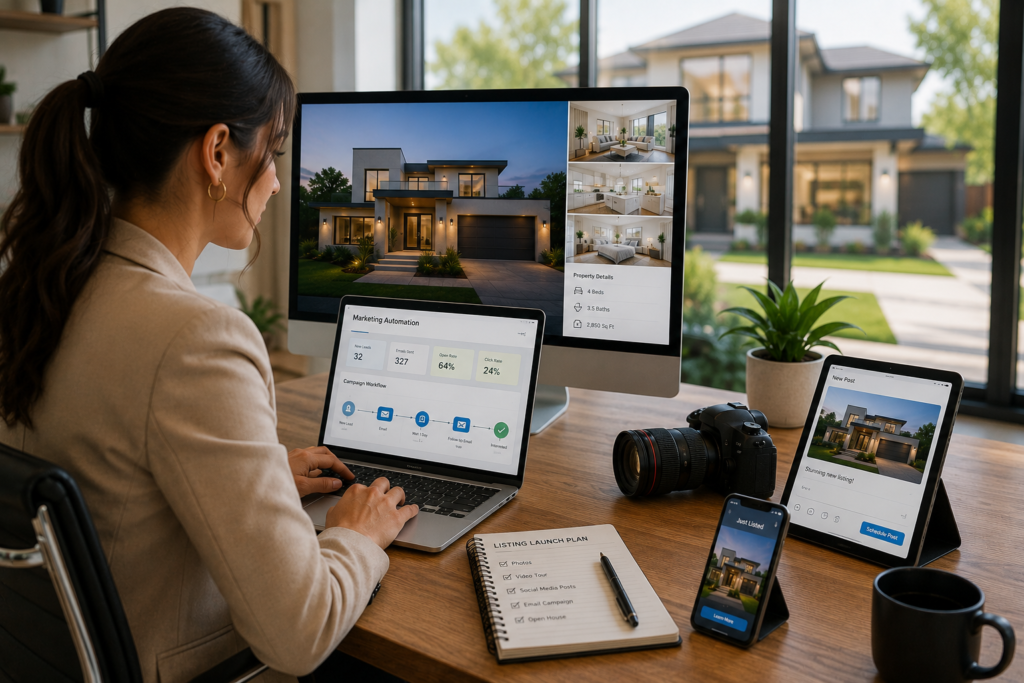
Real Estate Marketing Automation for Faster Listings
Real estate marketing involves far more than publishing a property listing. Once a home is ready for market, agents often need to prepare photographs, create social media content, produce videos, follow up with leads, communicate with sellers, and keep the property visible across multiple channels.
When these tasks are handled manually, even a single listing can consume hours of work.
This is why real estate marketing automation is becoming increasingly valuable. Automation allows Real Estate Agents to reduce repetitive work, maintain consistency, respond faster, and spend more time on activities that require personal attention.
The goal is not to remove the agent from the marketing process. It is to make the process more efficient.
What Is Real Estate Marketing Automation?
Real estate marketing automation uses software and technology to perform repetitive marketing tasks with limited manual involvement.
Instead of an agent remembering every follow-up, social media post, email, or marketing activity, an automated system can handle specific actions based on predefined workflows.
For example, a new property can trigger a series of marketing activities. Listing information can be organized, promotional content can be prepared, leads can receive follow-up messages, and campaign performance can be tracked.
The agent remains in control, but the technology handles repetitive execution.
This becomes particularly useful when an agent is managing multiple properties at the same time.
Why Manual Marketing Becomes Difficult
Real Estate Agents already have demanding schedules.
A typical day can include property showings, listing appointments, phone calls, negotiations, paperwork, client meetings, and lead follow-up. Adding hours of manual marketing production to that schedule can quickly become overwhelming.
The problem is rarely a lack of marketing ideas.
The problem is consistency.
An agent may intend to post about every new listing, send follow-up emails, create videos, and promote properties on social media. But when several transactions are happening at once, some of those activities can easily be delayed or forgotten.
Automation provides a system that keeps important marketing tasks moving even when the agent is busy.
Faster Listing Promotion
Speed matters when bringing a property to market.
Sellers expect their homes to be promoted quickly, and buyers want to see new inventory as soon as possible.
A manual workflow can create delays between receiving property photos and launching the marketing campaign.
Automation can shorten that gap.
Once the necessary property information and visual assets are ready, predefined workflows can help move the listing through different marketing stages without requiring the agent to manually initiate every task.
This can make the launch process more predictable.
Instead of asking, “Did I remember to post the new listing?” the agent can rely on a workflow designed to handle that activity.
Property Photography Is Part of the Workflow
Property photography sits at the center of modern real estate marketing.
Buyers often encounter the photographs before they read the full listing description or contact the agent. That makes high-quality visual content essential.
However, photography can create several production tasks.
Images may need enhancement, resizing, organization, virtual staging, social media preparation, and additional formatting.
AI-powered real estate tools can help automate parts of this visual workflow.
Walktru, for example, is designed around helping agents turn property photos into professional listing content. Its AI-powered capabilities include photo enhancement, virtual staging, listing reels, and other visual marketing assets.
When these activities become part of a connected workflow, agents can spend less time moving files between different tools and more time focusing on the property itself.
Automation Can Improve Social Media Consistency
Social media can be an effective way to extend the reach of a property listing beyond traditional real estate portals.
The challenge is maintaining consistency.
An agent may publish a new listing announcement on Monday and then become too busy to create additional content for the rest of the week.
Automation can help establish a repeatable content process.
A property can be promoted when it launches, followed by additional posts highlighting different features, visual assets, neighbourhood information, or updates.
The agent can still review and personalize the content, but the system reduces the amount of repetitive scheduling work.
This allows agents to maintain a stronger online presence without constantly thinking about what to publish next.
Automated Lead Follow-Up Can Reduce Missed Opportunities
Marketing does not end when someone clicks on a listing.
The next step is follow-up.
A potential buyer may submit an inquiry, request more information, download a property brochure, or visit a listing page without immediately contacting the agent directly.
If that lead receives no response, the opportunity can disappear.
Automated follow-up can provide an immediate first touch while giving the agent time to take over the conversation.
A system might send a confirmation message, provide additional property information, and remind the agent to personally follow up.
The purpose is not to replace human communication.
It is to make sure the first opportunity for communication does not depend entirely on someone’s memory or availability.
Automation Helps Agents Repurpose Content
One property can generate a surprising amount of marketing content.
The original property photographs can become social media posts, listing reels, email graphics, website content, and digital advertisements.
The property description can be adapted into captions or promotional copy.
Floor plans can become educational or visual content.
Virtual staging images can demonstrate the potential of vacant rooms.
Without automation, agents may need to create each asset individually.
A smarter workflow allows existing property information to be reused across multiple channels.
This is where AI can become particularly useful. Instead of creating every piece of content from scratch, agents can use technology to transform existing assets into different formats and then review the results before publishing.
Better Seller Communication Through Automation
Sellers want to know what is happening with their property.
They may want updates about marketing activity, online exposure, inquiries, showings, and other developments.
Providing these updates manually can become another administrative responsibility for agents.
Automation can help organize parts of the communication process.
For example, a system can remind an agent when it is time to provide a seller update or help generate a summary of recent marketing activity.
The agent can then review the information and communicate personally with the seller.
This creates a more consistent experience without making communication feel completely automated.
Automation Can Help Small Teams Compete
Large brokerages may have dedicated marketing teams.
They may have photographers, designers, social media managers, content specialists, and marketing coordinators supporting their agents.
Independent agents do not always have those resources.
Automation can help smaller teams operate more efficiently by reducing the amount of manual work required to execute a marketing plan.
A single agent can use technology to prepare visual content, schedule promotional activities, organize leads, and maintain follow-up without personally completing every repetitive task.
This does not eliminate the need for a marketing strategy.
It makes the strategy easier to execute.
AI and Automation Work Better Together
Automation determines what happens and when.
AI can help determine how content is created or adapted.
Combining the two can create a more efficient real estate marketing workflow.
For example, a new listing can enter a marketing workflow. AI can help enhance the property’s photographs, create variations of visual content, prepare a listing reel, or assist with promotional copy. Automation can then help distribute those assets through the appropriate channels.
The agent remains responsible for reviewing the content and approving what goes live.
This combination can reduce production time while maintaining human oversight.
Automation Does Not Mean Less Personalization
Some agents worry that automation will make their marketing feel generic.
That only happens when automation is used without strategy.
A well-designed workflow can actually create more opportunities for personalization.
Buyers can receive information based on the property they showed interest in. Sellers can receive updates relevant to their listing. Past clients can receive different communications from new leads.
Automation can handle the timing and organization while the agent controls the message and relationship.
The goal is to make communication more relevant, not less personal.
Choosing What to Automate First
Agents do not need to automate their entire business immediately.
A better approach is to identify the tasks that are repetitive, predictable, and time-consuming.
Listing promotion is a good starting point because the process is repeated every time a property launches.
Social media scheduling is another opportunity because consistency is important but manual posting can consume significant time.
Lead follow-up can also benefit from automation because speed matters when a potential buyer or seller makes an inquiry.
Visual content production is another area where AI-powered tools can reduce repetitive work.
Start with the tasks that consume the most time and provide the least strategic value.
Keep Human Review in the Workflow
Automation should never mean publishing everything without review.
Property information needs to be accurate. Photographs should represent the property honestly. Virtual staging should be disclosed appropriately. AI-generated copy should be checked for incorrect details.
Human review remains essential.
Real Estate Agents understand the property, the seller’s expectations, the local market, and the audience better than an automated system.
Technology should support that expertise rather than override it.
The most effective workflow combines automation with human judgment.
Measuring the Impact of Automation
Automation is only valuable if it improves the business.
Agents should look at practical outcomes rather than simply counting how many tasks have been automated.
Are listings being launched faster?
Are leads receiving responses sooner?
Is social media activity more consistent?
Is the agent spending less time preparing marketing materials?
Are sellers receiving better communication?
Is marketing generating more inquiries or showings?
These questions help determine whether automation is actually improving the workflow.
The purpose of technology is not to automate for the sake of automation. It is to create measurable improvements in efficiency and marketing performance.
The Future of Real Estate Marketing Workflows
Real estate marketing is likely to become increasingly connected.
Instead of separate systems for photography, content creation, social media, lead management, and analytics, agents will increasingly expect these activities to work together.
AI will contribute to content creation and analysis, while automation will manage repetitive workflows and timing.
This can create a marketing environment where one property upload leads to a series of coordinated activities rather than a collection of disconnected manual tasks.
For Real Estate Agents, that means less time spent managing marketing operations and more time available for clients.
Final Thoughts
Real estate marketing automation can help agents move faster without sacrificing the personal side of the business.
From listing promotion and social media scheduling to lead follow-up and visual content production, automation can reduce repetitive work and create a more consistent marketing process.
AI adds another layer by helping agents create and adapt property content more efficiently.
Walktru fits into this shift by helping Real Estate Agents transform property photos into professional marketing assets through an AI-powered workflow.
The best real estate marketing system is not necessarily the one with the most automation. It is the one that removes the right repetitive tasks while keeping the agent firmly in control of strategy, accuracy, and client relationships.
When technology handles the repetitive work and agents focus on the human work, property marketing becomes faster, more consistent, and easier to manage.