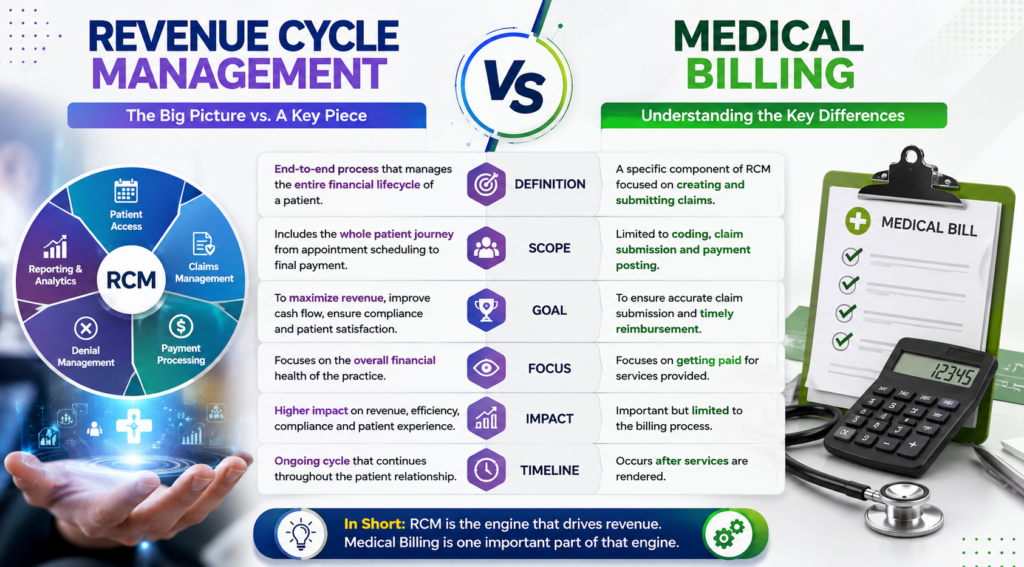
If you work in healthcare, you have probably heard these two terms used as if they mean the same thing. They don’t. Revenue cycle management is the full financial journey of a patient, starting from the first appointment call and ending when the balance is paid in full. Medical billing is just one piece of that journey, the part where claims are coded and sent to insurance companies for payment.
Understanding this difference matters more than it seems. Practices that confuse the two often end up with cash flow problems, denied claims, and frustrated staff. In this article, we will break down what each term really means, how they connect, and why the distinction is shaping conversations across the healthcare industry today.
What Is Revenue Cycle Management
Revenue cycle management, often shortened to RCM, covers every financial step tied to a patient visit. It starts before the patient even walks in and continues long after the appointment ends.
A typical revenue cycle includes:
- Patient scheduling and pre-registration
- Insurance eligibility verification
- Charge capture during the visit
- Medical coding
- Claims submission
- Payment posting
- Denial management
- Patient collections
Revenue cycle management is essentially the financial backbone of a healthcare practice. Without a strong process in place, even a clinic with excellent doctors can struggle to stay profitable.
What Is Medical Billing and How It Fits Into RCM
Medical billing is the process of translating a patient’s visit into a claim, then submitting that claim to an insurance payer for reimbursement. It relies heavily on accurate coding and clean documentation.
Think of medical billing as one department inside a much bigger building. That building is revenue cycle management. Billing cannot function well without accurate scheduling and coding upstream, and it cannot deliver full value without proper follow-up and collections downstream.
Many small practices treat billing as the entire financial operation. This is a common mistake. Billing alone does not address why claims get denied in the first place or why patients delay payments.
Revenue Cycle Management vs Medical Billing Key Differences
The easiest way to understand the difference is to look at scope. Medical billing is narrow and transactional. Revenue cycle management is broad and strategic.
Here is a simple comparison:
- Medical billing focuses on claim creation and submission
- Revenue cycle management covers the entire financial lifecycle of a patient
- Billing is reactive, dealing with claims after a visit happens
- RCM is proactive, addressing eligibility and documentation before a claim is even created
- Billing measures success by claims sent
- Revenue cycle management measures success by net collections and reduced denials
This is why healthcare organizations investing in revenue cycle management tend to see stronger, more predictable cash flow compared to those relying only on billing services.
Why Healthcare Providers Are Watching Revenue Cycle Management News
The healthcare finance space is changing quickly. Staying updated with revenue cycle management news has become important for practice owners, hospital administrators, and billing teams alike.
Recent industry conversations have centered around a few key shifts:
- Increased use of automation and AI in claims processing
- Growing payer scrutiny leading to more complex denial patterns
- Rising patient financial responsibility due to high-deductible health plans
- Greater emphasis on price transparency requirements
Practices that keep an eye on revenue cycle management news are better prepared to adjust their workflows before problems become costly. Ignoring these shifts often means playing catch-up after revenue has already been lost.
For example, a clinic that reacts early to new payer documentation rules avoids a wave of denials that a slower-moving competitor might face months later.
How Healthcare Revenue Cycle Management Companies Help Practices Grow
Handling revenue cycle management healthcare needs in-house can be overwhelming, especially for smaller practices. This is where healthcare revenue cycle management companies come in.
These companies typically offer:
- End-to-end billing and coding support
- Real-time eligibility verification
- Denial tracking and appeals management
- Reporting dashboards for financial visibility
- Compliance monitoring aligned with payer and government rules
The right partner does more than just send claims. A strong healthcare revenue cycle management company acts as an extension of your practice, identifying revenue leaks before they grow into larger problems.
Common mistakes practices make when choosing a partner include focusing only on price, ignoring reporting transparency, and not checking specialty-specific experience. Revenue cycle management for a cardiology practice looks very different from a dermatology clinic, and the right vendor should understand that.
If your practice is currently relying only on a billing service, it may be worth exploring whether a broader revenue cycle management approach could reduce denials and improve collections. It is not about replacing your team, it is about supporting it with the right processes and technology.
FAQs
Is medical billing the same as revenue cycle management?
No. Medical billing is one part of revenue cycle management, specifically the claims submission process. RCM includes billing along with scheduling, verification, and collections.
Why does revenue cycle management matter for small practices?
It directly affects cash flow. Practices with strong RCM processes see fewer denials and faster payments compared to those relying only on basic billing.
What role does revenue cycle management news play in daily operations?
Staying informed about industry shifts helps practices adapt early, avoiding denial spikes caused by new payer rules or compliance changes.
How do healthcare revenue cycle management companies add value?
They bring specialized tools, denial management expertise, and reporting systems that most in-house teams cannot easily build on their own.
Can revenue cycle management healthcare processes reduce claim denials?
Yes. By verifying eligibility and improving documentation before claims are submitted, RCM significantly lowers the chances of denials compared to billing alone.