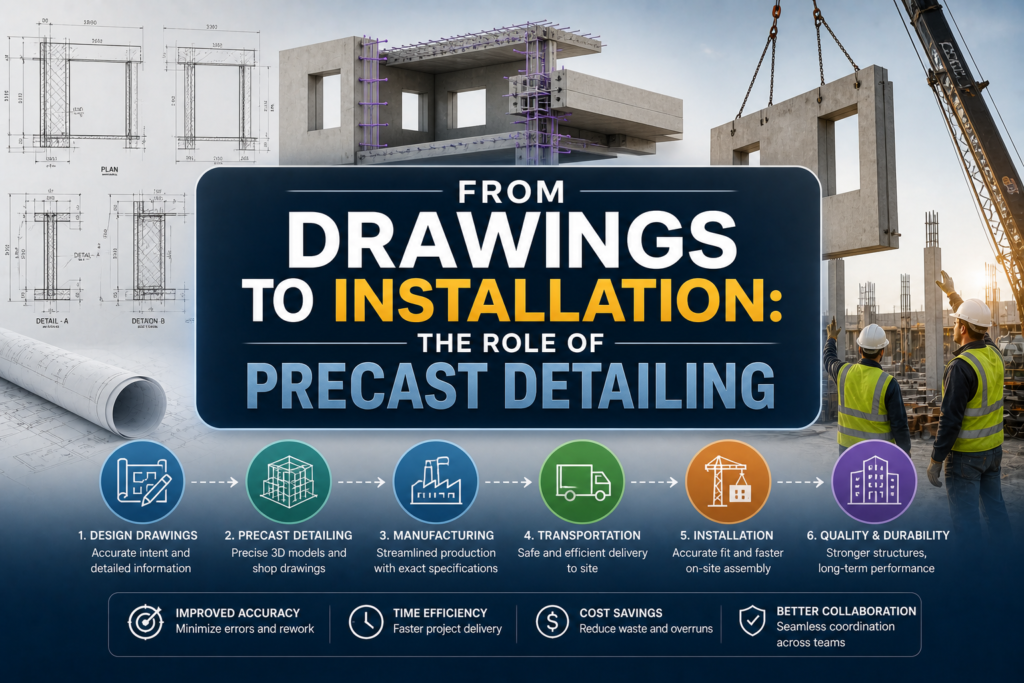
Nowadays, in construction, buildings are not built only on site. Many parts are made in factories and then taken to the construction site. These parts are called concrete elements. They include walls, beams, slabs, stairs and columns.
Precast detailing is a step which connects the building design with construction. Without precast detailing, precast parts would not fit properly which makes installation slow and causes more mistakes. Precast detailing ensures that all precast parts are made correctly.
Understanding Precast Detailing
Precast detailing is the process of making drawings and instructions for precast concrete parts. These parts are made in a factory before being sent to the construction site. Precast detailing shows how each piece of concrete should be created, shaped and connected to other pieces. These drawings include the following:
- Exact measurements of each piece
- Details about steel reinforcement
- Connection points where pieces connect
- Lifting points for cranes to pick up the pieces
- Instructions on how to install each piece
Role of Precast Detailing in Different Stages
Design Stage
Every building project begins with an idea. Architects create drawings of the building. These drawings show what the building will look like, how many floors it will have and how the spaces will be arranged. At this stage, precast detailing plays a big role and starts working in the background. Detailers review the design drawings and check all details carefully.
- Which parts can be made as precast elements
- What sizes will work best for transportation
- Where joints and connections will be needed
For instance, a big wall is divided into smaller panels. If a staircase is needed, detailers plan it in parts so a crane can lift it easily. At this stage, a common problem is cost uncertainty because builders do not know the exact budget impact. To solve this issue, contractors get help by hiring professional cost estimating services. They calculate the real project costs early by estimating materials, labour and production expenses. This prevents problems later like budget overruns or material shortages.
Engineering Stage
After the design is completed, structural engineers ensure that the building is strong. They double-check the loads, weight and safety factors to make sure everything is okay. Now the precast detailing part becomes really important. Estimators work with the engineers to add the following:
- Steel reinforcement inside each part
- Load-bearing details
- Connection points between parts of the building
At this stage, problems can come up such as the design becoming too expensive to build. But you can solve this problem by working with a construction estimating company to help you keep the design and materials within budget. They suggest ways to save money so you can avoid expensive changes or waste later in a building construction project.
Detailing Stage
This stage is really crucial for precast detailing. Detailers made shop drawings and these drawings are used in factories. These drawings have:
- Exact length, width and thickness of each part
- Steel bar sizes and spacing
- Embedded plates are for connections
- Lifting hooks for cranes to use
- Tolerance levels
For example, a drawing of a precast wall panel will show exactly where windows go, where steel bars are placed and how it connects to the floor slab.
Factories need these drawings to build things. If there is a mistake, a part will not fit when they get to the site. This is the part where precast detailing is like a guide that tells people how to build things. That is why many project owners hire expert precast detailing services to make sure the drawings are accurate and ready for construction without causing any problems.
Manufacturing Stage
When the shop drawings are approved, the precast elements are made in a factory. The workers use molds that are based on these drawings. The steel bars are placed exactly as they are shown in the detailing sheets. Then the concrete is poured into the molds. The precast detailing is very important here.
- It makes sure the steel is placed correctly.
- It shows where the lifting hooks must be fixed.
- It guides where the openings for doors and windows should be left.
For example, if a slab has a pipe that needs to come through it, the detailer marks the spot where the pipe will go. If this is not done, cutting the slab later will make it weaker. The precast detailing makes the factory production very accurate and controlled.
Transport Stage
After curing, precast parts are ready to move to the construction site. These parts are heavy so they need to be handled with care. Precast detailing also helps in this process. It provides:
- Lifting points for cranes
- Weight information for each precast element
- Safe handling instructions
- Balance points to avoid cracking during lifting
For instance, a long beam has to be lifted from the points. If it is lifted incorrectly, it might break. The precast detailing drawing prevents this kind of mistake from happening. So during transport, precast detailing makes sure that every precast element is handled safely and protected.
Installation Stage
This is the final and really important step. Precast elements are installed on the construction site using cranes. Everything is already planned in precast detailing so installation is fast and easy. Workers follow drawings that show:
- Exact position of each precast element
- How to connect them using bolts, welds, grout joints
- Alignment levels and spacing
- The order of installation
For example, wall panels are put in place first then slabs are fixed on top of them. Each piece fits together like a puzzle. If precast detailing is done correctly then:
- No cutting is needed on-site
- There is no confusion among workers
- Little rework is needed
This saves time, money and labour effort. Precast detailing helps to make the installation stage smooth and efficient. It also helps to ensure that everything is done correctly.
Conclusion
From the design idea to the final installation, precast detailing works behind the scenes. It helps with:
- Converting design drawings into real parts
- Making structures strong and safe
- Guiding production in the factory
- Ensuring safe transportation
- Speeding up installation on site
Without precast detailing, precast construction would not work properly. Parts would not fit together, delays would happen and costs would go up. The role of precast detailing is as a bridge between paper drawings and real buildings. Precast detailing makes sure each piece is made correctly, moved safely and installed perfectly.