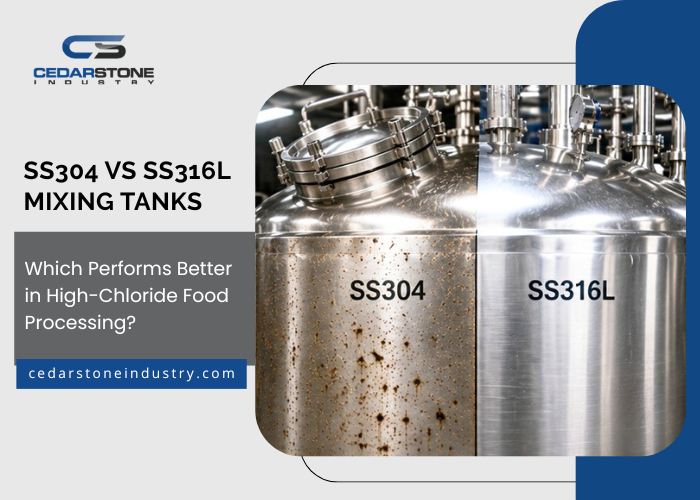
High-chloride food products push processing equipment to its limits. Salt-heavy sauces, brines, and citrus-based formulations can quietly damage tanks that are not engineered for the job.
Many facilities start with standard stainless steel, only to face premature corrosion, product contamination risks, and unexpected downtime.
So, the real question is not whether stainless steel works. It is which grade performs reliably under these conditions. That is where the comparison between SS304 and SS316L becomes critical, and where engineering experience makes all the difference.
Why Chloride Environments Change Everything
Chlorides are one of the most aggressive elements in food processing.
They attack the passive oxide layer that protects stainless steel. Once that layer breaks down, localized corrosion begins. This often shows up as pitting, which can penetrate deep into the metal while remaining difficult to detect early.
From an engineering standpoint, chloride concentration, temperature, and exposure time all influence failure rates. A tank that performs well in low-salt applications may degrade quickly in high-salt or acidic environments.
That is why material selection cannot be based on general assumptions.
SS304 vs SS316L: The Real Difference
SS304 is widely used because it is cost-effective and performs well in mild environments. It handles standard food products without issue.
However, it lacks molybdenum, which is the key element that improves resistance to chloride-induced corrosion.
SS316L includes molybdenum, typically around 2 to 3 percent. This significantly enhances pitting resistance and overall durability in aggressive conditions.
In practical terms, Cedarstone engineers often recommend SS316L for:
- Brine solutions with high salt concentration
- Soy-based or fermented sauces
- Citrus processing with low pH levels
- Applications involving frequent washdowns with chlorinated water
In these cases, SS304 may show early signs of pitting, while SS316L maintains structural integrity over a much longer period.
Pitting Resistance Is Not Optional
Pitting corrosion is one of the most common failure modes in food-grade tanks.
The challenge is that it starts small. Tiny pits form on the surface and gradually deepen. Over time, they compromise the tank wall and create sanitation risks.
From a design perspective, preventing pitting is far more effective than trying to manage it later.
SS316L stainless steel mixing tank offers higher resistance due to its chemical composition. But Cedarstone also evaluates:
- Weld quality
- Heat-affected zones
- Surface treatment after fabrication
Because poorly executed welds or rough surfaces can become starting points for corrosion, even with higher-grade materials.
Surface Finish: Where Engineering Meets Hygiene
Material grade alone is not enough. Surface finish plays a major role in both corrosion resistance and cleanability.
Food-grade tanks are typically finished to 32 Ra or smoother. This reduces microscopic crevices where residue and bacteria can accumulate.
For more demanding applications, electropolishing is often recommended. This process smooths the surface at a microscopic level and strengthens the passive layer.
Cedarstone designs often incorporate electropolished interiors for high-purity applications. This improves:
- Cleanability during CIP cycles
- Resistance to chemical attack
- Long-term surface stability
A smoother tank is not just easier to clean. It is also less likely to corrode.
Designed for CIP, Not Just Compatible With It
Many tanks are labeled as CIP-compatible. That does not always mean they are optimized for it.
Effective CIP performance depends on:
- Spray ball coverage and placement
- Flow dynamics inside the tank
- Proper drainage angles
- Elimination of dead zones
Cedarstone engineers design tanks with these factors in mind from the start. The goal is complete coverage during cleaning cycles without leaving residue behind.
In high-chloride environments, this becomes even more important. Residual salts combined with cleaning chemicals can accelerate corrosion if not fully removed.
So, proper CIP design directly supports both hygiene and material longevity.
Meeting FDA and 3-A Sanitary Standards
Compliance is not just about passing inspections. It is about building systems that consistently protect product quality.
Cedarstone mixing tanks are designed to meet FDA requirements for food contact surfaces. In addition, many systems follow 3-A sanitary design principles.
This includes:
- Smooth, crevice-free interiors
- Hygienic welds with proper finishing
- Self-draining geometries
- Minimal horizontal surfaces where residue can collect
These design elements reduce contamination risks and make cleaning more effective.
Real-World Performance Insights
In real production environments, the difference between SS304 and SS316L becomes clear over time.
For example, a facility producing high-salt sauces initially used SS304 stainless steel mixing tanks to reduce upfront costs. Within a few years, pitting corrosion appeared near weld seams and lower sections of the tank.
After switching to SS316L with improved surface finishing and optimized CIP design, the same operation saw a significant reduction in maintenance issues and downtime.
This is the kind of outcome that comes from combining the right material with proper engineering.
Cost vs Performance: A Practical Perspective
SS304 tanks are less expensive upfront. That makes them attractive for budget-driven projects.
However, when used in high-chloride applications, the long-term costs can outweigh the savings. Repairs, product loss, and downtime all add up.
SS316L, while more expensive initially, offers better durability and lower maintenance requirements.
From an engineering perspective, the focus should always be on total cost of ownership, not just initial investment.
Wrapping up
Choosing between SS304 and SS316L is not a simple material decision. It is an engineering decision based on process conditions, cleaning requirements, and long-term performance expectations.
For high-chloride food products, SS316L consistently delivers better resistance to pitting and corrosion. When combined with proper surface finishing, hygienic design, and optimized CIP systems, it provides a reliable and durable solution.
Cedarstone Industry approaches stainless steel mixing tank design with this complete picture in mind. The result is equipment that not only meets industry standards but performs reliably in demanding real-world conditions.