Most schools talk about “gifted” as if it were a single switch that is either on or off. A child either qualifies for the gifted program or does not. The reality is far more interesting, and far more useful for parents to understand.
Gifted children are not all alike. The gap between a child who is mildly ahead of their classmates and one who is reading chapter books at age four is enormous, and treating those two children the same way fails both of them. This is the idea at the heart of the five levels of gifted, a framework developed by Dr. Deborah Ruf, PhD, after years of testing and studying highly intelligent children and the families who raise them.
In this guide we will walk through all five levels, what sets each one apart, and how knowing your child’s level can completely change the way you advocate for them at home and at school.
Why “Gifted” Is Not One Thing
Picture a typical classroom of twenty eight children grouped by age. Schools tend to assume that the learning differences within that room are small. In practice the span is huge. Some children master the entire kindergarten curriculum before they ever set foot in school, while others are still building foundational skills.
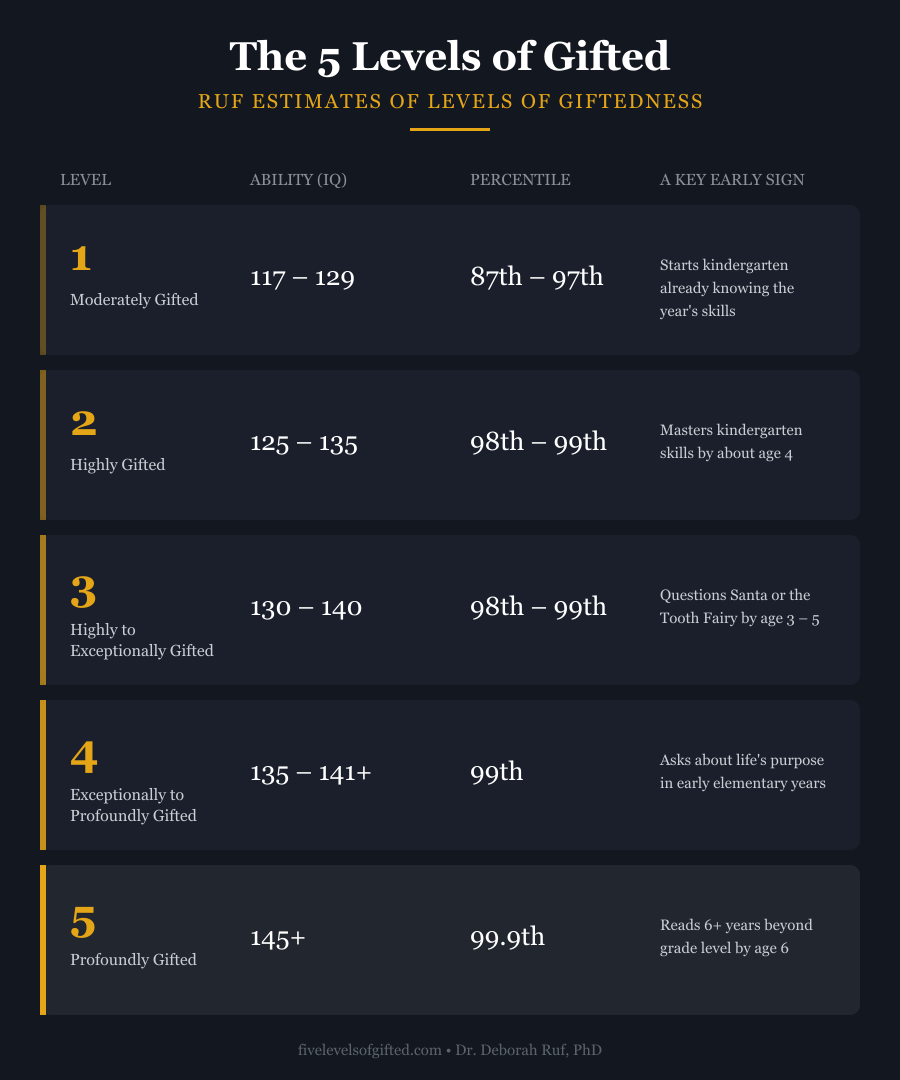
Dr. Ruf set out to map that span at the high end. The result is the Ruf Estimates of Levels of Giftedness, a system that sorts gifted ability into five distinct levels rather than one blunt label. Importantly, the levels are not decided by test scores alone. Personality, intrinsic motivation, inner drive, and the age at which a child hits early developmental milestones all play a part. Two children with the same IQ score can land in different levels because of the intensity and drive they bring to learning.
If you are still wondering whether your child counts as gifted at all, the Who Is Gifted? overview is a helpful place to start before reading on.
Level One Gifted
Level One is the most common form of giftedness, and the one most likely to fill a school’s gifted program simply because there are more of these children than any other level.
These children typically score around the 87th to 97th percentile on standardized tests, with ability scores in roughly the 117 to 129 range. They usually sit in the top quarter to top third of a mixed ability classroom. Many start kindergarten having already mastered the skills the year is meant to teach.
A few early signs parents often notice:
- Recognized colors and could rote count before age two
- Knew and said many words before eighteen months
- Read simple beginner books by about age six
- Showed impatience with repetition and slow pacing by age seven or eight
Level One children can comfortably go on to college and benefit from accelerated coursework. One quirk worth knowing: many of them do not actually meet a school’s strict cutoff for gifted services, even though they are clearly ahead of their peers.
Level Two Gifted
Level Two children mostly score in the 98th to 99th percentile, with ability scores around 125 to 135. In a typical classroom you might find one to three of them. These are the children who almost always qualify for gifted programs.
Many master most kindergarten skills a year or two before kindergarten even begins, often by age four. They tend to speak in full sentences early, pick out specific numbers and letters as toddlers, and read for pleasure by around age six.
Here is the catch for parents and teachers. Level Two children can do accelerated work almost from the day they enter school, but a number of them deliberately hold back. They may dial down their effort to fit in socially, or simply refuse work they have decided is pointless. Underachievement at this level is often a mismatch problem, not an ability problem.
Level Three Gifted
At Level Three you are looking at roughly the 98th to 99th percentile with ability scores around 130 to 140. These children are rarer, usually just one or two per grade level, and more common in schools serving highly educated communities.
The developmental markers start to feel striking:
- Many recognized colors, shapes, numbers and letters before twelve months
- Most knew the entire alphabet by seventeen to twenty four months
- Many questioned the reality of Santa Claus or the Tooth Fairy by age three to five
- Most read children’s chapter books by four and a quarter to five and a half years
A Level Three child is capable of achieving in essentially any career field. What ultimately shapes their path is opportunity and their own inner drive rather than raw ability.
Level Four Gifted
This is where standard testing starts to break down. Level Four children land primarily at the 99th percentile, but that number understates them. Their ability is qualitatively different from a Level Three child sitting at the same percentile, and conventional tests often cannot show the gap until the child takes an out of level test designed for older students.
In schools full of highly educated professional families, around two percent of students may be Level Four or higher. In a typical middle class elementary school you might not see a child this able every single year.
Many Level Four children could finish all academic coursework through eighth grade before reaching third or fourth grade, though very few ever get the chance. They often show concern for existential questions and life’s purpose by early elementary age, which can surprise parents who are not expecting deep philosophical conversations from a six year old. A good number of families turn to homeschooling to manage the mismatch between this child and an age based classroom.
Level Five Gifted
Level Five is the profoundly gifted range, and these children are genuinely rare, somewhere between one in 25,000 and one in 250,000. Almost certainly, none of them has ever shared a classroom with someone as intellectually able as they are.
The early timeline is remarkable:
- All spoke at near adult level complexity by age two
- All knew colors, numbers, the alphabet and shapes by about fifteen months
- All read children’s chapter books by three and a half to four and a half years
- All read six or more years beyond grade level by age six
What separates Level Five from Level Four is often the sheer degree of intensity and drive, not just the milestones themselves. These children tend to learn across every domain with a hunger that does not switch off, although a poorly matched school environment can temporarily mute it.
Why Knowing the Level Actually Matters
The point of the five levels is not to rank children or hand out bragging rights. It is to match each child with what they actually need.
When you understand how your child learns and how far ahead they really are, you can make better decisions about acceleration, enrichment, schooling options, and emotional support. Ignore those differences and you risk a bright, curious child quietly checking out, convinced that school has nothing for them. Dr. Ruf has written extensively about how the right fit between a child and their environment is the single biggest predictor of success, both academic and emotional.
If you want to put this into practice, start with the post on how to estimate how smart your child is using the free Ruf Estimates, then explore more parenting and education guidance on the Five Levels of Gifted blog.
Frequently Asked Questions
What are the five levels of gifted? They are Dr. Deborah Ruf’s framework for describing degrees of high ability, running from Level One (moderately gifted) up to Level Five (profoundly gifted). Each level reflects a different range of ability and a different pattern of early developmental milestones.
Is the level decided by IQ score alone? No. Test scores matter, but personality, motivation, inner drive, and the age at which a child hits early milestones all help determine the level. Two children with similar scores can sit in different levels.
My child does not qualify for the school gifted program. Could they still be gifted? Yes. Many Level One children do not meet a school’s strict cutoff even though they are clearly ahead of their peers. The Ruf Estimates of Levels of Giftedness can give you a fuller picture than a single school screening.
Where can I learn more about Dr. Ruf’s research? You can read about her work and books on the About page, which covers more than twenty five years of research into gifted children and adults.
Final Thoughts
Giftedness is a spectrum, not a stamp. Understanding the five levels of gifted gives you a far more accurate lens for seeing your own child, and a much stronger foundation for getting them the education and support that truly fits.
To go deeper, explore the full breakdown of each level in the Ruf Estimates of Levels of Giftedness, or browse more articles for parents on the Five Levels of Gifted blog.