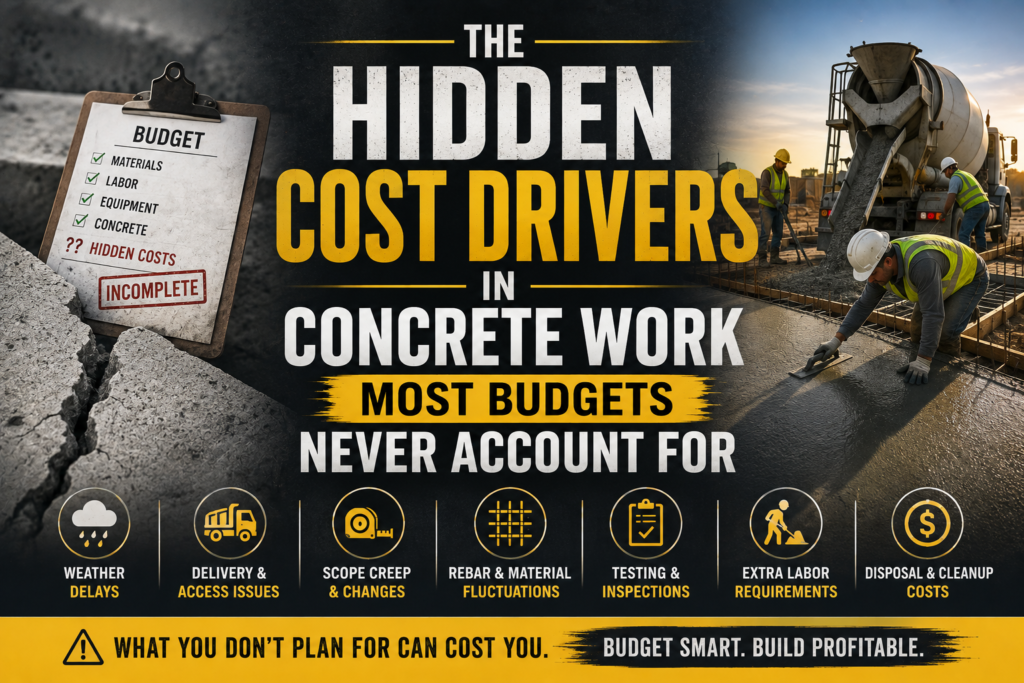
Concrete looks simple on paper. Pour the footings, form the walls, finish the slab, move on. But ask any contractor who’s actually managed a concrete-heavy job how often the final invoice matched the original number, and you’ll usually get a tired laugh instead of a straight answer. Concrete is one of the most cost-volatile parts of any build — not because the material is complicated, but because so much of what drives its price never makes it into a rough budget.
It’s Never Just “Concrete”
When people price out concrete work, the instinct is to think in cubic yards and call it done. But cubic yardage is only the starting point. The real cost lives in everything wrapped around that yardage — formwork labor, rebar placement, mix design, admixtures, waterproofing, and the site conditions that determine how fast (or slowly) a crew can actually pour.
Two slabs that look identical on a drawing can cost wildly different amounts depending on soil conditions, access for concrete trucks, weather windows, and whether the crew is fighting a tight schedule or has room to work efficiently. None of that shows up in a per-yard estimate pulled from a spreadsheet template.
Where the Budget Usually Breaks
Formwork is underpriced almost every time. Formwork isn’t a material line item — it’s a labor-intensive system, and the labor varies enormously depending on the method. Traditional job-built lumber forms cost differently than modular steel panels or aluminum systems for high-rise work. Estimators who default to a flat per-square-foot formwork rate, without accounting for the specific system a project actually needs, tend to miss the mark by a wide margin.
Reinforcement steel gets treated as an afterthought. Rebar isn’t just “add steel, add cost.” Bar size, spacing, lap splice requirements, and grade (40 versus 60) all shift the number meaningfully. On seismic-zone projects or anything with heavy structural loads, reinforcement can rival the concrete itself as a cost driver — yet it’s often estimated with a rough percentage instead of an actual quantity takeoff.
Mix design assumptions are stuck in the past. Standard 2,500 PSI residential mixes and 8,000+ PSI structural mixes are not interchangeable costs, and neither are the admixtures used to hit strength, workability, or durability targets. A budget built on a generic “concrete price per yard” ignores that spec-driven mix requirements can swing costs by a meaningful percentage.
Site conditions rarely get priced in early enough. Poor soil bearing capacity, high water tables, or restricted truck access all slow down pours and drive up labor hours. These are exactly the kind of variables that get discovered mid-project instead of during pre-bid planning — usually at the worst possible time.
Why Precision Here Actually Protects Your Margin
Concrete sits early in almost every construction schedule, which means an error here doesn’t stay contained — it ripples through every trade that follows. A miscalculated slab-on-grade or an underpriced foundation package can throw off sequencing, delay follow-on trades, and turn a tight schedule into a blown one.
This is part of why more contractors — especially those handling foundation-heavy or structurally complex projects — are leaning on specialists rather than estimating concrete scopes internally under deadline pressure. Detailed concrete estimating services typically break the work down by component (foundations, slabs, walls, columns, beams) and account for reinforcement steel, formwork systems, and mix specifications separately, instead of folding everything into a single blended rate. That level of detail is hard to replicate when concrete pricing is one small piece of a much larger, rushed pre-bid process.
What a Realistic Concrete Estimate Should Break Down
At minimum, a dependable concrete estimate should separate:
- Cubic yardage by component — foundations, slabs, walls, columns, and beams priced individually, not bundled
- Reinforcement steel quantities based on actual bar sizing and spacing, not a flat percentage
- Formwork system and labor, matched to the method the project actually requires
- Mix design and PSI requirements, tied to the specific structural or code demands of the job
- Site-specific adjustments for soil, access, and weather-related productivity loss
Skip any of these and the number isn’t really an estimate — it’s a placeholder that happens to have a dollar sign in front of it.
The Bottom Line
Concrete’s reputation as a “simple” scope of work is exactly what makes it dangerous to underprice. The material cost is the easy part. The labor, reinforcement, formwork systems, and site conditions wrapped around it are where budgets actually get made or broken — and where a rushed estimate quietly sets a project up to lose money before the first truck even shows up.
Get the breakdown right at the start, and everything downstream — schedule, cash flow, client trust — gets a lot easier to hold onto.