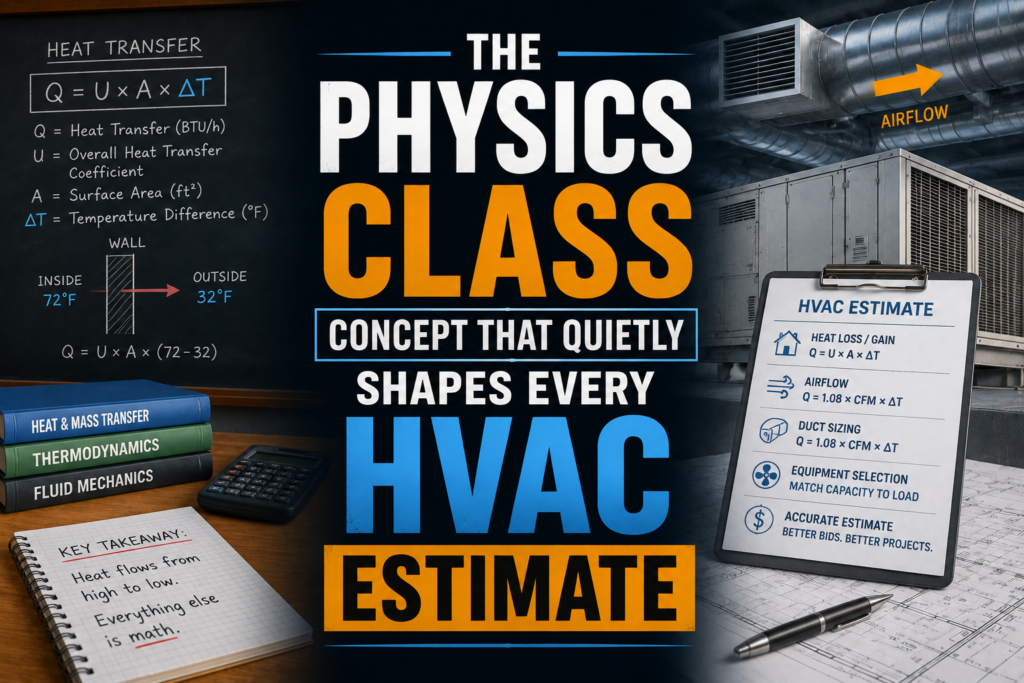
Most people haven’t thought about potential and kinetic energy since high school physics. Fair enough for most careers, it’s not exactly daily-use knowledge. But there’s one field where those two concepts never really stopped mattering: mechanical systems estimating. Every time someone sizes an HVAC unit, calculates a pump’s output, or figures out how much power a piece of equipment will draw, they’re leaning on the same basic energy principles from that old physics unit just applied to a real building instead of a textbook diagram.
Two Kinds of Energy, One Very Practical Use
Potential energy is energy stored because of position or state water held behind a dam, a charged battery, fuel sitting in a tank. Kinetic energy is the energy of motion that same water rushing through a turbine, a fan blade spinning, air moving through ductwork. Mechanical systems in a building are essentially a continuous conversion between the two: stored energy (electricity, fuel, pressure) becomes motion and output (airflow, water flow, rotation), and that conversion is what actually delivers heating, cooling, and water pressure to the people using the building.
It sounds abstract until you realize it’s the exact mechanism behind almost every piece of mechanical equipment in a construction project.
Why This Matters When Someone Is Sizing Equipment
Here’s where it gets practical. An HVAC unit that’s undersized for a space won’t have enough energy conversion capacity to keep up with heating or cooling demand; the building will feel perpetually behind, no matter how well everything else is installed. An oversized unit, on the other hand, wastes money both in upfront equipment cost and in ongoing energy consumption, and it can actually create comfort problems of its own (short-cycling, poor humidity control).
Getting equipment sizing right depends on understanding how much energy a system actually needs to convert to meet a given demand which is, fundamentally, an energy calculation before it’s ever a purchasing decision. The same logic applies to pumps and plumbing systems: sizing a pump wrong because the energy requirements weren’t properly calculated leads to either inadequate water pressure or unnecessarily high operating costs, both of which show up as complaints (or utility bills) long after the estimate is forgotten.
The Estimating Angle Nobody Talks About
This is the part that surprises people outside the trades: a mechanical estimator isn’t just counting units and pricing equipment off a catalog. A genuinely skilled mechanical estimator has to understand how energy behaves within a system well enough to predict equipment sizing, anticipate energy consumption, and flag when a design spec doesn’t actually match the physical demands of the building. Get that wrong at the estimating stage, and the error doesn’t stay theoretical; it becomes an equipment order, then an installation, then a building that’s uncomfortable or expensive to run for years afterward.
It’s also why maintenance and lifespan get factored into good mechanical estimates. Equipment under heavier continuous energy demand wears out faster, which means the estimate has to account for eventual repair and replacement costs, not just the initial installation price.
Where the Physics Actually Meets the Job Site
If you want a clear, non-technical breakdown of how these energy fundamentals connect directly to real-world equipment sizing and MEP cost estimating, there’s a solid explainer on what mechanical energy is and how it works that walks through the potential-versus-kinetic distinction and ties it directly to how estimators use that knowledge when pricing mechanical, electrical, and plumbing systems.
Why This Isn’t Just Trivia
It’s easy to assume the physics behind mechanical systems is background knowledge that doesn’t really affect the bottom line. In practice, it’s the opposite: every equipment sizing decision, every energy consumption projection, and every long-term maintenance estimate traces back to how well someone understands the energy conversion actually happening inside that system. The estimators who get this right tend to produce numbers that hold up in the real building, not just on paper.
Next time an HVAC quote or a pump specification lands on your desk, there’s a decent chance the number behind it started with the same energy concepts most people last saw on a whiteboard in tenth grade just applied to a very real, very expensive piece of equipment.