Micro switches play an important role in modern home appliances by providing accurate position detection, reliable switching operations, and essential safety functions. Although these components are small in size, they help ensure that household devices operate smoothly and efficiently. From detecting microwave oven door positions to monitoring washing machine lids and controlling refrigerator lighting, a suitable micro switch contributes to the overall performance and reliability of an appliance.
A home appliance micro switch is designed to respond to specific mechanical movements and convert them into electrical signals. Different appliances require different switching solutions depending on their operating mechanisms, electrical loads, installation dimensions, and environmental conditions.
Choosing the right micro switch involves understanding its operating mechanism, actuator design, contact configuration, and durability. This guide explores five common micro switch types for home appliances, their applications, and the important factors manufacturers should consider when selecting the right component.
What Is a Home Appliance Micro Switch?
A micro switch is a compact electromechanical switching device that operates when a small external force activates its actuator. Once the actuator reaches a specific operating point, the internal contacts change their electrical state, allowing the connected circuit to turn on or off.
These switches are widely used in household appliances because of their compact construction, precise operation, and ability to provide consistent switching performance.
Common applications include:
- Detecting refrigerator and freezer door positions.
- Monitoring washing machine lid and door status.
- Controlling microwave oven door interlocking systems.
- Detecting internal component movements in coffee machines.
- Monitoring ice maker mechanisms.
- Controlling movable parts in air purifiers and other household equipment.
The appropriate micro switch depends on the appliance’s mechanical structure, required switching function, and operating environment.
What Factors Should Be Considered When Selecting a Micro Switch?
Before selecting a micro switch for home appliances, manufacturers should evaluate several technical requirements. A switch that performs well in one application may not provide the same reliability in another.
1. Installation Dimensions and Mounting
The physical dimensions of a micro switch must match the available installation space. Its mounting holes, housing structure, and actuator position should align with the appliance’s mechanical design.
Compact appliances often require miniature micro switches that provide reliable performance without occupying excessive space.
2. Actuator Type and Operating Force
The actuator determines how external mechanical movement activates the switch. Common actuator designs include plunger, lever, roller lever, and pin plunger configurations.
Operating force should also match the movement of the appliance’s mechanical components. Excessive force may place unnecessary stress on plastic brackets, while insufficient force may result in unreliable switching.
3. Electrical Ratings and Contact Configuration
The electrical specifications must correspond to the connected circuit. Important parameters include:
- Rated voltage and current.
- Contact resistance.
- Electrical and mechanical life.
- SPST and SPDT contact configurations.
- Operating and release characteristics.
Selecting the correct contact configuration helps ensure proper integration with the appliance’s control system.
4. Environmental Protection
Some home appliances operate in environments exposed to moisture, condensation, dust, or elevated temperatures.
For these applications, manufacturers should consider sealed micro switches and verify their IP ratings, temperature limits, and environmental test results.
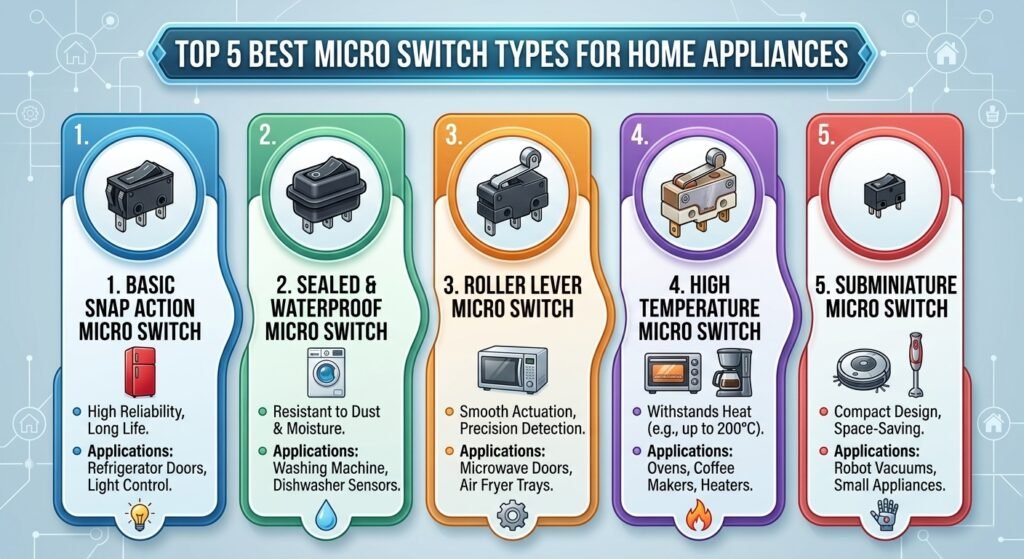
Top 5 Best Micro Switch Types for Home Appliances
Different household devices require different switching mechanisms. The following five types are commonly considered for home appliance projects.
1. Basic Micro Switches for General Position Detection
Basic micro switches are suitable for general position detection and electrical switching applications. Their quick contact operation makes them useful for detecting whether a mechanical component has reached a particular position.
These switches are commonly integrated into refrigerators, washing machines, coffee machines, and other household equipment.
Key Features:
- Compact and simple construction.
- Reliable electrical contact switching.
- Multiple actuator configurations.
- Available in different contact arrangements.
- Suitable for general-purpose applications.
Common Applications:
Basic micro switches are frequently used for refrigerator door detection, internal mechanism positioning, and status feedback in household appliances.
When selecting this type, manufacturers should evaluate operating force, actuator travel, contact configuration, and rated electrical load.
2. Sealed Micro Switches for Moisture-Prone Environments
Sealed micro switches are designed for applications where moisture, dust, and other environmental contaminants may affect normal switch operation.
They are particularly useful in washing machines, ice makers, coffee machines, and humidifiers. Their protective housing and sealing structures help reduce the possibility of contaminants entering the internal switching mechanism.
Key Features:
- Protective sealing construction.
- Improved resistance to environmental contaminants.
- Suitable for selected moisture-prone applications.
- Available with different actuator designs.
- Designed for dependable switching performance.
Common Applications:
Sealed micro switches can be used in washing machine mechanisms, ice maker assemblies, and coffee machine components exposed to condensation or water splashes.
Before selecting a product, manufacturers should verify the IP rating, temperature range, mounting position, and electrical specifications.
3. Door Interlock Switches for Appliance Safety
Door interlock switches are important components in appliances that require reliable door-status monitoring and safety-related switching functions.
Microwave ovens and washing machines are common examples. These switches help detect whether a door or lid has reached its required position and provide an electrical signal to the appliance’s control system.
Key Features:
- Designed for door-status detection.
- Available with different contact configurations.
- Supports appliance interlocking systems.
- Compatible with specific mechanical latch arrangements.
- Suitable for dedicated safety-related applications.
Common Applications:
In microwave ovens, door interlock switches are integrated with the door latch mechanism to monitor door position.
In washing machines, they help detect whether the door or lid is properly closed before the appliance begins its operating cycle.
For safety-critical applications, the complete interlocking system must be engineered and tested according to applicable appliance safety standards. A micro switch alone should not be treated as a complete safety system.
4. Plunger Micro Switches for Direct Linear Movement
Plunger micro switches are designed for applications where an external component applies direct pressure to a moving plunger.
Their straightforward actuation mechanism makes them suitable for equipment with predictable linear movement. When the moving component presses the plunger to its operating point, the switch changes its contact state.
Key Features:
- Direct pressure-based actuation.
- Compact mechanical construction.
- Suitable for linear movement detection.
- Available with different operating forces.
- Designed for precise position sensing.
Common Applications:
Plunger micro switches can be used in coffee machines, ice makers, refrigerator mechanisms, and other appliances with moving internal components.
When selecting this type, manufacturers should consider operating force, pre-travel, overtravel, mounting alignment, and the direction of applied mechanical force.
5. Compact Limit Switches for Travel-End Detection
Compact limit switches are suitable for detecting when a moving mechanical component reaches a defined position or travel endpoint.
Their integrated housing and actuator structure make them useful in appliances that contain movable mechanisms requiring accurate position feedback.
Key Features:
- Compact construction.
- Designed for position and travel-end detection.
- Multiple actuator options.
- Suitable for specific mechanical mounting arrangements.
- Reliable switching feedback when correctly installed.
Common Applications:
Compact limit switches can be used in electric drying racks, air purifiers, automatic appliance mechanisms, and other equipment with defined movement paths.
For simple position detection, a standard micro switch may be sufficient. A compact limit switch is more appropriate when the mechanical structure or travel-end detection requirements call for a dedicated configuration.
Which Micro Switch Is Best for Different Home Appliances?
Selecting the right micro switch becomes easier when its function is matched to the appliance’s mechanical requirements.
Micro Switch for Microwave Ovens
Microwave ovens commonly use micro switches for door position detection and interlocking systems. The switch works with the door latch mechanism to provide information about the door’s position.
Door interlock switches must be selected according to the required mechanical arrangement, electrical ratings, and appliance safety design.
Micro Switch for Washing Machines
Washing machines require switches for lid detection, door-status monitoring, and internal mechanism positioning.
Since these appliances experience vibration, moisture, and repeated mechanical operation, manufacturers should evaluate sealing requirements and mechanical durability.
Micro Switch for Coffee Machines and Ice Makers
Coffee machines and ice makers often have limited installation space and several moving internal components.
In coffee machines, switches may be positioned near removable covers, brewing assemblies, or mechanical transmission systems.
Ice makers use micro switches to detect the positions of moving components during water supply, ice production, and ice harvesting.
Temperature resistance, moisture protection, and actuator compatibility are important selection factors for these applications.
Micro Switch for Refrigerators
Refrigerators commonly use door switches to detect whether the door is open or closed. These switches can also control interior lighting and provide door-status feedback to the electronic control system.
Depending on the mechanical structure, a plunger or lever-style micro switch may be suitable.
How to Choose a Reliable Micro Switch Manufacturer?
For appliance manufacturers and product developers, selecting a dependable micro switch manufacturer is an important part of product development.
A reliable supplier should provide components that meet the required mechanical, electrical, and environmental specifications.
The following factors deserve attention:
- Product Quality: Consistent manufacturing quality and dependable switching performance.
- Customization: Availability of different actuator structures, terminal configurations, and mounting dimensions.
- Technical Support: Assistance with selecting suitable switches for specific appliance applications.
- Testing Capabilities: Mechanical life, electrical life, and environmental performance testing.
- Product Range: Availability of basic, sealed, miniature, and application-specific micro switches.
Manufacturers should also evaluate product datasheets, sample performance, and compatibility with the final appliance design before proceeding with mass production.
Conclusion
Choosing the right micro switch for home appliances requires a clear understanding of the device’s mechanical movement, switching function, electrical requirements, and operating environment. Hanxia provides reliable micro switch solutions designed to meet the diverse requirements of home appliance manufacturers, offering suitable options for different applications, including refrigerators, washing machines, microwave ovens, coffee machines, and ice makers.
For home appliance manufacturers, evaluating these factors during the product development and sampling stages can help improve switching reliability and overall appliance performance.
Unionwell provides micro switch solutions for different industrial and household appliance applications. By considering installation dimensions, actuator requirements, electrical loads, and environmental conditions, appliance manufacturers can identify suitable switching components for their projects.