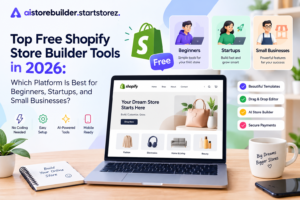
Starting an online store can feel difficult when you are new to ecommerce. You may think you need coding skills, design experience, a large budget, or a professional developer. However, modern ecommerce technology has made store creation much easier. Today, beginners, startups, and small businesses can use simple tools to create attractive online stores without spending months learning technical skills.
The biggest challenge is choosing the right platform. There are many ecommerce solutions available, and each one has different features, pricing options, design tools, AI capabilities, and customization choices. Some platforms are designed for beginners, while others are better for growing businesses that need advanced features.
A good free Shopify store builder can help beginners understand the basic process of creating an online store before investing heavily in a business. At the same time, AI-powered tools can reduce the time needed to create layouts, write product descriptions, organize content, and improve the appearance of a store.
Shopify itself now provides AI-powered store creation features that can generate store designs from a business description. Shopify also offers Shopify Magic, a collection of AI tools that can help with content, themes, media, and other store tasks.
In this guide, we will explore what to look for in a store builder, how AI is changing ecommerce website development, and which type of platform may be suitable for beginners, startups, and small businesses in 2026.
What Is a Shopify Store Builder?
A shopify store builder is a tool or platform that helps users create and customize an ecommerce store. Instead of developing every part of a website from scratch, users can work with themes, templates, visual editors, product sections, navigation tools, and other built-in features.
The purpose is simple: make ecommerce website development easier.
A modern store builder can help with several important tasks, including:
- Creating the main store layout
- Adding product pages
- Creating collections
- Designing navigation menus
- Customizing colors and fonts
- Adding images and videos
- Creating promotional sections
- Setting up important store pages
- Managing products and inventory
- Preparing the store for customers
This approach is especially useful for people who have a business idea but do not have technical development experience.
Shopify’s current website builder allows users to generate a site with AI or start from a theme, customize sections and navigation, add branding elements, and then add products and payment options.
Why Free Store Building Tools Are Popular in 2026
Starting a business always involves financial risk. Beginners may not want to spend a large amount of money on website development before knowing whether their idea will work.
Free tools, free trials, and low-cost store-building solutions give entrepreneurs an opportunity to test their ideas.
There are several reasons these tools are becoming popular:
Lower Starting Costs
A beginner can explore store design and ecommerce features without immediately paying a developer. This makes it easier to experiment with different ideas.
Faster Development
Traditional website development can take weeks or months. Modern visual and AI-assisted tools can reduce the amount of manual work required.
No Advanced Coding
Many platforms provide drag-and-drop editing, templates, and AI assistance. This means users can focus more on products and customers instead of technical development.
Easy Customization
Users can change fonts, colors, images, layouts, menus, and sections without rebuilding the entire website.
Better AI Support
AI is becoming an important part of ecommerce. It can help generate content, suggest designs, create product descriptions, and support everyday store management.
Shopify states that its Shopify Magic features are available at no additional cost across Shopify products, although specific features and availability can vary.
What Should You Look for in a Store Builder?
Not every platform is equally useful for every business. Before choosing a tool, consider the features that matter most to your project.
1. Ease of Use
The platform should have a clean interface. If you are a beginner, complicated menus and technical settings can slow you down.
Look for visual editing tools, clear instructions, ready-made templates, and simple product management.
2. Design Quality
Your store represents your brand. A professional design can help visitors feel more comfortable buying from you.
Look for responsive templates that work well on desktops, tablets, and mobile phones.
3. AI Features
An AI store builder can make the initial setup faster by helping with design and content. AI can be especially helpful for entrepreneurs who know what they want to sell but do not know how to turn their idea into a complete ecommerce website.
Good AI features may include:
- Store design generation
- Product description writing
- Image assistance
- Content suggestions
- Theme recommendations
- Marketing ideas
- Customer support assistance
4. Product Management
A store builder should make it easy to add products, prices, images, descriptions, variants, and inventory information.
If you plan to sell many products, strong product organization becomes even more important.
5. Mobile Responsiveness
A large number of shoppers use smartphones. Your store should therefore look professional on smaller screens.
Always preview your pages on mobile before launching.
6. Payment and Checkout Support
A beautiful website is not enough. Customers need a simple and reliable checkout experience.
Check which payment methods are supported in your target market before selecting a platform.
7. Scalability
Your first store may be small, but your business could grow quickly. Choose a platform that can support additional products, customers, sales channels, apps, and business requirements.
How AI Is Changing Store Creation
Artificial intelligence is changing the way websites are created. In the past, a beginner might need to choose a theme, edit every section manually, write product descriptions, find suitable images, and spend hours adjusting the layout.
AI can reduce some of this work.
An ai shopify store builder free solution can be useful for beginners who want to experiment with AI-assisted ecommerce development. Instead of beginning with an empty page, users can use AI to create a starting point and then customize the result.
AI should not completely replace human decision-making. Your business still needs a clear brand identity, useful products, accurate information, strong customer service, and a good marketing strategy.
Think of AI as an assistant rather than a replacement for your business knowledge.
Best Option for Beginners
Beginners usually need simplicity more than advanced functionality.
If you are building your first store, choose a platform that offers:
- Simple setup
- Visual editing
- Professional templates
- AI assistance
- Easy product management
- Mobile-friendly designs
- Clear pricing
- Helpful support
Shopify is widely designed around an all-in-one commerce experience. Its platform includes online store functionality, themes, products, checkout, payments, inventory, and additional ecommerce tools.
Shopify currently offers a free trial, but users need a paid plan to continue selling after the applicable trial period. Trial length and promotional offers can change, so beginners should always check the current terms before making a decision.
Best Option for Startups
Startups often need more than a simple website. They may want to test different products, build a recognizable brand, connect marketing tools, and grow their customer base.
For a startup, the most important factors are flexibility and scalability.
A startup should consider:
- How easy it is to add products
- Whether the platform supports multiple sales channels
- Whether useful apps or integrations are available
- How easily the design can be customized
- Whether the platform can support growth
- What the total operating cost will become after launch
A low-cost starting option can be attractive, but the cheapest platform is not always the best long-term choice. A slightly more capable platform may save time and development costs as the business grows.
Best Option for Small Businesses
Small businesses usually need a balance between price, simplicity, and professional functionality.
For example, a local clothing brand may need an online catalog, payment processing, product categories, promotional offers, and social media marketing. A small beauty business may need product pages, customer reviews, appointment-related features, and strong mobile design.
The best solution depends on the business model.
A small business should avoid paying for unnecessary features. At the same time, it should not choose a platform that becomes difficult to manage after the business starts receiving more orders.
Free vs Paid Store Builders
One important point is that “free” does not always mean completely free forever.
Some tools offer free design features, while the complete ecommerce service requires a subscription. Others provide free trials that allow users to build and test a store before selecting a paid plan.
Shopify’s current pricing information shows a free trial and promotional offers, followed by paid plans. The exact pricing and promotions can vary by billing method and location.
Before choosing a platform, check:
- Monthly subscription
- Transaction fees
- Payment processing fees
- Domain costs
- Premium themes
- App costs
- Marketing expenses
- Additional development costs
Understanding the total cost is more useful than looking only at the advertised starting price.
How to Build a Store With AI
Creating an ecommerce store with AI can be straightforward when you follow a clear process.
Step 1: Choose Your Business Idea
Decide what you want to sell and who your target customers are.
Step 2: Select Your Platform
Choose a platform that matches your budget, technical experience, and growth plans.
Step 3: Create the Basic Design
Use an AI tool or template to create the initial layout. Keep the design simple and focused on the customer.
Step 4: Add Products
Upload product images, names, prices, descriptions, variations, and other important information.
Step 5: Customize Your brand
Add your logo, colors, fonts, and brand messaging.
Step 6: Create Important Pages
Common pages include Home, Shop, About, Contact, Shipping, Returns, Privacy Policy, and Terms.
Step 7: Test Everything
Check your navigation, product pages, buttons, forms, images, mobile layout, and checkout process.
Step 8: Launch and Improve
Once the store is ready, launch it and monitor customer behavior. Use analytics and customer feedback to improve the experience.
Where aistorebuilder.startstorez Fits
For entrepreneurs interested in Shopify store building and web development, aistorebuilder.startstorez focuses on the idea of making online store creation easier through modern ecommerce and AI-assisted approaches.
The goal of an AI-based approach is not simply to make a website quickly. The real goal is to create a useful store that has a clear structure, professional appearance, strong product presentation, and an experience that customers can understand.
When choosing any tool, compare its features with your actual business needs rather than selecting a platform only because it uses the word “AI.”
Common Mistakes Beginners Should Avoid
Even with modern tools, beginners can make mistakes.
Too Many Design Elements
Adding too many animations, colors, popups, and sections can make a store confusing.
Weak Product Descriptions
AI can help create content, but always review it. Product information should be accurate and useful.
Ignoring Mobile Users
Always test your website on smartphones.
No Clear Navigation
Customers should quickly understand where to find products, categories, contact information, and important policies.
Choosing Based Only on Price
A cheap tool may become expensive if you need many paid add-ons later.
Launching Without Testing
Test the complete customer journey before sending visitors to your store.
Frequently Asked Questions
Is a free Shopify store builder good for beginners?
Yes. A free or trial-based tool can be useful for learning how ecommerce stores work. Beginners can experiment with layouts, products, and content before making larger investments.
Can I build a Shopify store without coding?
Yes. Shopify provides visual store-building tools, themes, and AI-powered features that can help users create and customize stores without traditional coding knowledge.
Is an AI store builder suitable for a small business?
Yes. AI can help small businesses save time when creating designs, product content, and other store materials. However, business owners should always review AI-generated content before publishing it.
Can AI create a complete ecommerce store?
AI can help generate important parts of a store, including design concepts and content. However, you still need to provide business information, products, pricing, policies, payment settings, and other details.
What is the difference between AI and traditional store builders?
Traditional builders usually require you to select and customize the design yourself. AI-powered tools can assist by generating starting designs and content based on instructions.
Is an ai shopify store builder free forever?
Not necessarily. Some AI features may be available for free, while the complete ecommerce platform may require a paid subscription. Always check the current pricing and feature limitations before launching a business. Shopify, for example, provides certain AI features at no additional cost while its overall commerce plans remain separate.
What is the most important feature for beginners?
Ease of use is usually one of the most important factors. A beginner-friendly platform should make it easy to create pages, add products, customize the design, and manage the store.
Final Thoughts
Choosing the right ecommerce platform in 2026 depends on your goals, budget, technical skills, and plans. Beginners should prioritize simplicity, startups should focus on flexibility and scalability, and small businesses should look for a balance between cost and useful features.
The best platform is not necessarily the one with the longest feature list. It is the one that helps you build, manage, and improve your store without creating unnecessary technical problems.
If you are exploring AI-powered ecommerce development, compare different tools, test their free options, and focus on the customer experience. A free dropshipping store builder can also be useful for entrepreneurs who want to test a dropshipping idea before investing more money into a complete ecommerce business.