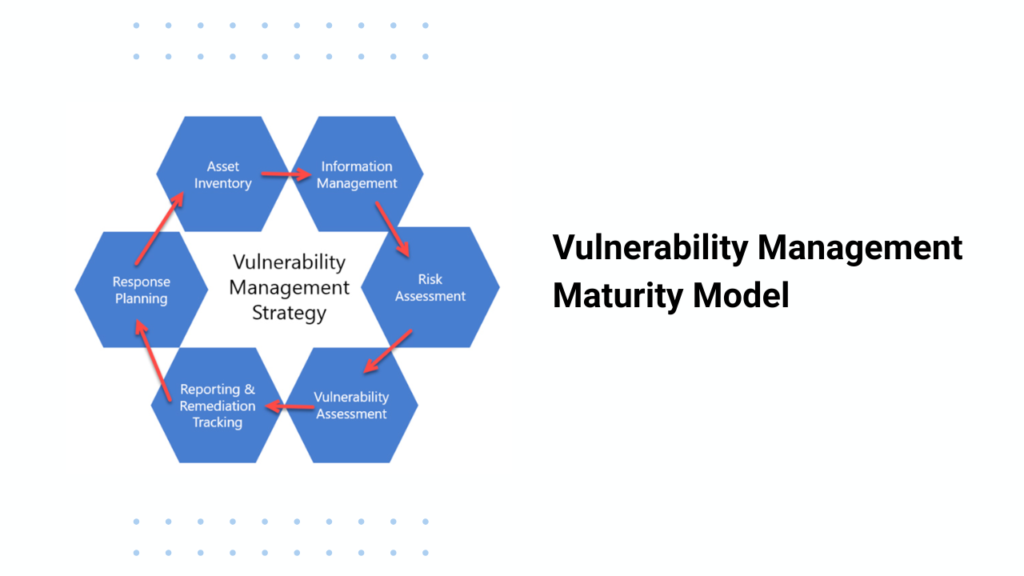
A vulnerability management program can start with a simple scan and a list of security issues. As an organization grows, that approach becomes harder to manage. Security teams need a clear way to measure how well they find, prioritize, fix, and verify vulnerabilities.
That’s where a Vulnerability Management Maturity Model helps. It gives organizations a way to assess their current security processes and decide what needs to improve next.
What is a Vulnerability Management Maturity Model?
A vulnerability management maturity model is a framework used to measure how mature an organization’s vulnerability management process is.
It looks beyond vulnerability scanning. A mature program connects asset discovery, vulnerability assessment, risk prioritization, remediation, verification, reporting, and continuous monitoring.
The model also helps security teams move from reactive patching to a repeatable process based on risk.
The 5 stages of vulnerability management maturity
Organizations can use different maturity frameworks, but most follow a similar progression.
1. Initial
Vulnerability management is mostly reactive. Teams run occasional scans, review security findings, and fix issues when they become urgent. Asset inventories may be incomplete, and there may be no consistent process for tracking remediation.
2. Developing
Regular vulnerability scans are in place, and security teams have started documenting findings. Basic ownership and remediation timelines exist, but processes may still depend heavily on manual work. High-risk vulnerabilities usually receive attention first.
3. Defined
The organization has documented vulnerability management policies and clear responsibilities. Assets are tracked more consistently, vulnerabilities are categorized by risk, and remediation deadlines are established. Reports also give management a clearer view of security exposure.
4. Managed
At this stage, vulnerability management is tied closely to business risk. Teams use threat intelligence, asset importance, exploit activity, and vulnerability severity when deciding what to fix first. Automated scanning and ticketing can reduce manual tracking, while regular metrics help teams measure progress.
5. Optimized
The highest maturity level focuses on continuous improvement. Security teams continuously monitor assets, detect new vulnerabilities, review remediation performance, and adjust their processes as threats change. Lessons from incidents and recurring weaknesses are used to improve security controls.
Why does maturity matter?
A vulnerability scanner can produce thousands of findings. The hard part is deciding which issues require immediate action.
A maturity model gives security teams a structured way to answer that question. It also helps organizations identify gaps between their current processes and the level of security they need.
For example, a small business may only need regular scanning, clear ownership, and defined patching deadlines. A large enterprise with thousands of assets may need automated discovery, risk-based prioritization, continuous monitoring, and detailed reporting.
How to measure your maturity level
Start by reviewing the main parts of your vulnerability management program.
Ask:
- Do you have an accurate inventory of assets?
- How often are systems scanned?
- How are vulnerabilities ranked?
- Who owns remediation?
- Are remediation deadlines defined?
- Do you verify that vulnerabilities were actually fixed?
- Can you measure remediation time?
- Do security reports show business risk clearly?
The answers can reveal where your current process sits on the maturity scale. You can also track practical metrics such as mean time to remediate, the number of overdue vulnerabilities, critical vulnerabilities remaining open, and the percentage of assets covered by vulnerability scans.
How to improve your maturity level
You don’t need to rebuild the entire program at once. Start with the biggest gap.
If asset visibility is poor, improve asset discovery first. If teams struggle with too many findings, introduce risk-based prioritization. If vulnerabilities remain open for months, establish ownership and remediation deadlines.
Automation can help once the basic process is clear. Vulnerability scanners, ticketing systems, asset management platforms, and security monitoring tools can connect different parts of the workflow.
The important part is consistency. A process that works every month is more useful than a complex system that only gets attention after a security incident.
Final thoughts
A vulnerability management maturity model gives security teams a practical way to understand where their program stands and what to work on next.
The goal isn’t to reach the highest maturity level as quickly as possible. It’s to build a vulnerability management process that fits the organization’s assets, risks, resources, and security requirements.