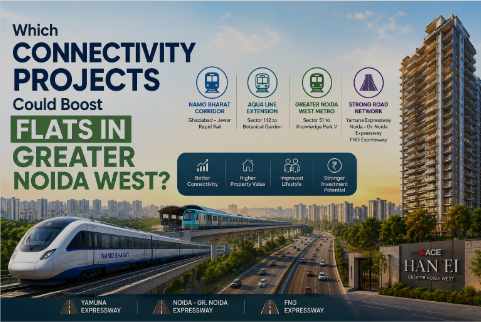
If you are comparing flats in Greater Noida West, connectivity is no longer just a location advantage. It is becoming one of the strongest factors shaping daily commutes, residential demand and long-term property potential. With major road corridors already supporting the locality and new rapid transit projects progressing through planning and execution, infrastructure growth could give Greater Noida West a stronger position within the wider NCR housing market.
Why Is Connectivity Becoming Important for Flats in Greater Noida West?
Greater Noida West has developed rapidly as a residential destination, but its next phase of growth will depend partly on how efficiently residents can travel between homes, workplaces, commercial centres and transport hubs.
The locality already benefits from access to the Yamuna Expressway, Noida-Greater Noida Expressway and FNG Expressway. The bigger opportunity lies in adding mass transit to this road network. Better public transport can reduce dependence on private vehicles while making residential neighbourhoods more accessible to a wider pool of homebuyers and tenants.
Market trends also point to an active housing market. The average multi-storey apartment rate in Greater Noida West is around ₹8,709 per sq ft, and the rate of 3 BHK is between ₹7,300 and ₹11,400 per sq ft, with the segment showing an 8% year-on-year indicator.
Which Connectivity Projects Could Boost Flats in Greater Noida West?
Three infrastructure developments deserve particular attention.
1. Ghaziabad-Jewar Namo Bharat Corridor
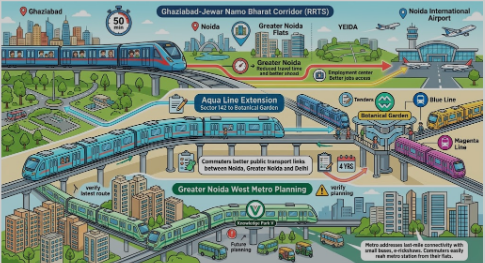
The proposed Ghaziabad-Jewar Namo Bharat corridor could become one of the most significant regional connectivity catalysts. As of July 2026, the 72.44 km corridor had moved to the Detailed Project Report stage. The proposed route is planned to connect Ghaziabad with Noida, Greater Noida, the YEIDA region and Noida International Airport, with 12 stations under the current plan.
For flats in Greater Noida West, the attraction is not only airport connectivity. A regional rapid transit system could improve access between residential areas and major employment and transport hubs. Recent reports suggest the corridor could eventually bring Ghaziabad and the airport into roughly a 40 to 50-minute travel window.
However, buyers should remain realistic. The project is still at the DPR stage, so its future benefits should not be treated as an immediate connectivity advantage.
2. Aqua Line Extension From Sector 142 To Botanical Garden
The Aqua Line extension is a more advanced infrastructure development. In February 2026, the Union Cabinet approved the 11.56 km Sector 142 to Botanical Garden corridor, comprising eight elevated stations and an estimated cost of ₹2,254.35 crore.
Its importance goes beyond Noida Expressway commuters. Botanical Garden is planned as an interchange between the Aqua Line and Delhi Metro’s Blue and Magenta lines. This could create a stronger public transport link between Noida, Greater Noida and Delhi.
The project has also moved beyond a conceptual proposal. NMRC issued tenders in 2026, with reports indicating an expected construction period of around four years.
- Greater Noida West Metro Planning
Greater Noida West is also included in wider metro expansion plans. NMRC lists the proposed Sector 51 to Knowledge Park V corridor at 17.435 km with 11 elevated stations. The project is intended to serve Noida, Greater Noida West and Greater Noida.
This is important because direct metro access could address one of the locality’s most discussed challenges: last-mile connectivity to the existing metro network.
The alignment has also been subject to changes as other rapid transit proposals have developed. Therefore, buyers should always verify the latest official route instead of relying solely on older property maps or promotional material.
How Could Road Connectivity Support Residential Demand?
Metro and rapid rail may attract the most attention, but roads remain essential for everyday travel. The Yamuna Expressway provides an important eastward connection towards Greater Noida and the airport region, while the Noida-Greater Noida Expressway links residential areas with employment, institutional and commercial destinations.
The FNG Expressway adds another strategic route towards Faridabad, Ghaziabad and other NCR locations.
This creates a useful advantage for flats in Greater Noida West because connectivity can be assessed according to the buyer’s actual destination. A location that works well for someone commuting towards Noida may offer different benefits from one chosen for regular travel towards Ghaziabad or the airport region.
Where Does ACE Han’ei Fit Into This Connectivity Story?
The ACE Han’ei project in Sector 12, Greater Noida West, fits naturally into this evolving infrastructure story. The project offers 3 and 4 BHK residences and is positioned around luxury living, spacious homes and connectivity.
For buyers comparing flats in Greater Noida West, ACE Han’ei’s location makes the surrounding road network particularly relevant. Access towards the Yamuna Expressway, Noida-Greater Noida Expressway and FNG Expressway can support different commuting requirements, while future transit improvements could strengthen the area’s wider accessibility.
The project also highlights features such as wrap-around balconies, Italian marble, modular kitchens, multiple high-speed elevators, a clubhouse, gym, yoga and Pilates facilities and a cycling track.
The important point is to evaluate ACE Han’ei on both present-day accessibility and the credibility of future infrastructure rather than treating proposed projects as guaranteed benefits.
ACE HAN’EI – RERA REG NO. UPRERAPRJ677887/10/2024 | www.up-rera.in/projects
Could Connectivity Push Property Prices Higher?
Connectivity can support appreciation, but it does not guarantee it. Infrastructure generally affects property markets in stages:
| Infrastructure Stage | Possible Residential Impact |
| Announcement and Planning | Higher Awareness and Future Expectations |
| Construction Progress | Greater Buyer Confidence and Investor Interest |
| Operational Connectivity | Better End-User Utility, Rental Appeal and Accessibility |
Greater Noida West is already experiencing residential price movement. The July 2026 market data indicates an average multi-storey apartment rate of ₹8,709 per sq ft, while 3 BHK rates have shown year-on-year growth.
Still, infrastructure is only one part of the equation. Project quality, supply, possession timelines, developer credibility and local demand can have an equally important influence.
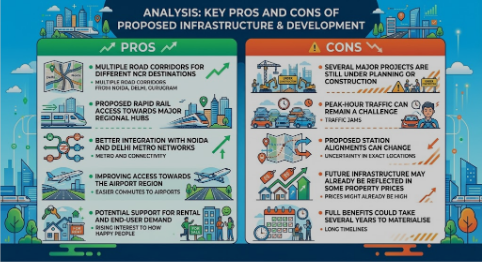
What Are the Pros and Cons for Homebuyers?
For flats in Greater Noida West, the main advantage is the possibility of benefiting from multiple connectivity upgrades instead of relying on one project.
What Should Buyers Check Before Buying Flats in Greater Noida West?
Do not select a property simply because a future metro or Namo Bharat station appears on a marketing map. Check current road access, peak-hour travel time, RERA details, construction progress, possession schedule and the latest official infrastructure alignment.
For flats in Greater Noida West, the stronger proposition is likely to be a property that offers practical connectivity today while having credible infrastructure opportunities for tomorrow.
Conclusion
Greater Noida West’s connectivity story is becoming increasingly diversified. The Yamuna Expressway, Noida-Greater Noida Expressway and FNG Expressway provide the existing road foundation, while the proposed Namo Bharat corridor and Aqua Line expansion could strengthen regional public transport.
For buyers of flats in Greater Noida West, connectivity should therefore be treated as part of a broader property decision rather than a standalone investment promise. Projects such as ACE Han’ei show how residential developments can be assessed against both current accessibility and the infrastructure network taking shape around them.
FAQs
Which metro line is planned for Greater Noida West?
NMRC lists the proposed Sector 51 to Knowledge Park V Aqua Line extension as a 17.435 km corridor with 11 elevated stations intended to serve Noida, Greater Noida West and Greater Noida.
What is the Namo Bharat route from Ghaziabad to Noida International Airport?
The proposed Ghaziabad-Jewar Namo Bharat corridor is planned to connect Ghaziabad with Noida, Greater Noida, the YEIDA region and Noida International Airport. As of July 2026, the project was at the DPR stage.
Will the Aqua Line connect Sector 142 with the Botanical Garden?
Yes. The approved 11.56 km corridor will connect Sector 142 with Botanical Garden through eight elevated stations and provide interchange access with the Blue and Magenta lines.
Is Greater Noida West well connected by road?
Greater Noida West has access to major corridors, including the Noida-Greater Noida Expressway, FNG Expressway and routes towards the Yamuna Expressway. Actual travel times depend on the destination and traffic conditions.
Is connectivity enough to decide which flat to buy?
No. Connectivity should be evaluated alongside RERA status, developer track record, construction quality, possession schedule, maintenance costs, amenities and the property’s exact location.
Why are property prices increasing in Greater Noida West?
Infrastructure development, residential demand, new launches and improving regional connectivity can support price growth. However, appreciation is not guaranteed and can vary considerably between sectors and projects.