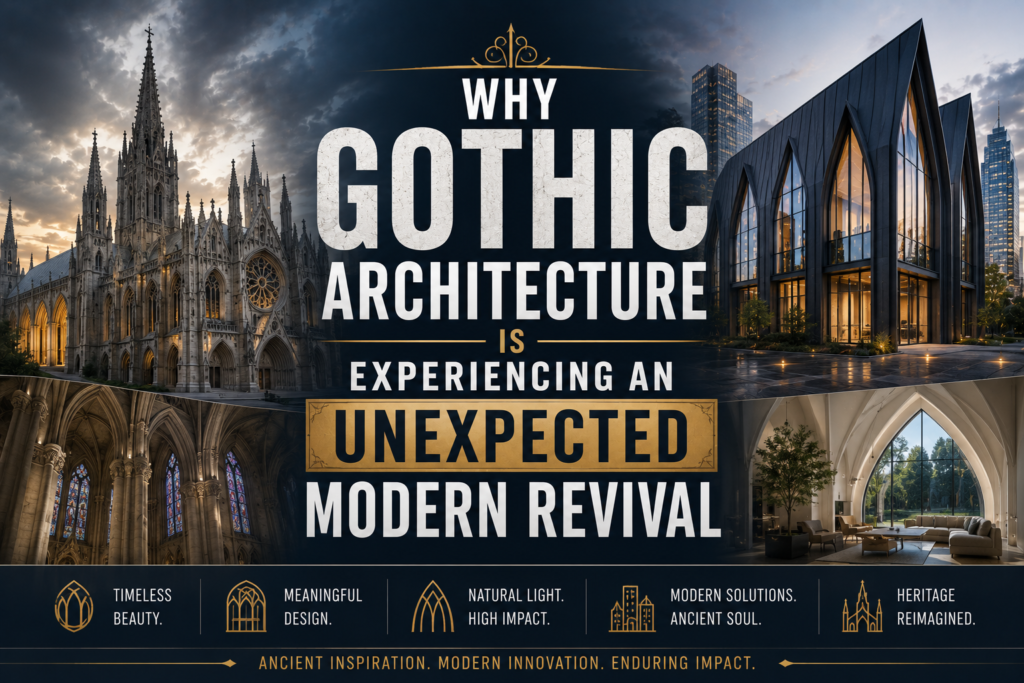
Walk into a contemporary restaurant, boutique hotel, or modern residence designed in the last five years, and you might spot elements that seem out of place: pointed arches, ornate stonework, dramatic soaring spaces, moody dramatic lighting. Ten years ago, these elements would have felt anachronistic or overly theatrical. Today, they’re increasingly showing up in genuinely modern design not as pastiche or irony, but as legitimate aesthetic choices blended with contemporary sensibilities.
Gothic architecture, once relegated to churches, castles, and historical preservation, is having a moment. And it’s not a nostalgic moment, it’s a genuine rethinking of what Gothic principles offer contemporary design.
Why Gothic Reads As Modern Now
Part of this shift comes from design fatigue with minimalism. After a decade of white walls, clean lines, and “less is more,” there’s an appetite for spaces with visual drama, depth, and detail. Gothic’s emphasis on verticality, intricate ornamentation, and layered visual interest is precisely what contemporary design culture is now seeking.
But there’s something deeper: contemporary designers are discovering that Gothic principles, the structural logic of pointed arches, the spatial drama of ribbed vaults, and the visual coherence created by repeated geometric patterns solve real design problems elegantly. A pointed arch isn’t just ornament; it’s an efficient structural form that creates visual drama while distributing load intelligently. A ribbed vault isn’t theatrical; it’s a brilliant solution for spanning large spaces while keeping walls thin and windows expansive.
Gothic architects 700 years ago figured out how to create soaring, light-filled, visually complex spaces using structural logic. Contemporary architects are rediscovering that those solutions are genuinely useful, not just historically interesting.
Where Modern Gothic Shows Up
High-end hospitality has embraced Gothic elements enthusiastically. Boutique hotels, particularly in urban markets, increasingly feature pointed arch doorways, dramatic vault ceilings, ornate stone details, or moody lighting schemes that echo Gothic sensibility. The effect is theatrical without being kitschy; it communicates luxury through visual complexity and craft rather than through expensive minimalism.
Residential design has shifted too. Modern residences, particularly in transitional or eclectic design contexts, increasingly incorporate Gothic elements. A pointed arch opening between rooms. Ornamental stone or plaster details. Deep, moody color palettes. Dramatic multi-story spaces with careful lighting that references Gothic cathedrals. These aren’t costume pieces; they’re integrated into otherwise contemporary homes.
Commercial spaces particularly boutiques, galleries, and restaurants use Gothic references to create a sense of timelessness and craft. A Gothic-inspired ceiling or arch structure creates atmosphere and visual interest that contemporary minimalism struggles to achieve.
Institutional design continues to reference Gothic, but increasingly in contemporary ways clean geometric interpretations of Gothic forms rather than literal historical recreation.
The Design Logic Behind The Revival
What’s driving this isn’t nostalgia; it’s functionality and psychology. Gothic architecture solved real problems:
Verticality and light. Pointed arches and ribbed vaults allowed medieval builders to create tall spaces that felt light and open while maintaining structural integrity. Contemporary designers want the same thing: spaces that feel expansive and full of light. Gothic’s structural logic delivers that.
Visual complexity without clutter. Gothic decoration isn’t random; it follows geometric logic. Ornamental patterns repeat, creating visual interest without feeling chaotic. In an era when we’re overwhelmed by visual stimulation, designed complexity actually feels calming in a way that plain minimalism doesn’t.
Sense of craft and permanence. Gothic construction emphasized handcrafted stone, intricate detail, and structural honesty. In a world of mass production and planned obsolescence, that signals value and permanence in a way contemporary materials struggle to achieve.
Emotional impact. Gothic spaces inspire awe. They’re designed to move people emotionally to make visitors feel they’re in a space larger than themselves. Contemporary design culture is rediscovering that emotional resonance matters more than it assumed 15 years ago.
The Contemporary Take On Gothic
Modern designers aren’t simply copying medieval churches. They’re extracting Gothic principles and reinterpreting them through contemporary lenses:
Simplified geometry. Rather than every detail being ornate, contemporary Gothic borrows key Gothic forms, pointed arches, ribbed vaults, vertical emphasis and deploys them selectively, without the historical density of decoration.
Materiality shifts. Traditional Gothic used stone and wood. Contemporary Gothic-inspired design uses those materials but also incorporates steel, concrete, and modern finishes, creating a blend of historical and contemporary.
Lighting sophistication. Historical Gothic relied on natural light through stained glass and small windows. Contemporary Gothic uses dramatic artificial lighting recessed, colored, directional to create the same sense of theatrical illumination with more control.
Scale flexibility. Historical Gothic was necessarily large cathedrals and castles. Contemporary applications scale Gothic principles to residential and commercial spaces, creating Gothic atmosphere in intimate contexts.
Understanding Gothic Principles For Contemporary Application
For architects, designers, and anyone interested in how Gothic design actually works and how its principles translate to contemporary contexts, understanding the historical development, structural logic, and different Gothic styles is essential before attempting contemporary interpretation.
This comprehensive guide to Gothic architecture history, types, and modern trends covers exactly that from Early Gothic through Flamboyant, explaining the structural innovations and design logic behind each evolution, and then exploring how contemporary design is reinterpreting Gothic principles. That foundation is what transforms a Gothic-inspired design from copying historical styles to thoughtfully reinterpreting them.
Why This Matters Beyond Aesthetics
The Gothic revival in contemporary design signals something deeper than a style cycle. It suggests that contemporary culture is reconsidering assumptions made during the minimalist dominance of the last 20 years questioning whether “less is more” actually produces better spaces, whether visual complexity is inherently bad, whether ornamentation is inherently wasteful.
By those reconsiderations, Gothic architecture’s emphasis on integrated structure and ornament, on verticality and light, on craft and permanence, starts looking less like outdated historical style and more like a coherent alternative to contemporary defaults.
The spaces emerging from this rethinking aren’t medieval recreations. They’re genuinely contemporary designs informed by Gothic logic using pointed arches and dramatic vaults not because they’re historically correct but because they solve real problems better than contemporary alternatives do. That distinction is what makes the Gothic revival legitimate rather than nostalgic.
The Bottom Line
Architecture moves in cycles, but this particular return to Gothic isn’t a simple nostalgia cycle. It’s a genuine rethinking of whether Gothic’s structural logic, spatial drama, and visual complexity offer something that contemporary minimalism doesn’t. For designers engaging with this trend seriously, understanding Gothic principles and the why behind the forms, not just the aesthetic, is what separates thoughtful contemporary interpretation from superficial historical copying.