A mechanical engineering graduate from Pune spent the better part of a year after his B.Tech sending applications to automation companies. He had a decent academic record and had studied robotics as part of his coursework. But every company that called him back asked the same thing: had he worked with PLCs, SCADA systems, or IIoT platforms in a real environment? His answer was always no. The college lab had machines, but nothing like what a live factory floor runs. He eventually joined NAMTECH’s fellowship, spent three weeks working on actual Festo and Siemens equipment in a smart factory, and had a placement within weeks of finishing.
That story is becoming more common. And it explains, better than any survey, why graduates are walking away from traditional courses and choosing an Industry 4.0 Fellowship Program instead.
What Traditional Courses Deliver?
A standard B.Tech or post-graduation course gives you theory, and in most cases, it gives you that theory with equipment that has not been updated in years. The software is old. The projects are simulated. The assessments measure recall, not application.
Only 37% of employers in logistics felt that graduates from traditional training institutions were actually prepared for Industry 4.0 roles, even though 80% of those institutions believed their students were ready. That gap is not a small miscalculation. It is a structural problem. Traditional courses were not built for the pace at which smart manufacturing, AI, robotics, and IIoT have changed the demands of the job.
What does an Industry 4.0 Fellowship Program bring?
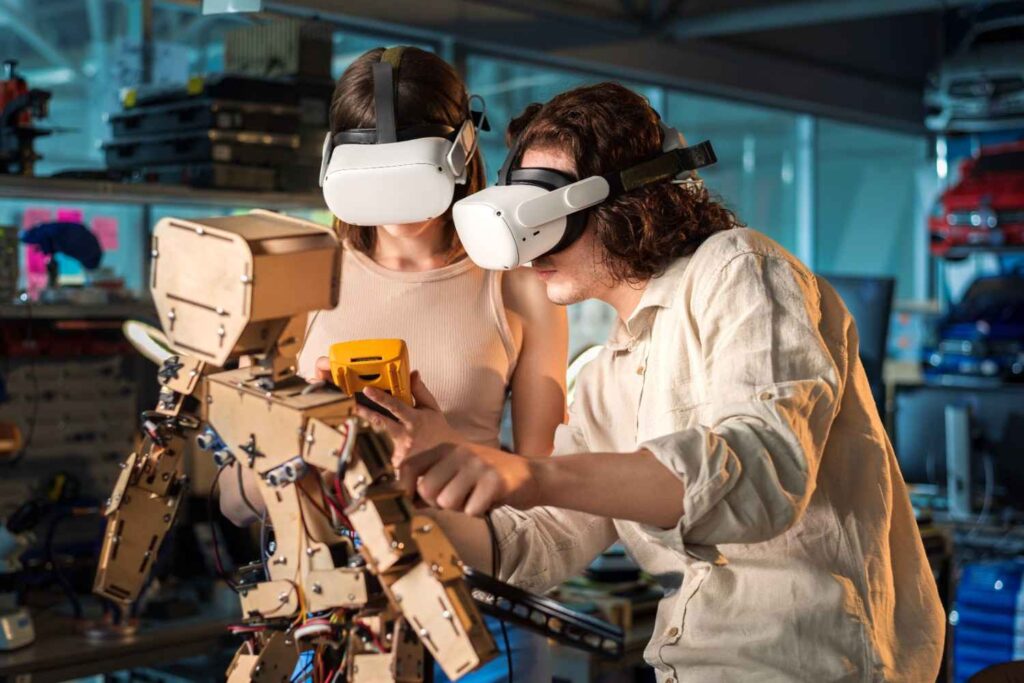
The difference is not just the content. It is the context. An Industry 4.0 Fellowship Program places you on an actual factory floor, working with live machines and real production data. You are not watching a demo. You are running a predictive maintenance script on an industrial robot, tracing a live sensor data stream from source to dashboard, or testing a computer vision defect detection model on actual production images.
NAMTECH’s fellowship, for instance, is structured across three phases: an online foundational module with guided mini-challenges, expert-led industry masterclasses and project formulation, and then two full weeks on-campus working with industry-grade equipment from Festo, Schneider, and Siemens on real project themes like AI-based quality inspection systems, digital twins for live factories, and IIoT real-time production dashboards. These are not case studies. They are deployments.
That kind of applied exposure changes what a graduate can say in an interview, and more importantly, what they can actually do on the job from day one.
Why the Job Market Has Shifted?
Large manufacturers and automation companies have changed what they look for. They want people who understand not just the concept of a cyber-physical system, but how to configure, troubleshoot, and improve one. Skills in tools like SCADA, MES, PLCs, and AI/ML frameworks now appear in job descriptions for roles that used to only ask for a degree.
Candidates with hands-on Industry 4.0 training also command better starting packages. Specialised practical skills in areas like IIoT and applied AI carry a premium over standard engineering degrees, because employers are hiring people who possess the knowledge to apply technology, not just people who have read about it. A traditional course rarely builds that distinction.
The Mentorship Gap No Classroom Fills
One reason graduates are actively seeking out the Industry 4.0 Fellowship Program format is mentorship that is genuinely current. Programs like NAMTECH’s fellowship bring in international academic experts and industry professionals who are working on live manufacturing problems. Fellows get direct exposure to challenges from companies like ArcelorMittal Nippon Steel India, which means the context is not hypothetical.
This matters because a lot of what makes Industry 4.0 implementation difficult has nothing to do with knowing the technology in isolation. It is about understanding how legacy systems integrate with new ones, where real bottlenecks appear in sensor-to-cloud pipelines, and how a team inside a plant actually responds when a system flags an anomaly. A mentor who has navigated those situations can transfer that knowledge in a few weeks in ways that two years of coursework often cannot.
The Practical Output Graduates Walk Away With
What a fellowship produces that a traditional course rarely does is a verifiable, concrete body of work. A student who completes a fellowship does not just receive a certificate. They receive a letter of recommendation, a deployed project they can walk through in detail, and, in many cases, funding support for the hardware and development they used to build it.
That combination, real project, credible recommendation, institutional backing, is precisely what hiring teams look for and rarely find in a candidate fresh out of a university course. It compresses what would otherwise take years of junior-level work experience into a structured, focused period.
Who Should Follow this Program?
Not every graduate needs a fellowship. But for B.Tech students in mechanical, electronics, or computer engineering who want to work in smart manufacturing, automation, AI in production, or industrial systems, the Industry 4.0 Fellowship Program format is a direct route to relevant employment.
It suits graduates who are willing to put in focused, applied effort over a concentrated period rather than spending two more years in a general postgraduate program. It suits students who want to build something real and be accountable for it. And it suits those who have already noticed that the companies they want to work for are asking questions their degree never prepared them to answer.
The shift among graduates is not a trend. It is a response to a straightforward problem: traditional courses were designed for a different version of the manufacturing industry, one that no longer exists on most competitive factory floors. An Industry 4.0 Fellowship Program is built for the version that does.