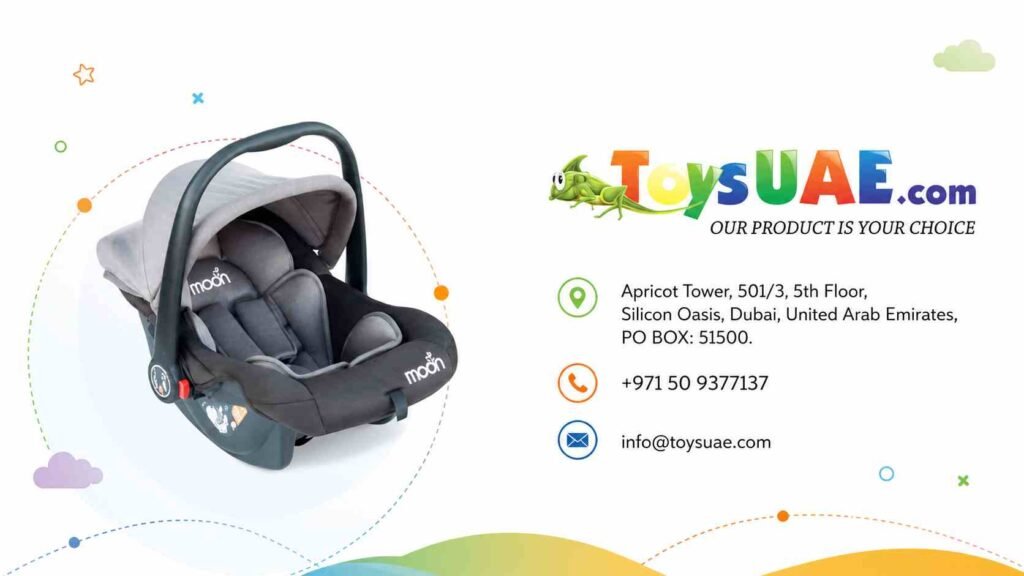
child car seat
You’re running late for school drop-off. Your ten-year-old is already buckled into the back, but your eight-year-old, who is tall for her age, says she’s “basically big enough” for the front. It’s a fair question, and one nearly every UAE parent has to answer.
This guide gives you the short answer first, then explains the rules behind it. You’ll also see how a child car seat fits into each stage, what the penalties are, and how to keep your kids safer on every trip.
What Age Can a Child Sit in the Front Seat in the UAE?
Quick answer: A child must be at least 10 years old and at least 145 cm tall before sitting in the front seat. Both conditions apply. A tall nine-year-old stays in the back, and so does a ten-year-old who hasn’t reached 145 cm.
Reports on the law also say children can’t sit in the front passenger seat alone or on an adult’s lap. A proper child car seat doesn’t change this. Under UAE law, children under 10 can’t be placed in the front seat even when they’re in a child seat.
So the child age in front seat of car rule is simple to remember. Think of it as a combination lock: 10 years and 145 cm. Until both numbers line up, the back seat is where your child rides.
Why the Back Seat Is Safer for Children
The rule isn’t arbitrary. A child’s body is still developing, and an adult-sized safety system can hurt a small passenger.
- Airbags are built for adults. A front airbag deploys with enormous force. For a small child, that force can cause serious injury. Passenger-side airbags are hazardous to a rear-facing infant or convertible seat placed in the front cabin.
- Seat belts don’t fit small bodies. The belt can ride across the neck or stomach instead of the chest and hips, which is where it should sit.
- The rear seat sits farther from a frontal impact. That extra distance matters in a collision.
The Abu Dhabi Police have also pointed out that an unrestrained child in a crash feels an impact comparable to a fall from about 10 metres. The back seat, combined with the right restraint, is the safest place for any young passenger.
Child Car Seat Laws in the UAE: What Every Parent Should Know
The front seat rule is only one piece of the child car seat laws here. The wider rules work in stages:
| Child’s stage | What the law expects |
| Under 4 years | A proper child safety seat |
| Over 4 years, until 145 cm | A booster seat is recommended until the adult belt fits |
| Under 10 years or under 145 cm | Back seat only |
| 10+ years and 145 cm+ | Adult seat belt, front seat allowed |
The UAE Traffic Law, in force since July 2017, requires child seats up to age four and bans children under 10 or below 145 cm from the front seat. Booster seats are advised for older children until they reach 145 cm, after which the regular seat belt can do the job.
The same rules apply across the country. Both emirates follow the same federal law, so the core numbers stay identical wherever you drive. Dubai, Abu Dhabi, Sharjah and the rest all expect the same from you.
Fines and Penalties for Breaking the Rules
Ignoring the rules can cost you. Not providing a child safety seat for a child aged four or below carries an AED 400 fine, and so does letting a child under the age limit sit in the front. Some sources also mention black points on the driver’s licence, and the details can change, so check the Ministry of Interior or your emirate’s police website for the latest penalties.
Still, the fine is the smallest reason to follow the law. The real cost is the risk to your child.
How Long Should a Child Be in a Child Car Seat?
This is one of the most common questions parents ask, and the honest answer is: it depends on size more than birthdays.
Quick answer: Most children need some form of child car seat or booster until they reach about 145 cm in height. For many kids, that’s somewhere between 10 and 12 years old.
Here’s how the journey usually looks:
Stage 1: Rear-Facing Seat (Birth to Toddler Years)
Newborns and infants ride rear-facing. The seat shell cradles the head, neck and spine in a crash. Pediatricians recommend keeping children in rear-facing seats for as long as possible.
Stage 2: Forward-Facing Seat
Once your child outgrows the rear-facing limits of their seat, they can move to a harness-based forward-facing position. The harness spreads crash forces across the strongest parts of the body.
Stage 3: Booster Seat
A booster lifts your child so the adult belt lies across the collarbone and hips. Boosters take over after the early seat stage and continue until the child reaches 145 cm or turns 10.
Stage 4: Adult Seat Belt
Only when the belt fits correctly, with the lap belt low across the hips and the shoulder belt across the chest, is your child ready to go without a booster.
When Can a Child Face Forward in a Child Car Seat?
Parents often move to forward-facing too early because it feels like a milestone. Here’s the practical way to decide.
Quick answer: A child can face forward once they’ve outgrown the rear-facing height or weight limit of their seat, and have also passed the minimum age the seat manufacturer sets. Many safety experts suggest keeping kids rear-facing until at least age two, and longer if the seat allows.
UAE law fixes the under-four requirement and the front seat limits, but it doesn’t name one exact age for turning a seat around. That’s why the manual matters. Check these three things:
- Weight limit: Is your child still under the rear-facing maximum?
- Height limit: Is the top of their head still comfortably below the seat shell’s edge?
- Manufacturer’s age guidance: Does the manual say your child is ready?
If the answer to all three is “still within limits,” keep them rear-facing. Bent legs aren’t a safety problem. Rear-facing remains the safer choice for a growing child.
Choosing a Convertible Car Seat for Your Family
A convertible car seat is a popular pick in the UAE because it grows with your child. It starts rear-facing for infants and later converts to forward-facing, so you buy one seat instead of two.
When shopping, look for:
- Certified safety standards. Look for the Emirates Conformity Assessment mark when buying a car seat.
- ISOFIX compatibility, which gives a secure, tighter fit without relying only on the seat belt.
- Adjustable headrest and harness, so the seat adapts as your child grows.
- A good fit for your car. Compact cars in busy cities like Dubai and Sharjah need slimmer seats, and larger SUVs give you more room.
- Easy-clean fabric. UAE summers mean spilled juice and sticky heat, so removable covers help.
If you’re still comparing options, ToysUAE baby shop has a range of car seats from newborn stages through boosters, with same-day and next-day delivery across the UAE.
Practical Safety Tips for UAE Parents
A few habits make a real difference:
- Never leave a child alone in a parked car. That’s treated as a criminal matter under the child protection law, not just a traffic offence. Temperatures here climb fast.
- Check the harness every trip. You should be able to fit no more than one finger between the strap and your child’s collarbone.
- Skip bulky winter-style padding under the harness. It can leave straps too loose.
- Use the seat in taxis and rentals too. The law doesn’t pause because the car isn’t yours.
- Replace any seat after a crash, even if it looks fine.
- Register your seat with the maker so you hear about recalls.
Frequently Asked Questions
What is the minimum age for a child to sit in the front seat in the UAE?
Ten years old, and at least 145 cm tall. Both conditions must be met.
Can a child sit in the front seat in a car seat in the UAE?
No. Children under 10 aren’t allowed in the front seat even when they’re properly seated in a child seat.
Is a child car seat mandatory in the UAE?
Yes, for children aged four and under. Older children should use a booster until the adult belt fits, which is generally at 145 cm.
What is the fine for breaking the child seat rules?
The fine is AED 400 for failing to provide a child seat or for seating a child too young in front. Always confirm current penalties with the authorities.
When can my child switch to forward-facing?
When they’ve outgrown the rear-facing limits of their seat and meet the manufacturer’s minimum age. Waiting longer is generally safer.
Final Thoughts
Safe travel with kids comes down to a few clear numbers: under 4 needs a child seat, and the front seat waits until 10 years old and 145 cm. Add the right child car seat for each stage, and you’ve covered the biggest risks on every UAE road.
Not sure which seat fits your child right now? Browse the car seat collection at ToysUAE, compare convertible and booster options, and get your pick delivered fast anywhere in the UAE. Your child’s next ride can be a safer one.