New men’s leather biker gloves often feel stiff during the first few wears. That’s normal. Leather needs time to soften, flex, and shape around the hand. But stiffness is different from pain. If your fingers go numb, seams dig in, or circulation feels restricted, the gloves might be the wrong size.
Breaking in leather motorcycle gloves is about gradual softening and natural molding, not forcing the leather to stretch. Rider gloves for women follow the same principles, with fit adjustments that support comfort and grip from the start.
Why New Leather Motorcycle Gloves Feel Stiff
New leather has structure, reinforced palms, knuckle armor, double stitching, and protective lining all add firmness that needs time to relax. The leather hasn’t conformed to your hand shape yet, and seams haven’t softened through movement. Stiffness is normal during the first few wears, but pain is not.
Leather starts to mold with natural hand heat and repeated movement. Finger mobility improves as the material flexes, and the palm begins to shape around your grip. The break-in period allows the glove to become an extension of your hand rather than something fighting against it.
First, Make Sure the Gloves Actually Fit
Break-in improves comfort, but it cannot turn the wrong glove size into the right one. Gloves should feel snug without pain. Your fingertips should reach near the end of each finger tube without being crushed. The palm should wrap your hand cleanly without bunching around the throttle or clutch.
Check that the wrist closure secures properly, thumb mobility feels natural, and knuckle armor sits directly over your knuckles. Leather may relax slightly over time, but it won’t fix gloves that are fundamentally too small, too loose, or badly shaped for your hand. Use a size chart to match finger length, palm width, and wrist fit before assuming break-in will solve everything.
Step 1: Wear Them Around the House
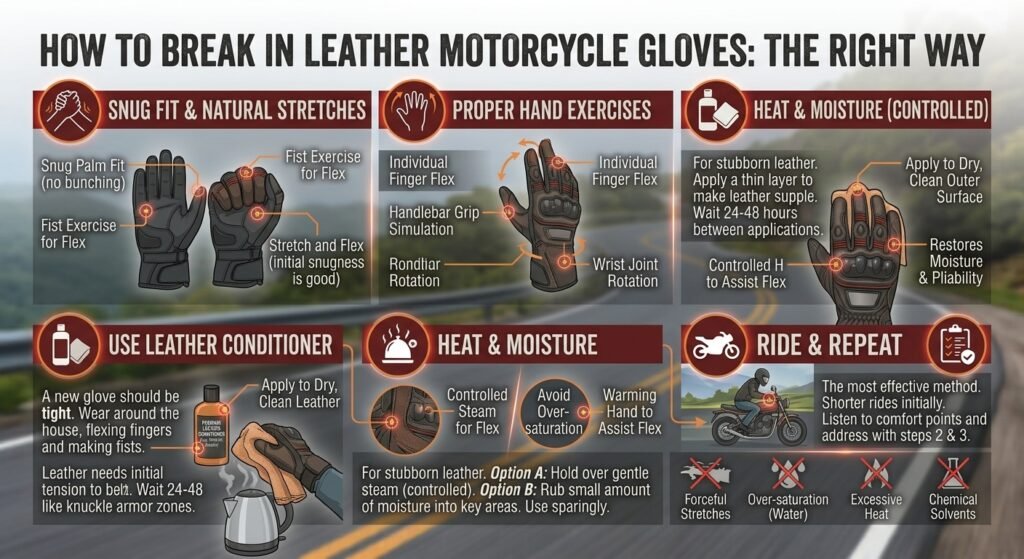
Start by wearing your leather motorcycle gloves indoors for short sessions. Open and close your hands, flex your fingers gently, and make soft fists. Grip a handlebar, broom handle, or similar round object to mimic throttle and brake positions. Let natural hand warmth begin softening the leather without forcing it.
Avoid pulling hard on fingers or seams. Gentle movement helps the leather shape around your hand without stressing the stitching or damaging the glove. This low-pressure method is the safest way to start the break-in process.
Step 2: Take Short Rides Before Long Rides
Once the gloves feel slightly more flexible indoors, test them on short rides. Check throttle control, clutch pull, and brake lever feel. Notice where pressure points develop and whether grip comfort improves. Give the gloves time to relax between rides rather than wearing them continuously for hours.
Avoid starting with a long trip when the gloves are still stiff. Short rides let the leather break in naturally while allowing you to monitor hand fatigue and road feedback. If numbness or sharp pressure develops, reassess fit before continuing.
Step 3: Use Leather Conditioner Carefully
Leather conditioner can help dry or stiff areas, but it should be used sparingly. Apply a small amount with a soft cloth, focusing on areas that feel particularly firm. Check the care label first, as some gloves with waterproof inserts, suede panels, or special finishes may not respond well to standard conditioners.
Do not soak the leather. Over-conditioning can soften the glove too much, darken the color, or weaken protective reinforcement. Let gloves air dry naturally after application. The leather conditioner should support the material, not drown it.
What Not to Do When Breaking In Leather Gloves
Most glove damage happens when riders try to rush the break-in process. Avoid these common mistakes:
- Do not soak gloves in water: This can shrink leather, damage lining, and weaken stitching
- Do not use heat sources: Hair dryers, heaters, ovens, or direct sunlight can crack and stiffen leather
- Do not pull aggressively on fingers or seams: Forced stretching damages construction and creates weak points
- Do not over-condition: Too much conditioner makes leather greasy, dark, or too soft for protection
- Do not use harsh chemicals: Alcohol-based cleaners, household oils, or aggressive solvents degrade leather quality
- Do not ignore numbness: Sharp pressure or restricted circulation means the gloves may be the wrong size
Patience prevents damage. Let the leather mold naturally through movement and body heat instead of forcing it.
Men’s Leather Biker Gloves: Break-In Tips by Style
Heavy duty men’s leather biker gloves break in differently depending on style and construction.
- Short cuff gloves usually soften faster because they have less material and fewer reinforced areas around the wrist.
- Gauntlet gloves may need more time, especially around the extended cuff where leather, lining, and closure systems create more structure.
- Reinforced palms and knuckle armor can feel firmer initially, particularly in touring gloves designed for long-distance protection.
- Cruiser gloves with lighter construction often break in more quickly.
- Waterproof gloves with breathable inserts or warm linings may take longer because of the additional layers between leather and hand.
Rider Gloves for Women: Fit and Break-In Notes
Rider gloves for women should match palm shape, finger length, and wrist fit from the start. Extra finger length can affect clutch and brake control, while a bulky palm causes bunching that doesn’t improve with break-in. Flexible goatskin leather and lighter lining materials may soften faster than heavy cowhide with thick insulation.
Break-in should enhance comfort in gloves that already fit properly. It cannot fix gloves that are too wide, too long, or too tight. Women riders should prioritize correct sizing first, then use gradual wear and natural hand movement to improve grip comfort and finger flexibility.
How Long Does It Take to Break In Leather Motorcycle Gloves?
Most leather motorcycle gloves begin to feel better after several short wears or rides. Lightweight gloves with minimal reinforcement may soften after just a few sessions. Thicker gloves with gel palms, hard knuckle armor, and waterproof inserts can take longer.
Break-in time depends on leather type, glove construction, riding frequency, and how much you flex your hands during wear. Full-grain cowhide takes longer than supple goatskin. Heavily armored touring gloves need more patience than casual street gloves. Regular short rides speed the process more than occasional long rides.
Signs Your Gloves Are Breaking In Correctly
A proper break-in improves movement and comfort while keeping the glove secure. Watch for these positive signs:
- Fingers flex more easily without resistance
- Palm feels less stiff when gripping the throttle
- Grip feels more natural and confident
- Wrist closure sits comfortably without pinching
- No numbness or restricted circulation
- No sharp pressure points on knuckles or seams
- Leather forms around your hand without losing shape or structure
If these improvements appear gradually, the break-in is progressing well.
Signs You Bought the Wrong Size
Breaking in should make good gloves better, not fight against poor sizing. Stop wearing the gloves if you experience:
- Fingertips feel crushed or constantly compressed
- Fingers go numb during or after rides
- Palm bunches up when gripping the throttle
- Knuckle armor sits above or below your actual knuckles
- Seams dig into fingers or palm
- Gloves slip, twist, or rotate on your hand
- Wrist closure cannot secure properly even when fully tightened
These signs indicate a sizing problem that break-in cannot fix. Consider exchanging for a different size or style.
Final Thoughts
Breaking in leather motorcycle gloves takes patience, but the right process is simple. Men’s leather biker gloves should soften through short wear sessions, natural hand movement, and light conditioning when needed, not through heat, soaking, or aggressive stretching. Top quality rider gloves for women should start with proper hand shape and fit, then break in gradually for better comfort and control. Let the leather mold to your hands through use, and avoid shortcuts that damage the gloves or reduce their protective qualities.