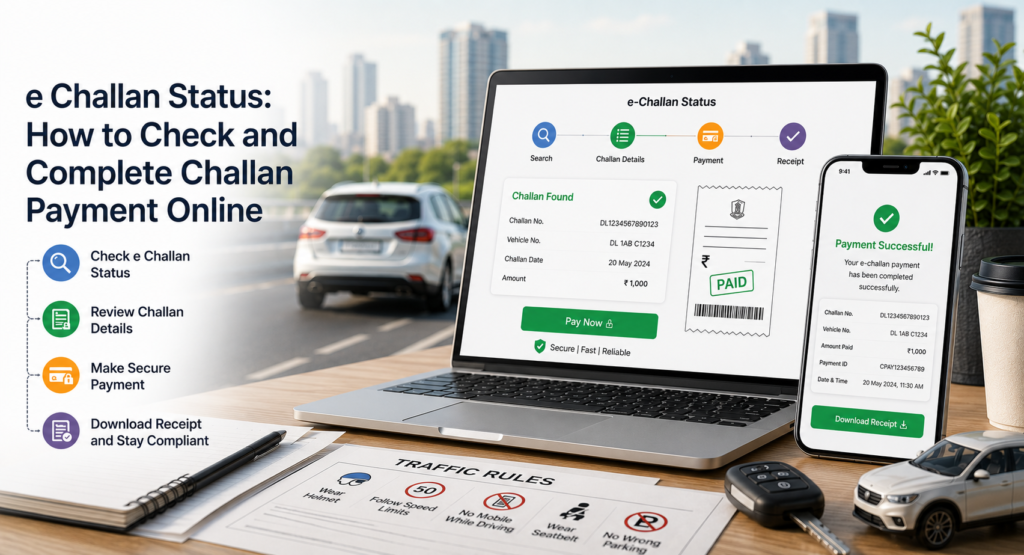
3. e Challan Status- How to Check and Complete Challan Payment Online
Most drivers do not set out to develop unsafe habits. They become part of everyday routines gradually. A person may ignore a dashboard warning because the vehicle still appears to work normally, park in a restricted area for a few minutes, or postpone checking a traffic notice because there are more urgent tasks to complete.
Individually, these decisions may seem insignificant. Repeated over time, however, they can create avoidable expenses, administrative complications, and safety risks.
Responsible driving is not only about knowing traffic rules. It also involves recognising small habits that can lead to larger problems and making deliberate changes before they become routine.
When Convenience Becomes a Risk
Drivers often make quick decisions to save time. Examples include stopping where parking is prohibited, taking a phone call while moving, failing to check mirrors before changing lanes, or assuming that a short journey does not require the same attention as a longer one.
The difficulty is that road conditions can change in seconds. A brief distraction may cause a driver to miss a pedestrian, a cyclist, a traffic signal, or another vehicle approaching from an unexpected direction.
Convenience should not take priority over safety. If a driver needs to check directions or respond to a message, the better approach is to stop in a safe and lawful location before doing so.
Similarly, parking decisions should account for visibility, pedestrian access, traffic movement, and applicable restrictions. A short stop can still obstruct others or create a hazardous situation.
The Problem With Repeatedly Postponing Maintenance
Another common habit is delaying minor maintenance because the vehicle continues to operate. A warning light may remain illuminated for days, a tyre may gradually lose pressure, or an unusual sound may be dismissed as unimportant.
Not every warning indicates an immediate emergency, but unexplained changes should not be ignored. Consult the vehicle manual and seek qualified inspection when necessary, particularly if braking, steering, tyre condition, or engine performance may be affected.
A practical way to avoid repeated delays is to maintain a simple list of maintenance tasks, record service dates, and schedule inspections before they become urgent.
Owners should also distinguish between cosmetic issues and problems that could affect safe operation. This makes it easier to prioritise spending without overlooking important concerns.
Why Administrative Delays Matter
Driving responsibilities extend beyond vehicle operation. Owners may need to monitor insurance validity, registration information, applicable permits, and traffic challan-related notices.
When these tasks are postponed, it can become harder to locate relevant documents or understand what action is required. A notice that remains unread may also create unnecessary uncertainty about its status.
Digital tools can help owners organise certain tasks. ChallanPay is relevant to traffic challan-related services, while Lawyered may be considered when legal guidance is required. LOTS247 Sarathi may also be relevant to transport-related service requirements. Before using any platform, check the exact service offered and confirm important information through the appropriate official channel.
A useful habit is to review vehicle-related notifications periodically, keep payment or submission acknowledgements, and record any pending action. This creates a clearer administrative history and reduces the likelihood of overlooking an important task.
Build Habits That Are Easy to Maintain
Changing every driving habit at once may be unrealistic. It is often more effective to focus on a few repeatable actions.
Before starting a journey, check that the seat belt is fastened, mirrors are positioned correctly, and navigation is set up while stationary. During the journey, maintain attention, follow road signs, and avoid distractions. Afterward, address any warning signs or vehicle issues rather than repeatedly postponing them.
Owners can also create calendar reminders for document renewals and scheduled servicing. Families who share a vehicle should agree on how problems, expenses, and maintenance requirements will be communicated.
The objective is to make responsible behaviour the easiest option, rather than something that requires constant reconsideration.
Technology Can Support Better Decisions
Digital reminders, service histories, navigation applications, and online vehicle services can help drivers stay organised. However, technology works best when users verify information and understand its limitations.
An online result should not automatically be treated as final proof that every requirement has been satisfied. Users should check the source, confirm relevant details, and retain appropriate acknowledgements.
Likewise, driver-assistance features do not remove the need for attention. Cameras, sensors, and alerts can support awareness, but drivers remain responsible for responding appropriately to road conditions.
Make Consistency the Goal
Good driving habits are most effective when practised consistently. A driver who follows safety precautions only on highways but ignores them on familiar local roads is still exposed to unnecessary risk.
The same principle applies to vehicle maintenance and documentation. Regular checks are generally more manageable than dealing with a long list of unresolved problems.
Conclusion
Small decisions shape the overall experience of vehicle ownership. Avoiding distractions, addressing maintenance concerns, reviewing notices, and keeping documents organised can prevent many avoidable difficulties.
No driver can eliminate every risk, but consistent habits can make journeys safer and responsibilities easier to manage. The most useful improvement is often not a dramatic change; it is a small action repeated at the right time.