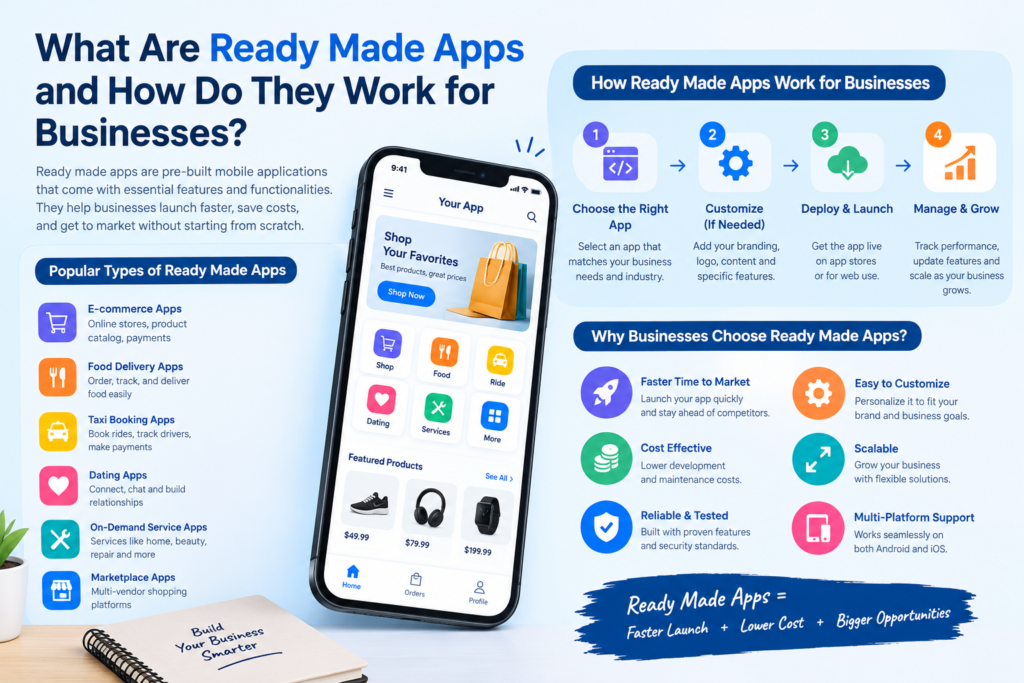
Building a mobile or web application from scratch can be exciting, but for many businesses, it can also be expensive, time-consuming, and difficult to manage. Companies often need an app to improve customer engagement, automate operations, accept payments, manage orders, or provide digital services, yet they may not have the resources to spend months developing every feature from the ground up.
This is where ready made apps come into the picture.
Ready made apps are pre-developed software solutions designed to provide businesses with a set of features that are already built, tested, and ready to be customized or deployed. Instead of starting development with a blank screen, businesses can begin with an existing application and adapt it to their brand, business model, and operational requirements.
From food delivery and e-commerce to education, transportation, healthcare, booking platforms, and on-demand services, ready made apps are becoming an increasingly practical option for companies that want to establish a digital presence quickly.
But what exactly are ready made apps, how do they work, and when should a business consider using one?
Let’s explore.
What Are Ready Made Apps?
A ready made app is a pre-built application developed for a specific business category, industry, or use case. It typically contains the core features required to operate a particular type of business.
For example, a ready made food delivery app may already include:
-
Customer registration and login
-
Restaurant listings
-
Menu management
-
Search and filters
-
Shopping cart
-
Online payments
-
Order tracking
-
Notifications
-
Ratings and reviews
-
Admin management
Rather than developing all these components individually, a business can use the existing framework and customize elements such as the logo, colors, interface, payment methods, pricing structure, and business rules.
The important point is that “ready made” does not necessarily mean “one-size-fits-all.” Many solutions can be modified to meet the needs of a particular company.
A business can therefore get a functioning digital product without going through the entire process of designing and developing an application from scratch.
How Do Ready Made Apps Work?
The process behind a ready made app is relatively straightforward.
First, a business selects an application that matches its industry and requirements. The provider generally supplies a pre-developed software package containing the application’s core functionality.
The business then identifies the areas that need customization. These might include branding, user roles, payment gateways, dashboards, notifications, integrations, or specific workflows.
Once customization is complete, the application is configured and tested before being launched.
A typical process looks like this:
Choose → Customize → Integrate → Test → Launch → Maintain
1. Choose the Right App
The first step is identifying a solution that fits the business model.
A company shouldn’t select an app simply because it has many features. The more important question is whether those features actually support the company’s operations.
For instance, a grocery delivery business may need inventory management and delivery scheduling, while an appointment-based business may prioritize calendars, availability management, reminders, and online payments.
2. Customize the Application
After selecting the software, the business can customize it according to its requirements.
Common customization options include:
-
Company logo and branding
-
Colors and fonts
-
App layout
-
User registration
-
Product or service categories
-
Pricing
-
Payment methods
-
Notifications
-
Admin dashboards
-
Business rules
This step helps transform a generic application into a digital product that represents a particular company.
3. Add Integrations
Modern businesses rarely operate through one software system alone.
A ready made app may need to connect with payment gateways, customer relationship management systems, accounting software, maps, analytics platforms, communication tools, or other third-party services.
For example, an e-commerce business could integrate its app with a payment provider, shipping service, inventory platform, and customer support system.
These integrations allow information to move between different systems and reduce manual work.
4. Test the Application
Before launch, the application needs to be tested carefully.
Testing can cover everything from registration and checkout to notifications, payment processing, database operations, and administrator functions.
The goal is to identify technical problems before customers encounter them.
5. Launch and Maintain
Once the app has been tested, it can be launched for customers or employees.
However, launching an application isn’t the end of the process. Businesses need ongoing maintenance, security updates, bug fixes, performance monitoring, and potentially new features as their requirements change.
Why Are Businesses Choosing Ready Made Apps?
The biggest attraction of ready made apps is that they can reduce the time and resources required to launch a digital solution.
Traditional custom development can involve extensive research, UI/UX design, architecture planning, coding, testing, deployment, and maintenance. While custom development remains valuable for businesses with highly specialized requirements, it isn’t always necessary.
A ready made solution can provide a starting point that has already gone through much of the development process.
Here are some of the main reasons businesses consider this approach.
Faster Time to Market
Speed can be extremely important in competitive markets.
If a company spends six to twelve months developing an application, competitors may have already launched similar services and attracted customers during that period.
Ready made applications can shorten the development timeline because the underlying software has already been created.
Instead of building every feature, businesses focus primarily on customization, integration, testing, and deployment.
This can help a company start serving customers sooner.
Lower Development Costs
Developing an application from scratch requires a development team and significant investment in design, programming, testing, infrastructure, and ongoing maintenance.
Ready made apps can reduce the initial development workload because the core application already exists.
This makes them particularly attractive to startups, small businesses, and companies testing a new business idea.
The cost advantage doesn’t mean businesses should select an app solely because it is inexpensive. A cheaper application that cannot scale or support important business requirements may eventually become more expensive.
The better approach is to evaluate the total cost of ownership, including customization, hosting, maintenance, upgrades, and support.
Access to Proven Features
A mature ready made application often includes features that have already been implemented and tested across similar business scenarios.
This can reduce the risk associated with building common functionality from scratch.
For example, features such as user authentication, push notifications, search, product management, order processing, and payment integration are common across many applications.
Businesses can take advantage of these established components instead of reinventing them.
Easier Business Validation
One of the biggest challenges for startups is determining whether customers will actually use a product.
Investing heavily in custom development before validating the idea can create unnecessary financial risk.
A ready made application can provide a practical way to launch a minimum viable product or initial version of a service.
Businesses can then collect customer feedback, monitor usage, identify popular features, and make informed decisions about future development.
Scalability Can Be Built In
A common misconception is that ready made apps are only suitable for small businesses.
In reality, the scalability of a solution depends largely on its underlying architecture and the provider supporting it.
A well-designed application can be configured to support increasing numbers of users, transactions, products, or locations.
However, businesses should always ask potential providers about scalability before purchasing a solution.
Questions about database architecture, server capacity, cloud infrastructure, API support, caching, security, and performance become increasingly important as the business grows.
Ready Made Apps vs. Custom Apps
The decision between a ready made application and a custom-built solution depends on the company’s goals.
A ready made app generally starts with an existing product and adapts it to the business.
A custom application starts with the company’s requirements and builds the software specifically around them.
Neither option is automatically better.
Ready Made Apps
They are generally suitable when:
-
The business needs common industry features.
-
A faster launch is important.
-
The company wants to control initial development costs.
-
The business model has already been proven.
-
Moderate customization is sufficient.
Custom Apps
Custom development may be preferable when:
-
The business has highly specialized workflows.
-
Existing solutions cannot support important requirements.
-
The application requires unique technology.
-
Extensive customization is expected.
-
The product itself is a major competitive advantage.
For some businesses, a hybrid approach can work particularly well. They can start with a ready made application, validate the business model, and gradually invest in custom development as their needs become more sophisticated.
Examples of Ready Made Apps for Different Industries
Ready made applications aren’t limited to one sector.
E-Commerce
Businesses can use ready made e-commerce applications to manage products, customers, orders, payments, promotions, and delivery.
A retailer can customize the platform with its own branding and product catalog instead of building an online shopping system from the ground up.
Food Delivery
Food delivery solutions commonly include separate interfaces or dashboards for customers, restaurants, delivery partners, and administrators.
These systems can handle ordering, payments, restaurant management, delivery tracking, and notifications.
Healthcare
Healthcare businesses can use ready made solutions for appointment scheduling, patient communication, doctor profiles, notifications, and service management.
Healthcare applications require special attention to privacy, security, and regulatory requirements, so businesses should carefully evaluate how customer data is stored and protected.
Education
Educational institutions and training companies can use ready made learning platforms for courses, student accounts, video content, quizzes, progress tracking, and communication.
This allows education providers to establish a digital learning environment without creating every component independently.
On-Demand Services
Cleaning, repair, beauty, transportation, home maintenance, and other service businesses can use ready made on-demand applications.
Customers can typically browse services, select a provider, book appointments, make payments, and receive updates.
What Should Businesses Check Before Buying a Ready Made App?
Choosing a ready made app shouldn’t be treated like buying an ordinary piece of software.
The application can become an important part of the company’s operations, so businesses need to evaluate it carefully.
Customization Options
Find out what can actually be customized.
Some providers allow extensive modifications, while others only offer basic branding changes.
Ask whether the company can modify workflows, features, APIs, dashboards, and database structures if necessary.
Security
Security should never be an afterthought.
Businesses may be storing customer names, contact details, payment information, business records, and other sensitive data.
Ask about authentication, encryption, access controls, backups, security updates, and data protection practices.
Ownership and Licensing
Understand what you’re actually purchasing.
Does the business own the source code? Is it receiving a license? Is the software hosted by the provider? Can the application be moved to another server?
These details can have major consequences later.
Support and Maintenance
Even a well-built application can experience technical issues.
Check what support is included and whether maintenance, bug fixes, updates, and security patches are provided.
A reliable support arrangement can save significant time when problems occur.
Integration Support
Make sure the app can connect with the tools your business already uses or plans to use.
APIs and integration capabilities become especially important as a company grows.
Future Scalability
Think beyond today’s requirements.
An application that works for 500 customers may behave very differently when the business has 50,000 customers.
Ask how the solution handles growth and whether additional infrastructure or licensing costs will apply.
Are Ready Made Apps the Right Choice for Every Business?
No.
Ready made apps offer considerable advantages, but they also have limitations.
A business may eventually discover that its processes don’t fit the application’s existing structure.
Customization can also become complicated if the underlying software wasn’t designed to support extensive modifications.
There may also be limitations around performance, ownership, integrations, or long-term development.
For businesses with a highly unique concept, building a custom application from the beginning may make more sense.
The key is to avoid choosing technology based purely on development cost or speed.
The right solution should support the company’s business strategy.
How Ready Made Apps Can Support Business Growth
A digital application isn’t valuable simply because it exists. Its value comes from how effectively it helps a business operate and serve customers.
A well-selected ready made app can contribute to growth in several ways.
It can automate repetitive tasks, improve customer convenience, centralize business information, provide useful analytics, and make services available through digital channels.
For example, instead of managing customer bookings through phone calls and spreadsheets, a service company can allow customers to schedule appointments through an app.
Instead of manually processing every order, an e-commerce business can automate parts of the purchasing and fulfillment process.
Instead of relying entirely on physical locations, a retailer can use a mobile application to reach customers directly.
The technology becomes a tool for improving the business rather than simply another digital expense.
The Future of Ready Made Apps
The ready made app market is likely to continue evolving as businesses look for faster and more flexible ways to adopt digital technology.
Artificial intelligence, automation, cloud computing, APIs, analytics, and low-code development are changing how applications are created and customized.
Future ready made applications may offer more intelligent personalization, automated workflows, predictive analytics, AI-powered customer support, and easier integration with other business systems.
This could make pre-built software even more adaptable.
At the same time, businesses will need to become more selective. Having hundreds of features doesn’t necessarily make an application better. Security, performance, flexibility, user experience, integration capabilities, and long-term support will remain critical considerations.
Final Thoughts
Ready made apps provide businesses with an alternative to starting application development from zero.
By using pre-built functionality, companies can potentially reduce development time, control initial costs, launch services faster, and test new business ideas with less technical overhead.
However, choosing the right solution requires more than looking at a feature list.
Businesses should evaluate customization, security, scalability, integrations, ownership, maintenance, support, and long-term costs before making a decision.
For a startup looking to validate an idea, a small business trying to digitize its operations, or an established company entering a new market, a ready made application can be a practical starting point.
The real advantage isn’t simply having an app quickly. It’s having the right technology in place to solve real business problems and create a better experience for customers.