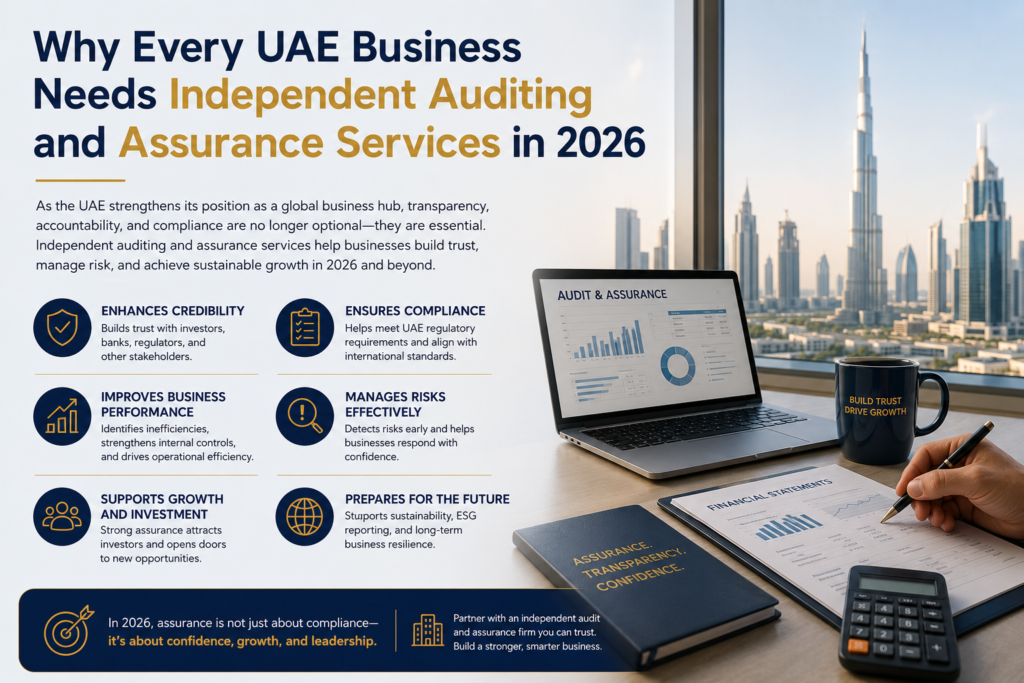
The UAE continues to strengthen its position as one of the world’s leading business destinations. With new regulations, evolving corporate tax requirements, increasing foreign investment, and greater financial transparency expectations, businesses operating in the Emirates face a more demanding compliance environment than ever before.
Whether you own a startup in Dubai, a manufacturing company in Sharjah, a trading business in Abu Dhabi, or a multinational operating across multiple emirates, maintaining accurate financial records is no longer optional—it is essential. This is where auditing and assurance services UAE become invaluable.
Independent auditing goes far beyond checking numbers. It provides business owners, investors, lenders, regulators, and stakeholders with confidence that financial statements accurately reflect a company’s financial position. Assurance services also help organizations identify operational risks, improve governance, strengthen internal controls, and make informed strategic decisions.
As we move through 2026, businesses that invest in professional auditing and assurance services are better equipped to manage risk, maintain compliance, attract investment, and achieve sustainable growth.
Understanding Auditing and Assurance Services
Although often used together, auditing and assurance are not identical services.
An audit is a formal examination of a company’s financial statements to determine whether they fairly represent the organization’s financial performance in accordance with applicable accounting standards.
Assurance services are broader. They provide independent evaluations of financial information, internal controls, compliance procedures, operational effectiveness, and business processes to improve the reliability of information used by stakeholders.
Together, these services help businesses strengthen financial integrity while supporting better decision-making.
| Audit Services | Assurance Services |
|---|---|
| Verify financial statements | Improve reliability of financial information |
| Detect material misstatements | Evaluate business processes |
| Review accounting records | Assess internal controls |
| Ensure regulatory compliance | Reduce operational risks |
| Increase stakeholder confidence | Improve governance and transparency |
Why Independent Audits Matter More Than Ever in 2026
The UAE business landscape has changed significantly over the past few years. Companies now operate in an environment where financial transparency is expected by regulators, investors, financial institutions, suppliers, and international partners.
Several developments have increased the importance of independent audits:
- UAE Corporate Tax implementation
- Enhanced VAT compliance requirements
- International financial reporting expectations
- Increased anti-money laundering (AML) regulations
- Greater investor due diligence
- Digital accounting systems
- Cross-border business expansion
Businesses that fail to maintain accurate financial records risk penalties, reputational damage, delayed financing, and regulatory complications.
Independent Audits Build Financial Credibility
Every business relies on trust.
Banks want reliable financial statements before approving loans.
Investors need confidence before committing capital.
Suppliers often evaluate financial stability before extending credit.
Government authorities require accurate financial reporting for compliance purposes.
Independent auditors provide objective verification that financial records present a true and fair view of the company’s financial position.
This credibility becomes particularly valuable during:
- Business expansion
- Fundraising
- Mergers and acquisitions
- Joint ventures
- Licensing renewals
- Government tenders
Companies with audited financial statements often enjoy smoother negotiations and stronger business relationships.
Better Compliance with UAE Regulations
The regulatory framework in the UAE continues to evolve. Businesses must comply with various legal and financial obligations, including:
- Corporate Tax regulations
- VAT requirements
- Economic Substance Regulations (where applicable)
- Ultimate Beneficial Ownership (UBO) requirements
- Anti-Money Laundering (AML) obligations
- Financial reporting standards
- Free zone compliance requirements
Independent auditing helps identify compliance gaps before they become costly legal issues.
Instead of reacting to regulatory problems, businesses can proactively correct deficiencies and reduce exposure to fines or investigations.
Stronger Internal Controls Reduce Risk
Many business owners believe fraud only happens in large corporations.
In reality, small and medium-sized businesses are often more vulnerable because they typically have fewer internal controls.
Independent auditors review areas such as:
- Cash management
- Payment approvals
- Payroll systems
- Inventory controls
- Revenue recognition
- Procurement procedures
- Financial authorization processes
Weak controls can lead to:
- Employee fraud
- Accounting errors
- Duplicate payments
- Revenue leakage
- Unauthorized transactions
- Asset misappropriation
By identifying these weaknesses early, businesses can strengthen operational efficiency and reduce financial losses.
Improved Decision-Making Through Reliable Financial Data
Business decisions are only as good as the financial information supporting them.
Owners regularly make decisions regarding:
- Hiring
- Expansion
- Pricing
- Investment
- Budgeting
- Cost reduction
- Financing
If accounting records contain inaccuracies, management may make costly strategic mistakes.
Auditing improves confidence in financial reporting, allowing leaders to base decisions on reliable data rather than assumptions.
Easier Access to Business Financing
Banks and financial institutions assess risk carefully before approving loans or credit facilities.
One of the first documents lenders request is audited financial statements.
Independent audits help demonstrate:
- Financial stability
- Consistent revenue
- Cash flow management
- Asset strength
- Debt capacity
- Profitability
Companies with professionally audited financial records often experience faster financing approvals and improved lending terms.
Increased Investor Confidence
The UAE remains a preferred destination for foreign investment.
Investors carefully examine financial statements before investing in any company.
Independent auditing provides reassurance that:
- Financial reports are accurate.
- Revenue figures are reliable.
- Liabilities are properly disclosed.
- Business risks are identified.
- Financial controls are functioning effectively.
For startups seeking venture capital and established businesses pursuing expansion funding, audited financial statements significantly enhance credibility.
Supporting Corporate Tax Compliance
The introduction of corporate tax has increased the importance of accurate accounting.
Businesses must maintain complete financial records that support:
- Tax calculations
- Income reporting
- Expense documentation
- Transfer pricing documentation (where applicable)
- Tax return preparation
Independent auditors help ensure financial records are organized, accurate, and capable of supporting tax compliance.
This reduces the likelihood of disputes during regulatory reviews or tax assessments.
Enhancing Business Reputation
A strong reputation is one of a company’s most valuable assets.
Customers, investors, suppliers, and business partners increasingly prefer working with organizations that demonstrate transparency and accountability.
Independent audits signal that a business values:
- Ethical practices
- Financial integrity
- Professional governance
- Compliance
- Risk management
This enhanced reputation can create new commercial opportunities and strengthen long-term relationships.
Supporting Business Growth
Growth introduces complexity.
As businesses expand, they encounter:
- More employees
- Additional transactions
- Multiple locations
- International customers
- Larger inventories
- Increased regulatory obligations
Auditing and assurance services provide the financial oversight necessary to manage this complexity effectively.
Regular audits help ensure that financial systems continue to support sustainable growth.
Common Areas Reviewed During an Audit
Independent auditors evaluate numerous financial and operational areas, including:
| Audit Area | Purpose |
|---|---|
| Financial Statements | Verify accuracy and compliance |
| Revenue Recognition | Ensure income is properly recorded |
| Expenses | Validate business expenditures |
| Bank Reconciliations | Confirm cash accuracy |
| Inventory | Verify stock records |
| Fixed Assets | Review asset ownership and depreciation |
| Accounts Receivable | Confirm customer balances |
| Accounts Payable | Verify supplier obligations |
| Payroll | Review employee compensation records |
| Internal Controls | Identify operational weaknesses |
Industries That Benefit Most from Auditing Services
While every business benefits from independent auditing, some sectors have particularly high compliance requirements.
These include:
- Construction
- Real estate
- Retail
- Manufacturing
- Healthcare
- Hospitality
- Logistics
- Technology
- Professional services
- Financial services
- Import and export
- E-commerce
Regardless of industry, accurate financial reporting supports stronger operational performance.
Common Misconceptions About Auditing
Many business owners delay audits because of common misconceptions.
“Audits Are Only for Large Companies”
Small businesses also benefit from independent financial reviews, especially as they grow or seek funding.
“Audits Only Detect Fraud”
Fraud detection is only one aspect. Audits also improve financial reporting, compliance, governance, and operational efficiency.
“Audits Are Too Expensive”
The cost of an audit is often significantly lower than the potential costs associated with financial errors, tax penalties, fraud, or regulatory non-compliance.
“Our Accountant Already Reviews Everything”
Internal accounting teams prepare financial records, while independent auditors provide objective verification, offering an additional layer of confidence.
Choosing the Right Auditing and Assurance Partner
Selecting the right audit firm is an important business decision.
Consider factors such as:
- UAE regulatory expertise
- Industry experience
- Knowledge of IFRS
- Corporate tax understanding
- Risk assessment capabilities
- Transparent communication
- Proven track record
- Tailored advisory services
A reliable audit partner not only reviews financial statements but also provides practical recommendations to improve financial processes and strengthen governance.
Future Trends in Auditing and Assurance
The auditing profession continues to evolve alongside technology and regulatory changes.
Key trends shaping auditing in 2026 include:
- AI-assisted audit procedures
- Cloud-based accounting integration
- Continuous auditing
- Data analytics
- Cybersecurity assurance
- ESG reporting assurance
- Enhanced fraud detection tools
- Real-time financial monitoring
Businesses that embrace these innovations can improve financial oversight while increasing operational efficiency.
Frequently Asked Questions
Are auditing and assurance services mandatory in the UAE?
The requirement depends on the company’s legal structure, jurisdiction, licensing authority, and applicable regulations. Many businesses are required to maintain audited financial statements, while others choose independent audits to improve credibility and governance.
How often should a business conduct an audit?
Most businesses conduct annual audits. However, organizations experiencing rapid growth, significant operational changes, or heightened regulatory requirements may benefit from more frequent reviews.
Can audits help identify fraud?
Yes. While the primary objective is to express an opinion on financial statements, audit procedures may uncover fraud risks, irregularities, or weaknesses in internal controls that warrant further investigation.
What documents are typically required for an audit?
Auditors generally review financial statements, general ledgers, bank statements, invoices, contracts, payroll records, tax documentation, inventory records, and supporting accounting evidence.
How long does an independent audit take?
The duration depends on the size and complexity of the business, the quality of financial records, and the scope of the engagement. Small businesses may complete the process in a few weeks, while larger organizations may require additional time.